Decarbonized energy generation
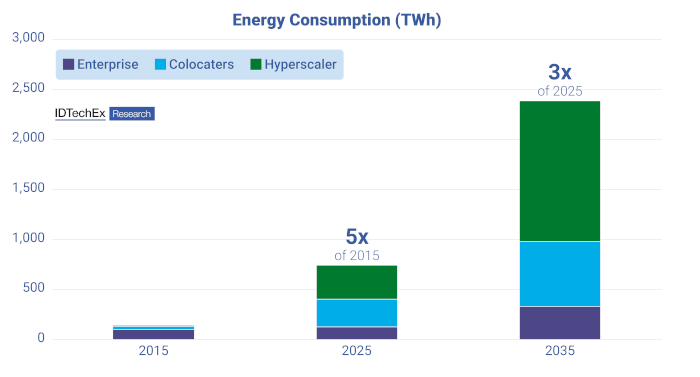
The rapid growth in data center construction is beginning to push grid capacity to its limits in some regions. To expand in a way that aligns with sustainability goals, data center hyperscalers are playing an increasingly active role in launching new renewable energy projects beyond standard power purchase agreements (PPAs) and renewable energy certificates (RECs). For example, the first microgrid projects are emerging, exploring on-site and off-grid power generation for data centers.
Wind and solar power have long been favored by data center players due to their low LCOE (levelized cost of electricity), which is often lower than fossil fuel alternatives. However, the intermittency of these renewables means that fossil fuel power generation is still necessary for many hours each day. There is a push to change how Scope 2 energy emissions are accounted for under the Greenhouse Gas Protocol to favor hourly energy matching, so that demand-side signals can be sent for emerging low-carbon energy technologies to better facilitate the continuous energy demands of data centers.
The new IDTechEx report, “Sustainability for Data Centers 2025–2035: Green Technologies, Market Forecasts, and Players,” examines these technologies, including hydrogen fuel cells, enhanced geothermal energy, small modular nuclear reactors, and grid-scale lithium-ion batteries. It identifies key players and case studies in the data center space and analyzes the economic and technical factors that determine which emerging energy solutions hold the most promise for green data centers over the next decade.
Improved energy efficiency
Existing policies regarding data center decarbonization, such as the EU Energy Efficiency Directive, address the power usage efficiency (PUE) of data centers. If less energy can be consumed per data center by improving thermal, electrical, and IT efficiency, the environmental impact is minimized. Therefore, from chips, memory modules, and cooling components to AC/DC converters, data center stakeholders are competing to improve energy efficiency.
As the data center industry transitions from traditional air cooling to direct-to-chip liquid cooling, reducing greenhouse gas emissions, water usage, and energy consumption, trade-offs in other areas, such as cost and complexity, must be considered. Furthermore, with major component vendors like Nvidia, AMD, SK Hynix, and Infineon continuing to emphasize energy efficiency, component-level energy efficiency (e.g., GPUs, CPUs, memory modules, power converters, etc.) is also experiencing growth.
Reduction of scope 3 emissions
Scope 3 emissions typically account for the majority of data center CO2 emissions. The main contributors to Scope 3 emissions include the initial manufacturing/assembly of servers and networking equipment used in data centers, as well as emissions related to data center construction. In 2023, Microsoft's Scope 3 emissions were 30.9% higher than in 2020, which was attributed to the carbon embodied in building materials and hardware components such as semiconductors, servers, and racks.
Since Scope 3 emissions are indirect emissions across a company's value chain that are not caused by the company itself, it can be difficult for data center stakeholders to address them. IDTechEx explores three different ways for companies to reduce Scope 3 emissions in its new Sustainability for Data Centers report: (1) Purchasing carbon credits (specifically carbon removal credits) to offset CO2 emissions that are difficult to avoid, (2) Using low-carbon materials in data center construction (green concrete, green steel, and wood) either physically or through attribute purchases (reserve and reclaim), and (3) Choosing IT hardware with lower embodied carbon/manufacturing over a data center's lifecycle.
Author: Eve Pope, technology analyst at IDTechEx