


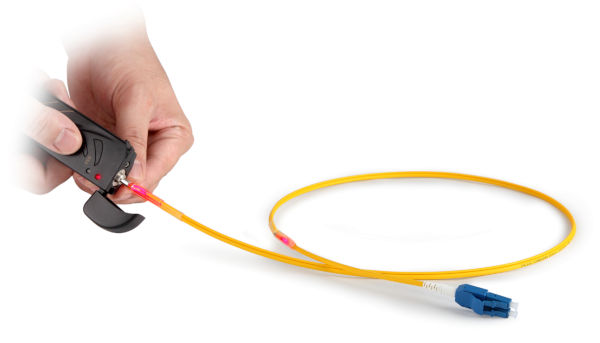
This T&S solution makes the patch cord traceable by using a portion of the cable with an additional fiber optic structure for identification in high-density environments, where cable congestion can pose a significant challenge to both tracing and locating the other end of a cable.
This situation can occur both indoors and outdoors.
Some significant examples are found in data centers, headquarters, mobile switching centers, telecom closets, active and passive fiber distribution hubs, and MDU units.
Therefore, the use of Traceable Fiber Patch Cords provides visual identification of the far end of the jumper and eliminates errors caused by lost labels or confusion in high-density frames and fiber capacity upgrade projects. They also contribute to lower costs by reducing installation, maintenance, and troubleshooting time (without service interruption).
These precision-connected patch cords feature PC, UPC, and APC end polishing, LC, MU, SC, FC, and ST fiber connectors, factory termination (tested), and compliance with RoHS, TIA/EIA-568.3-D, EIA/TIA-604, IEC-61754, IEC-61753-1, and GR 326 Core standards.
Available in custom lengths, they can feature single-mode (G.652/G.657) and multimode (OM1, OM2, OM3, and OM4) fibers, LSZH and PVC jackets in yellow (G.652/G.657), orange (OM1/OM2), aquamarine (OM3), and aquamarine/magenta (OM4), or custom colors, and AA and AB polarity (TIA 568.3-D).
They operate in a temperature range of -20 to +70 °C.






