Munich Airport announced in March of this year plans to launch the future LabCampus project, an innovation lab on the airport campus that will foster collaboration between businesses and across industry boundaries. Starting November 1st, the renowned Senseable City Lab at the Massachusetts Institute of Technology (MIT) will be on board to provide conceptual support for the establishment and development of the new innovation campus. Under an initial three-year cooperation agreement, the Cambridge, MA-based MIT Senseable City Lab will act as a research partner, supporting the team in Munich as it transforms the campus into a smart, innovative city. The goal is to create an ideal urban environment that offers optimal conditions for people and businesses to work together efficiently, creatively, and, above all, under one roof. This will provide an environment for designing and developing products and services for the world of the future and for testing them on-site. To make this a reality, LabCampus GmbH will work with MIT to establish a future-proof infrastructure from the outset, focusing on the most advanced technologies in the areas of energy, mobility and urban planning, as well as connectivity between for optimal sustainability and livability for users.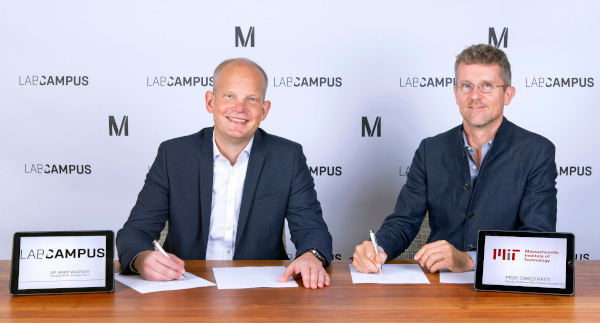
“This collaboration is a significant milestone for our innovation hub,” says Dr. Marc Wagener, Managing Director of LabCampus GmbH. “We will work with MIT researchers to study and evaluate key trends and digital technologies that can benefit us in the development and successful implementation of a smart city concept.” Prof. Carlo Ratti, Director of the MIT Senseable City Lab, is equally enthusiastic: “This is an excellent opportunity for us to participate in creating a smart city from the very beginning. It gives us the chance to look ahead and weave everything, including future needs, into the infrastructure from the outset.”.
MIT Senseable City Lab is the first global player outside of Europe to sign a cooperation agreement with LabCampus GmbH. Research institutions that have signed on as innovation partners include FAU Erlangen-Nuremberg and the Hasso Plattner Institute, as well as the Fraunhofer Institute, which is also exploring the possibility of leasing space at LabCampus. LabCampus is also engaged in detailed discussions with other international groups.