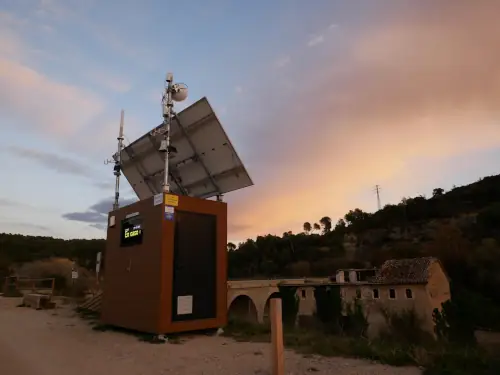
The solution integrates renewable energy generation, energy storage, telecommunications, and sensor systems into a transportable structure. Its design allows it to operate independently of the electrical grid, reducing the need for permanent on-site maintenance.
Among its possible applications are the surveillance of areas at risk of forest fires, the monitoring of rivers and areas susceptible to flooding, access control, counting people and establishing communications in isolated locations.
An autonomous and transportable infrastructure
The cabin functions as a control post and communications node that can be configured according to the needs of each installation.
The prefabricated structure incorporates a technological container and masts for the installation of antennas, as well as photovoltaic and mini wind turbine systems, batteries and various telecommunications, surveillance and sensor equipment.
The system is designed as an *off-grid* infrastructure, so it can operate without a connection to the conventional electrical grid.
According to Sacen, its installation can be completed in a single day. Since it requires no permanent foundations, the cabin can be disassembled and later moved to another location.
This feature allows it to be used both in long-term installations and in temporary deployments associated, for example, with periods of higher fire risk.
Sensors to monitor environmental conditions
One of CO2Free's application areas is real-time environmental monitoring. The infrastructure can incorporate sensors to measure parameters such as water level, flow rate, humidity, and temperature. In this way, it can be used to monitor rivers, forest areas, and other locations where certain environmental changes may indicate a risk.
To connect the distributed devices, you can use long-range, low-power IoT networks such as LoRaWAN. The installation also supports weather stations and other sensor systems designed to collect information about environmental conditions.
Thermal cameras and fire detection
For surveillance purposes, CO2Free can integrate 360-degree cameras and systems designed to identify and track hotspots. These technologies can be used to support the early detection of forest fires.
The infrastructure also supports thermal cameras, video surveillance systems, people counting devices, optical barriers, presence and intrusion detectors, and alarm control panels. The specific configuration of this equipment can be adapted to the needs of each site.
Emergency communications and alerts
In addition to gathering information, the control center can communicate with the services responsible for responding to an incident. The system allows for the configuration of alerts directed to firefighters, forestry services, local authorities, or emergency centers, according to the protocols defined for each project.
It can also include a 112 emergency call button, siren and public address systems, and an LED screen to display information or alerts. To maintain communications in locations without conventional terrestrial infrastructure, the cabin can integrate various connectivity technologies.
The options considered include satellite communications, radio links, TETRA and BTS, as well as the networks used to connect sensors and other IoT devices.
Photovoltaic energy, mini wind turbines and batteries
Energy independence is based on combining photovoltaic and small wind turbines with battery storage systems. The energy configuration must be sized according to the installed equipment and the operating needs of each project.
The goal is to keep telecommunications, surveillance, and sensor systems operational without relying on a permanent connection to the electrical grid. This architecture is particularly relevant in isolated locations where extending a power line might require additional construction or simply not be feasible.
Pre-installation of equipment at the factory
Another feature of CO2Free is the pre-integration of many of its components before the cabin is moved to its final location. The structure, masts, energy generation and storage system, and technological equipment can all be pre-installed at the factory.
This approach reduces the operations that need to be carried out on-site and shortens the commissioning process. The system can be transported to hard-to-reach areas using the appropriate transport and lifting equipment for each location.

An infrastructure that can be removed and reused
The transportable nature of the cabin also allows for a modification of the typical life cycle of this type of installation. Instead of building a permanent infrastructure, the system can remain in one location for as long as needed and then be moved.
One possible application would be to install the cabin during a fire prevention campaign and then relocate it to another area. By eliminating the need for permanent foundations, its removal facilitates the subsequent restoration of the land, a particularly relevant feature in natural areas and other zones where physical intervention is to be limited.
Six facilities on the Via Blava Anoia
One application of this technology is found on the Via Blava Anoia, a project promoted by the Barcelona Provincial Council. The initiative incorporates six autonomous assistance points powered by renewable energy. Sacen participated in the development, supply, and installation of the technological solution used at these locations.
According to the company's estimates, operating the six facilities using renewable energy would have avoided approximately 4.1 tons of CO₂ between July 2025 and March 2026. For a complete annual operating cycle, Sacen estimates a reduction of approximately 5.9 tons of CO₂.
In addition to emissions associated with energy consumption, the plan seeks to reduce other impacts related to the installation of permanent infrastructure, such as foundations, works on the ground and the need to extend connections to the electrical grid.
The combination of renewable generation, storage, sensors, and different communication technologies allows this type of autonomous infrastructure to be used for environmental monitoring, surveillance, and communications in places where access to energy and conventional connectivity is limited.