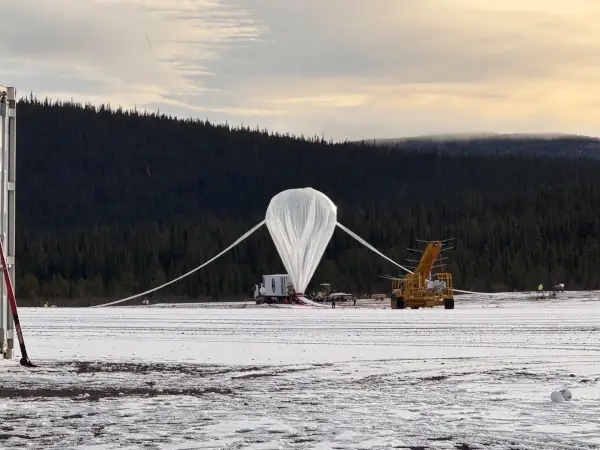
According to measurements reported by the team, the result sets a new European record for Wi-Fi HaLow range, a technology designed for long-distance, low-power communications. The experiment, called BLESS (BEXUS HaLow Evaluation in Stratospheric Systems), was conducted aboard the BEXUS 38 stratospheric balloon, launched from the Esrange Space Centre in Kiruna, Sweden, on October 17, 2026.
HaLow Wi-Fi reaches a distance of 187.7 kilometers
The goal of BLESS is to study the behavior of Wi-Fi HaLow under stratospheric conditions and evaluate its application in communications between high-altitude platforms and ground stations. During the mission, the team successfully transmitted data over a distance of 187.7 kilometers in a unidirectional link, enabling them to analyze the range, signal quality, and reliability of this technology in aerospace environments.
The BEXUS 38 balloon reached a maximum altitude of 33.4 kilometers, according to data published by the European Space Agency (ESA), and carried six university experiments that were successfully recovered after the flight. The results obtained may contribute to the development of future aerospace telemetry systems and Internet of Things (IoT) applications that require long-range communications with reduced energy consumption.
An experiment selected for the REXUS/BEXUS program
BLESS was designed and developed by UFV students and selected to participate in the international REXUS/BEXUS program, which allows European university students to conduct scientific and technological experiments using research rockets and stratospheric balloons. UFV was the only Spanish institution among the six teams supported by the ESA and the Swedish National Space Agency (SNSA) for the BEXUS 38 and 39 flights. The BLESS project shared the BEXUS 38 flight with the COATHEAL experiment, developed by the Polytechnic University of Bucharest, within the group of teams supported by both agencies.
The selection process required presenting the project's technical feasibility to international specialists and passing the necessary reviews for its integration into the mission. The REXUS/BEXUS program is being developed through an agreement between the German Aerospace Center (DLR) and the Swedish National Space Agency, with the collaboration of the European Space Agency (ESA).
Technical testing and development of a ground station
The development of the experiment required integrating communication systems, programming, and mechanical components, as well as conducting tests to verify its operation under the expected flight conditions. Among the tests performed, a thermal vacuum test at Luleå University (Sweden) stands out, designed to replicate the pressure and temperature conditions of the stratosphere. The students also developed a ground station to monitor the experiment and test communications during the mission.
New applications for aerospace communications
The initiative arose in the Internet of Things course, taught by Silvia Romero, as a project applying communication technologies to the aerospace sector. Participation in BEXUS 38 allowed students to be involved in the different phases of a mission, from systems design and integration to testing and flight operations. After completing the mission, the team continues to analyze the recorded data to characterize the behavior of Wi-Fi HaLow in the stratosphere.
The results will be used to evaluate the potential of this technology in future aerospace communication systems, especially in applications that require long-range, low-power wireless links and connectivity between air platforms and ground stations.