1. PHYSICAL PROTECTION: We will need to provide the cable's external structure with some protection to prevent rodents from reaching the cable core, where the copper fibers or pairs that conduct optical or electromagnetic signals are located. This can be achieved
with: Metallic armor. Using mesh, corrugated metal, or steel spirals, we will provide the cable with strong protection. This will not prevent rodents from gnawing on the outer sheath, but thanks to the metallic element, we will prevent them from reaching and damaging the interior.
Fiberglass coatings, also known as dielectric armor (a term that can be misleading, as it equates "armor" with metal). In this construction, a layer of fiberglass is placed between the outer sheath and the interior of the cables. With this type of light protection, we will make it difficult for rodents to reach the interior, since gnawing on the fiberglass damages them and they stop gnawing. Total protection cannot be guaranteed, but it does provide a deterrent.
2. CHEMICAL PROTECTION: In this case, the cable sheaths are manufactured with rodent-repellent additives, which deter rodents by smelling or tasting them when they begin to gnaw. They are effective in buried environments, where a certain degree of humidity is maintained, allowing the sheath to retain these properties for a longer period.
KEYNET offers RODENT-RESISTANT cables identified in 2 categories:
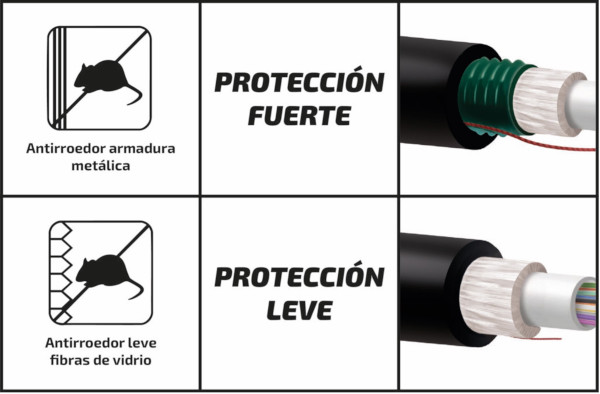
We use the term "LIGHT PROTECTION" for cables constructed with fiberglass between the outer and inner sheaths as a deterrent against rodents, which damages small rodents when they bite. In industry, another equivalent term is also used: "Dielectric Protection," as these cables do not contain metallic elements. We believe that "light" more clearly conveys the low level of protection compared to "dielectric protection."
Depending on the ENVIRONMENT where the installation will take place, we must choose one type of cable or another. Light protection is effective against small rodents (mice, voles, dormice, etc.), but NOT when larger rodents are present (rats, squirrels, rabbits, beavers, etc.). In the latter case, we must use cables with metallic elements and additional anti-rodent and antibacterial additives for greater protection.
Author: Article provided by Keynet-Systems