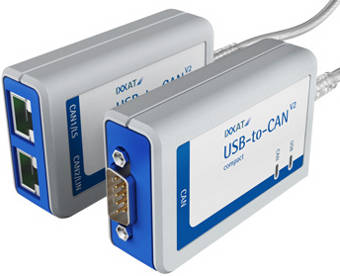
 Thanks to its powerful hardware and a high-speed USB 2.0 connection (480 Mbit/s), the interfaces offer high-performance data transfer with minimal latency and low power consumption, enabling secure and error-free message transmission and reception on CAN networks with high transmission rates and bus loads. Transmitted messages can be timestamped, filtered, and stored directly on the USB-to-CAN V2 interface.
The current versions of IXXAT drivers for Windows and Linux (VCI and ECI) support the new USB-to-CAN V2, allowing its use in existing applications without software modification. The CANopen and SAE J1939 APIs also support the new USB-to-CAN V2 device family.
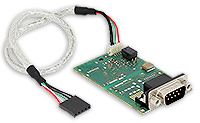
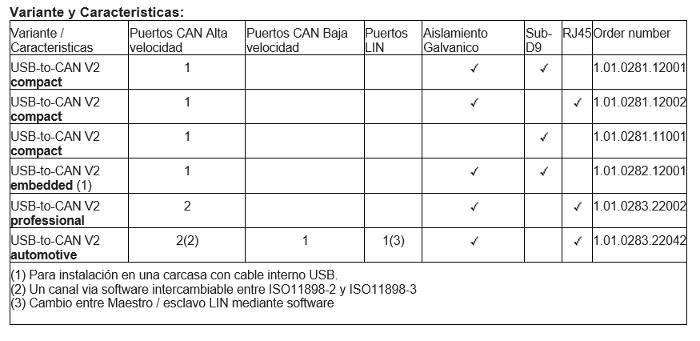
A recently introduced variant is the embedded USB-to-CAN V2, which is designed without a housing, with or without a slot card, and includes a USB cable for installation in a computer.
Due to its attractive price and size, the USB-to-CAN V2 is ideal for use with other products in the series, such as the canAnalyser, for development, service, and maintenance tasks.
 LIN (Automotive variant)
LIN communications are supported in both LIN master and LIN slave modes.
In LIN slave mode, the interface automatically responds to requests received from the master, and the response data is updated via the PC application using a buffer. In master mode, the PC application processes the master's calls. Incoming LIN messages are sent to the application with a timestamp, the master's request, the response, and status information.
'
MiniMon V3 – (Includes: CAN-Bus Traffic Analysis Tool)
MiniMon V3 is a program for online monitoring of CAN bus traffic, as well as the individual transmission of CAN objects. The MiniMon program is included free of charge in the VCI V3 driver and is therefore available for Windows.
The main window contains the following areas.
• Overview of available CAN interfaces.
• Current status of the selected CAN controller.
•Viewing received messages.
•Display of transmission messages.