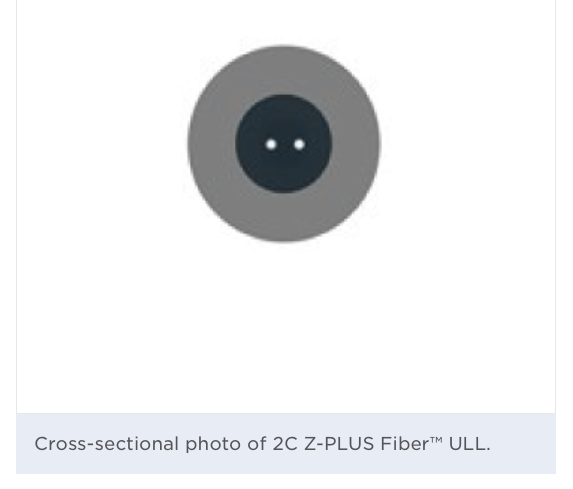
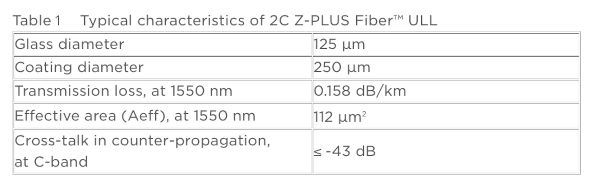
Applications of 2C Z-PLUS Fiber™ ULL
・Extensive areas of submarine network systems, from regional to transoceanic distances.
・High-capacity, long-distance terrestrial transmission.
Networks between data centers.
・Ultra-low loss in required applications:
quantum cryptography communications, sensor networks for seismic and fire detection.
*1 Related Press Releases
・World's first multi-core fiber test bench for optical communications installed in L'Aquila, Italy.
・NEC Corporation, OCC Corporation, and Sumitomo Electric Industries, Ltd. complete first submarine cable test using multi-core fiber.
・Sumitomo Electric and NICT develop world's first 19-core optical fiber with standard outer diameter and set a new world record for transmission capacity—achieving a key technology for long-distance optical communication beyond 5G—
*2 Related page from Sumitomo Electric: 50 years of optical fiber history
https://sumitomoelectric.com/articles/a-50-year-history-of-optical-fibers-part-1
*3 Sumitomo Electric product page
https://global-sei.com/fttx/optical-fibers/z-fiber/
*4 Cross-interference between cores.
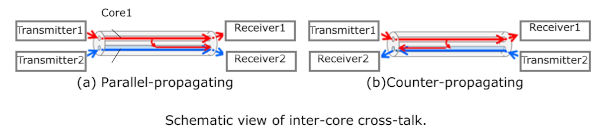
Signal interference between cores in MCF, where part of the optical signal propagating in one core leaks into another. Cross-interference can degrade signal quality, so a lower value is preferable. There are two types of cross-interference in the parallel and opposite propagation directions, respectively, as shown in the following figure. In principle, opposite propagation cross-interference has a lower value than parallel propagation cross-interference.