


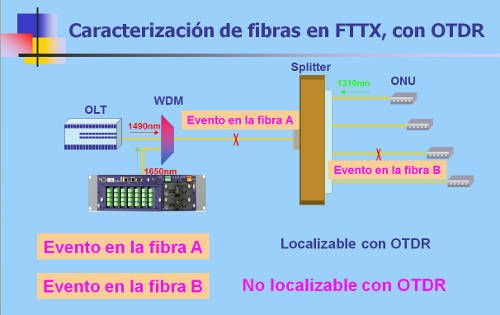
In FTTX deployments, which include passive optical splitters, it is often necessary to take measurements from both ends of the installation to locate faults in each segment: between the central office (OLT) and the splitter, and between the splitter and the user access point (ONU).
This approach can present challenges in the splitter-ONU phase. Although at the central office all the fibers in a cable are grouped into one or more distribution frames, at the user end each fiber corresponding to each splitter output is located within the customer's premises. This requires travel and permits, resulting in additional time and expense when locating fiber optic damage.
The COFITEL Group recommends the use of reflective fiber identifiers, such as ID Reflectors, designed and manufactured by T&S Communications, for identifying each fiber segment downstream of the splitter from the central office and verifying link status.
User terminals equipped with these identifiers allow monitoring of access fibers from the central office, enabling immediate fault identification and, consequently, faster service restoration.
For example, each ONU is identified with a number that corresponds to an event on the graph. The line status can be deduced from analyzing this graph.
ID Reflectors are available in three versions: with Type A or B FBG (Filter Bragg Grating) sensors or with a fine particle filter (TFF), all with SC/APC or LC/APC finishes to suit the needs of each application.
The COFITEL Group is taking advantage of its presence as an exhibitor at ACUTEL 2014 to conduct practical demonstrations of this reflective fiber identifier as well as the rest of the products in its extensive catalog.






