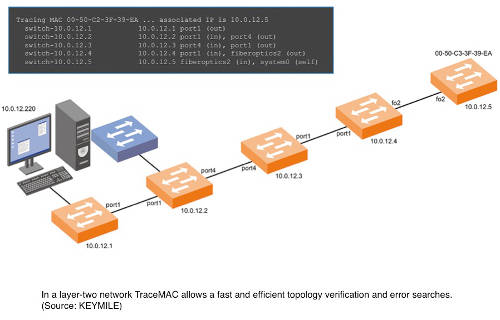
HYTEC, a subsidiary of KEYMILE, has extended the Link Layer Discovery Protocol (LLDP) to enable address tracing in Layer 2 networks. This technological innovation, called TraceMAC, is available immediately. TraceMAC offers a solution to typical problems related to the administration, control, and analysis of large Layer 2 WANs used by utility companies such as gas, electricity, and gas providers.
In Layer 3, the traceroute command is used to send ICMP echo request IP data packets across a network to reach a target device. However, in Layer 2 networks, a comparable method for identifying hardware addresses was lacking—until now. Complex, manually typed command sequences were required to locate an address step-by-step on a network by reading hardware address tables.
To provide this functionality, TraceMAC applies the standardized IEEE 802.1AB LLDP protocol with a new communication method and organization-specific Type-Length-Value (TLV) elements to gather information. The goal is to achieve automated and therefore more efficient control. The elements are the Trace Request, Trace Reply, Device Name, Outgoing Port Name, IPv4 address, IPv6 address, Incoming Port Name, and Trace Identifier TLV formats. Until now, LLDP had only been used for exchanging information directly between adjacent devices on a network. For identifying problems caused by devices in different locations across large WANs, LLDP had limited use. All of this is set to change with TraceMAC. Currently, TraceMAC
is part of the KEYMILE LineRunner-IS-3400 and the HYTEC-HY104 product families. Both product families include various types of boards for transmitting data in mission-critical networks.
“TraceMAC is another component of our new strategy focused on mission-critical networks,” explains Axel Fory, CEO of KEYMILE. “The solution was created by the research and development team in Germany and helps gas, electricity, and water utilities operate their networks more safely and reliably.” KEYMILE is reviewing how the TraceMAC LLDP extension can be integrated into the official IEEE standardization process. How TraceMAC works is explained in detail in the article “Tracing of hardware addresses in layer two bridged networks,” which is available from the IEEE in the IEEE Xplore digital library.
KEYMILE TraceMAC automates troubleshooting in layer two networks
KEYMILE's TraceMAC is the only solution on the market that enables automatic address location in a Layer 2 network. This technical innovation is based on an extension of the LLDP protocol. In large switched WANs, such as those commonly used in power supply services, TraceMAC enables fast and efficient topology verification and troubleshooting.
Unlabeled
-
-
Anritsu expands its fiber optic visualization tool
Anritsu introduces the Fiber Visualizer for its MT9090A Network Master platform, creating a field testing solution that simplifies high-precision measurements of fiber optic cables, connections, and splices during the installation or maintenance of high-speed networks...
-
Fluke Networks MPO inspection camera with gesture-based user interface
Fluke Networks has introduced the FiberInspector™ Pro FI-3000, the industry's most efficient inspection camera for multi-fiber push-on (MPO) terminations. MPO technology allows for the simultaneous connection of up to 32 fibers transmitting hundreds of gigabits of data...
-
Cable tester and switch diagnostics
Fluke Networks has introduced the LinkIQ cable and network tester, which combines switch diagnostics and state-of-the-art cable measurement technology to enable installers, systems integrators, and network service professionals to...
-
Visual fiber optic fault tester
Fibercom presents the F/HFO-VFL visual fault tester with a detection distance greater than 5 km, equipped for 2.5 mm ferrule connectors, visible red laser emitter (650 nm), class 3A laser diode light source and output power (nominal) 5 mw.
-
Fibercom presents the Focis Connector Inspection System in Spain
This is the Focis Connector Inspection System, a small, robust and ergonomic device consisting of a palm-sized touchscreen, a digital probe and the SimpleView AFL Plus inspection and analysis software.
Newsletter
Latest News
ACUTELAN files complaint against DIGI with the CNMC for predatory pricing
On April 22, 2026, the ACUTELAN association submitted a formal application to the CNMC to...
Demonstration of free-space optical communication with PCSEL: a breakthrough from Vector Photonics
Vector Photonics, the Scottish start-up that is leading the way in the use of surface emission lasers with crystal...
AI for Good Global Summit 2026: Innovation and Leadership in Artificial Intelligence in Geneva
As governments accelerate their strategies on artificial intelligence, sovereign AI, and...
Iceland's Parliament modernizes its security with Genetec Security Center and IoT sensors
The Parliament of Iceland, Alpingi, one of the oldest democratic institutions in the world,...
Commvault strengthens data and AI security in Commvault Cloud with new governance and classification capabilities
Commvault has announced an expansion of its data security and AI capabilities within...
Technical Courses and Seminars
D-Link launches the 29th season of free webinars on networks, 5G and cloud
D-Link has announced that the 29th season of its D-Link Webinars begins tomorrow. These sessions...
Taoglas launches The Antenna Podcast, a new technical space about antenna design and innovation
Antennas remain one of the most critical and, at the same time, most misunderstood elements in...
ISE 2026 Barcelona: Summits, Megatrends and the most ambitious content program in the AV sector
Returning to Barcelona in February 2026, Integrated Systems Europe (ISE) presents its program of...
E-book: the future of satellite communications
Mouser Electronics, Inc., in collaboration with Qorvo and other technology innovators...
European project “Engineers of the Future” with free online training for young people and teachers on cybersecurity, green energy and automation
The GAIA Cluster has participated in the European project "Engineers of the Future", co-financed by...
Optical Networks
Evolution of optical networks: ROADM, OpenROADM and OpenZR+ in the 400G and 800G era
The rapid increase in data traffic is driving the construction of new infrastructure worldwide...
Legrand launches Chroma Link, the fiber optic solution for high-density AI networks
Legrand has announced the launch of Chroma Link™, a fiber optic cabling solution with...
Hollow Core Fiber (HCF) Deployment and Testing
Hollow Core Fibers (HCF) represent a significant evolution...
Network infrastructure in the age of AI: why fiber optics is key beyond bandwidth
New requirements for network infrastructures: why, in the age of AI, fiber optics...
Nokia drives optical networks for the AI era with new coherent solutions and multi-fiber amplifiers
Nokia has announced a suite of new optical network innovations designed to address...
Fiber optic network testing in hyperscale data centers: keys to ensuring performance and reliability
Hyperscale data centers represent the backbone of the digital infrastructure...
High-Speed Network Demands: Architectures, Challenges and Technological Evolution in the Era of Exponential Traffic
The rapid growth of IP traffic, driven by applications such as 4K/8K video, computing...