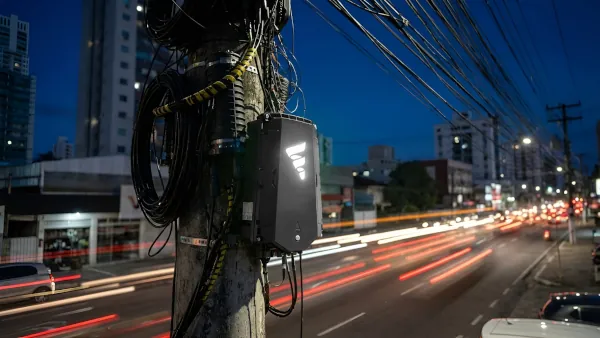
Multiplied by millions of interventions annually, this lost time becomes one of the biggest drains on operational efficiency in the sector—and until now, no one had addressed the problem at the component level itself.
Fibramérica, an international manufacturer of infrastructure solutions for fiber optic networks, presents FABLIGHT: a technology that integrates optical retroreflectivity properties into the passive components of FTTH networks—distribution boxes, splice closures, and outside plant elements. Under direct illumination, such as from a flashlight or vehicle headlights, assets equipped with FABLIGHT are visible and identifiable in total darkness, without the need for batteries, additional electronics, or maintenance.
FABLIGHT requires no power source, connectivity, or additional hardware. Retroreflectivity is a material property: pigments composed of high-refractive-index microspheres are incorporated into the composition of the components during the manufacturing process. The result is an asset that reflects light back to its source—a flashlight, vehicle headlights—with greater intensity than a conventional surface. This is the same physics that has made road signs, safety vests, and airport markings visible at previously impossible distances. Fibramérica has adapted it for the first time to FTTH component manufacturing standards.
According to operational tests conducted by Fibramérica's engineering team in simulated nighttime intervention scenarios, asset location time can be reduced by up to 30% compared to standard operating conditions. The technology requires no changes to existing installation processes or maintenance protocols. “The technology was developed to solve a real operational problem: efficient location in low-visibility conditions. The marketing impact is an important additional consequence, but the core is engineering applied to field operations,” says Ariel Kun, Product Manager, Fibramérica.
A typical regional operator's FTTH network can include between 50,000 and 500,000 outside plant points deployed in urban environments. Until now, these assets served a single, technical function. With FABLIGHT, each of these points also becomes a brand touchpoint—visible under specific lighting conditions, identifiable by the operator's colors and logo, and present in the customer's everyday environment.
FABLIGHT will begin to be incorporated into selected component lines during the first half of 2026 and is already in active production for projects in Asia. The technology will be available to operators and integrators from March 2026 as an integrated upgrade within standard manufacturing processes—requiring no modification of existing infrastructure or additional training for technical personnel.