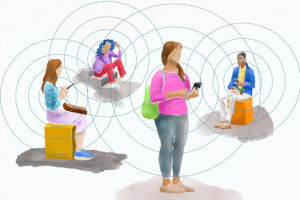
 Imagine you've been diagnosed with Covid-19. Health officials begin contact tracing to contain the spread, asking you to identify the people you've been in close contact with. The obvious people that come to mind: your family, your coworkers. But what about the woman in front of you in line at the pharmacy last week, or the man who bags your groceries? Or any of the other strangers you've been near in the past 14 days?
 A team led by MIT researchers and including experts from many institutions is developing a system that augments manual contact tracing by public health officials while preserving everyone's privacy. The system relies on short-range Bluetooth signals emitted by people's smartphones. These signals represent random strings of numbers, similar to chirps that other nearby smartphones may recall hearing.
If someone tests positive, they can upload a list of the "beeps" their phone has made in the last 14 days to a database. Other people can then scan the database to see if any of those sounds match those picked up by their phones. If there's a match, a notification will inform that person that they may have been exposed to the virus and will include information from public health authorities about the next steps to take. Crucially, this entire process is conducted while maintaining the privacy of those who test positive for COVID-19 and those who wish to check if they have been in contact with an infected person.
"I keep a record of what I've transmitted, and you keep track of what you've heard, and this will allow us to know if someone was near an infected person," says Ron Rivest, a professor and director of the MIT Institute and a researcher on the project. "But for these transmissions, we're using cryptographic techniques to generate random, rotating numbers that are not only anonymous, but pseudonymous, constantly changing their 'ID' and cannot be traced back to an individual.".
This approach to private, automated contact tracing will be available in several ways, including through SafePaths, MIT's first privacy initiative launched in response to COVID-19. This comprehensive suite of mobile applications is being developed by a team led by Ramesh Raskar of the MIT Media Lab. The design of the new Bluetooth-based system has benefited from SafePaths' initial work in this area.
Bluetooth Sharing:
Smartphones already have the ability to announce their presence to other devices via Bluetooth. Apple's "Find Me" feature, for example, uses chirps from a lost iPhone or MacBook to attract the attention of other Apple devices, helping the owner of the lost device locate it.
“Find My inspired this system. If my phone is lost, it can start transmitting a Bluetooth signal that’s just a random number—it’s like being in the middle of the ocean and waving a light. If someone walks by with Bluetooth enabled, their phone knows nothing about me; it just tells Apple, ‘Hey, I saw this light,’” says Marc Zissman, associate chief of the Division of Information Science and Cybersecurity at MIT’s Lincoln Lab and co-principal investigator on the project.
With their system, the team is essentially asking a phone to send out this type of random signal continuously and to keep a record of these signals. At the same time, the phone detects the chirps it has picked up from other phones and only records the chirps that would be medically significant for contact tracing: those emitted from within a radius of approximately 6 feet and collected over a certain period of time, say 10 minutes.
Phone owners would become involved by downloading an app that enables this system. After a positive diagnosis, a person would receive a QR code from a health official. By scanning the code through the app, that person could upload their record to the cloud. Anyone with the app could then use their phone to scan these records. A notification, if there is a match, would tell a user how long they were near an infected person and the approximate distance.
Privacy-preserving technology.
Some of the most successful countries in containing the spread of Covid-19 have been using smartphone-based approaches for contact tracing; however, researchers point out that these approaches have not always protected people's privacy. South Korea, for example, has implemented apps that notify officials if a diagnosed person has left their home and can leverage people's GPS data to pinpoint exactly where they have been.
"We don't track location, we don't use GPS, and we don't attach your personal ID or phone number to any of these random numbers your phone is emitting," says Daniel Weitzner, senior research scientist at MIT's Computer Science and Artificial Intelligence Laboratory (CSAIL) and co-principal investigator on this project. "What we want is to allow everyone to participate in a shared process to see if you may have been in contact, without revealing or forcing anyone to reveal anything.".
Choice is key. Weitzner sees the system as a virtual doorbell that preserves people's right not to answer. However, the hope is that everyone who can opt in will do so to help contain the spread of Covid-19. “We need a large percentage of the population to opt in for this system to really work. We care about all the Bluetooth devices out there; it’s really critical to make this a complete ecosystem,” he says.
Impact on Public Health:
Throughout the development process, researchers have worked closely with a medical advisory team to ensure that this system effectively contributes to contact tracing efforts. This team is led by Louise Ivers, an infectious disease expert, associate professor at Harvard Medical School, and executive director of the Massachusetts General Hospital Center for Global Health.
“For the United States to truly contain this epidemic, we need a much more proactive approach that allows us to trace contacts more broadly for confirmed cases. This automated, privacy-protecting approach could really transform our ability to control the epidemic here and could be adapted for use in other global settings,” Ivers says. “What’s also great is that the technology can be flexible in terms of how public health officials want to manage contacts with exposed cases in their specific region, which can change over time.”.
For example, the system could notify someone that they should self-isolate, or it could ask them to register through the app to connect with healthcare professionals regarding their daily symptoms and well-being. In other circumstances, public health officials could request that this person get tested if they notice a cluster of cases.
The ability to conduct contact tracing quickly and on a large scale can be effective not only in flattening the curve of an outbreak, but also in allowing people to safely return to public life once a community is on the downside. "We want to be able to allow people to carefully return to normal life while also having the ability to quarantine and identify certain vectors of an outbreak," Rivest says.
Toward Implementation:
Engineers at Lincoln Laboratory have led the prototyping of the system. One of the most difficult technical challenges has been achieving interoperability—that is, making it possible for an Android device to pick up a chirp from an iPhone and vice versa. A test conducted in the lab late last week demonstrated that they achieved this capability, and that other phones of various makes and models could pick up the chirps.
The next vital step toward implementation is engaging with smartphone manufacturers and software developers: Apple, Google, and Microsoft. “They have a critical role here. The goal of the prototype is to demonstrate to these developers that this is feasible for them to implement,” Rivest says. As those collaborations form, the team is also demonstrating its prototype system to state and federal government agencies.
Rivest emphasizes that collaboration has made this project possible. These collaborators include the Massachusetts General Hospital Center for Global Health (CSAIL), the MIT Lincoln Laboratory, Boston University, Brown University, the MIT Media Lab, the Weizmann Institute of Science, and SRI International.
The team also aims to play a central and coordinating role with other efforts across the country and in Europe to develop similar privacy-preserving contact tracing systems.
“This project is being carried out in a truly academic style. It’s not a competition; it’s a collective effort by many, many people to make a system work,” says Rivest.
###
Written by Kylie Foy, Lincoln Lab