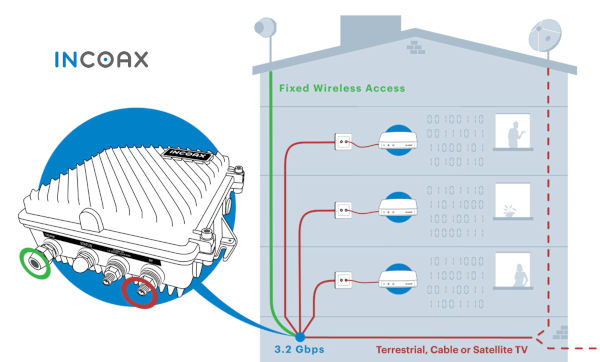
Authorities have been struggling for several years to close the gap between approved homes and homes actually connected. A study by the RVA/Fiber Broadband Association earlier this year shows that less than 45% of all approved homes in the US are connected, and despite ongoing efforts, the gap continues to widen. A major contributing factor is the difficulty of cost-effectively laying new cables in apartments. Deployment costs have been too high and installations too invasive for building owners and tenants to accept, resulting in the current low adoption rate.
Fiber-Assisted Wireless (FWA) technology offers operators shorter deployment timelines and a faster time to revenue. Combined with MoCA Access™, the advantages are even greater. MoCA Access is a fiber-assisted wireless extension (FWA) technology specified for 2.5 Gbps of symmetrical data speeds over existing coaxial cabling in buildings. This allows operators to achieve significant cost savings on deployments without sacrificing performance, especially compared to fiber. Previously passed-through multi-devices (MDUs) that went unconnected due to high deployment costs and low estimated subscriber adoption rates can now be repurposed from a new business perspective. This technology enables operators to connect more subscribers to high-performance services, bridging the digital divide.
“A significant obstacle to network operators’ deployment plans has been the effective delivery of reliable gigabit or multi-gigabit speeds to MDUs in abandoned industrial areas,” Tiainen continues. “This is driving the growth of fiber access technologies and 5G mmWave FWA, especially considering that laying fiber to the home or rooftop Ethernet cabling is not cost-effective. We need multiple technologies to achieve the ambitious global targets set for digital inclusion. If we rely on a single technology, such as fiber, we will slow down deployments and even risk leaving a large part of the population behind.”
Tiainen has helped launch the Broadband Forum's "Fixed Wireless Access Extension" project, which will help connect multi-dwelling units (MDUs) with 5G FWA, and has called on others to contribute. The project focuses primarily on reaching apartments and flats within MDUs by repurposing existing property infrastructure, such as coaxial cabling, to extend FWA connectivity to all units.
Coverage is uncertain between the base station and the apartments due to 5G signal attenuation in the walls, as high-frequency millimeter wave signals often have difficulty penetrating through multiple walls, typical of an MDU.