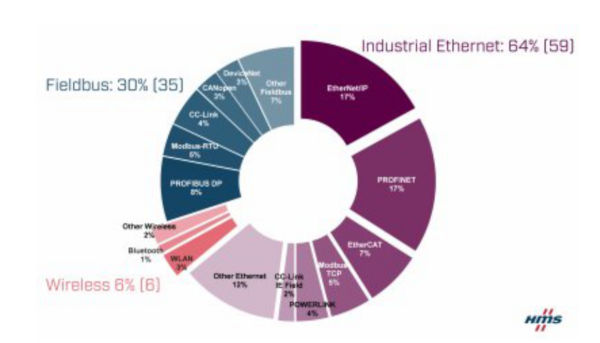
HMS Networks presents its annual analysis of the industrial networking market, with a particular focus on new nodes installed in factory automation worldwide. As an independent provider of solutions for industrial communication and the Industrial Internet of Things, HMS has extensive knowledge of the industrial networking market. The 2020 study includes estimated market shares for fieldbuses, Industrial Ethernet, and wireless technologies. Estimated growth rates are not included this year due to the unique market conditions resulting from the Coronavirus pandemic.
Industrial Ethernet market share grows, while fieldbuses continue to decline.
In the study, HMS concludes that Industrial Ethernet continues to gain market share from fieldbuses. Industrial Ethernet now accounts for 64% of the global market for new nodes installed in factory automation (compared to 59% last year). EtherNet/IP and PROFINET share first place with a 17% market share each. EtherCAT continues to perform well globally with a 7% share, and Modbus-TCP, with 5%, narrowly surpasses Ethernet POWERLINK with a 4% share.
Fieldbus market share continues to decline.
HMS estimates that fieldbuses will account for 30% of newly installed nodes (compared to 35% last year). PROFIBUS, still number one with 8%, represents less than 10% of the total industrial networking market for the first time. Modbus-RTU follows with 5%, and CC-Link with 4%.
Reflections on Industrial Ethernet and Fieldbus Market Shares
: “We expect the industrial networking market to grow steadily over the next few years, but due to the exceptional situation caused by the Coronavirus, which is now affecting general business conditions worldwide, we have chosen not to include growth figures in our 2020 analysis, but only market shares,” said Anders Hansson, Marketing Director at HMS Networks. “Therefore, looking only at market shares this year, we see that Industrial Ethernet continues to drive industrial connectivity in factories, led by EtherNet/IP and PROFINET, with EtherCAT in third place.” Hansson continued: “PROFIBUS remains the fieldbus with the largest presence, but it has lost market share as the overall decline of fieldbuses continues.” Another interesting observation is that Modbus continues to work well, whether it's the Modbus RTU fieldbus or the Ethernet-based Modbus-TCP, indicating that factories are not refraining from using technologies that work well in their new installations just because they have been in use for some time.
Wireless communication remains stable and its future looks bright.
Wireless technologies maintain a 6% market share, with WLAN being the most popular technology, followed by Bluetooth. "Wireless technologies are maintaining their market share in a growing market, which isn't bad, but we expect their share to increase over time," says Anders Hansson. "With all the ongoing global activity on wireless technologies using mobile telephony (e.g., private LTE/5G networks) that will enable the next level of smart manufacturing, market demand will increase for wirelessly connected devices and machines to be included in the flexible, less-wired automation architectures of the future."
Regional network variations: EtherNet/IP and PROFINET are the leading networks in Europe and the Middle East, followed by PROFIBUS and EtherCAT. Other popular networks include Modbus (RTU/TCP) and Ethernet POWERLINK. The US market is dominated by EtherNet/IP, with EtherCAT gaining some market share. PROFINET and EtherNet/IP lead a fragmented Asian market, followed by PROFIBUS, EtherCAT, Modbus (RTU/TCP), and CC-Link/CC-Link IE Field.
Author: Anders Hansson, Chief Marketing Officer at HMS Industrial Networks
Scope of the study:
The study includes HMS's 2020 estimate based on the number of new nodes installed in 2019 for factory automation. A node is defined as a machine or device connected to an industrial network. The figures presented represent HMS's consolidated view, which takes into account internal insights from industry colleagues, our own sales statistics, and general market sentiment.