 The report, titled "Latin America Telecoms Market: Trends and Forecasts 2012-2017," analyzes the most important trends affecting fixed and mobile telecommunications services in the region and assesses the impacts of these trends over the next five years.
"The relative value of the Latin American telecoms market is increasing as a result of higher revenue growth compared to developed markets," explained Pablo Iacopino, Principal Analyst of the Global Telecoms Research Program at Analysys Mason. "Brazil is the largest telecoms market in Latin America in terms of retail telecom revenue, generating US$62 billion in 2012, and is the fourth largest market in the world after the US, China, and Japan."
The main contributors to revenue growth during 2012-2017 will be mobile broadband (growing at a compound annual growth rate of 15.8%), mobile data (a CAGR of 12.6%), and fixed broadband (6.6%). These three service categories will account for almost 90% of the revenue increase during the forecast period. "GDP per capita is rising, and customers will be more interested in high-value devices (smartphones, mobile broadband)—for example, the middle class is expanding in Brazil, and the number of internet users is expected to grow substantially in the coming years," added Iacopino. Smartphones will represent 50% of all mobile phones in Latin America in 2017.
However, voice services (fixed and mobile) remain dominant in Latin America – their contribution was around 60% of total retail revenue in 2012. The report forecasts that this contribution will decrease to 50% by 2017 because non-voice services will grow more strongly than voice services.
The number of active mobile connections will also increase during this period, from 672 million connections in 2012 to 830 million by the end of 2017. The penetration rate of connections in the population will rise from 111% to 131%, with Argentina, Brazil, and Chile being the most penetrated markets (above 150% in 2017).
"We expect an improvement in the customer mix because most of the growth in the number of mobile phones will come from contract connections," explained Iacopino. The growth rate in the number of prepaid mobile phone connections will be lower than that of contract connections during the forecast period, growing at a compound annual growth rate of 3.0% compared to 6.9%. "This is partly because continued cuts in mobile termination rates (MTRs) will reduce the need for multiple prepaid SIM cards to optimize call costs."
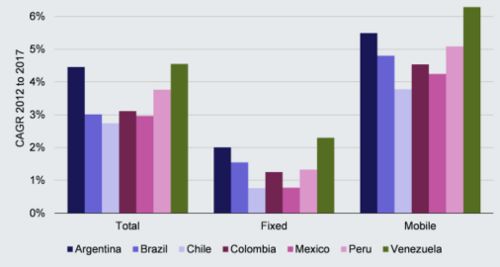
In addition to providing an overview of the region, the report also provides detailed forecasts for the seven Latin American countries, which together account for almost 90% of the region's GDP and nearly 80% of its population: Argentina, Brazil, Chile, Colombia, Mexico, Peru, and Venezuela. Figure 1 shows the retail revenue forecasts for these seven countries.
Equinix selects Infinera Cloud Xpress for data center interconnection in Hong Kong
Infinera announces that Equinix has selected Infinera Cloud Xpress to interconnect its data centers in Hong Kong. Infinera Cloud Xpress offers Equinix a platform with hyperscale density, operational simplicity, and low power consumption.