


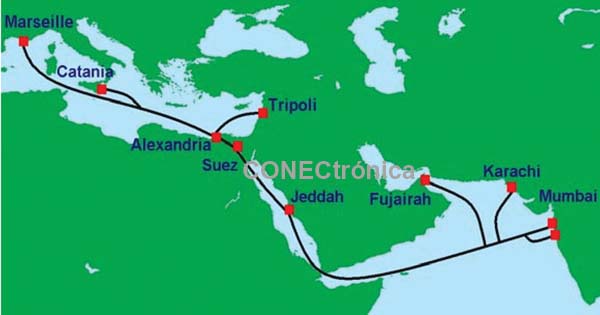
 The upgrade involved the installation of submarine cable terminal equipment in eight countries. The IMEWE cable system, which entered service in 2010 as a 10 Gbps DWDM system, is an ultra-high-capacity fiber optic submarine cable system linking India to Europe via the Middle East.
This cable network system with a total length of approximately 12,091 km is complemented by 10 terminal stations owned by a consortium of nine leading telecommunications companies in eight countries: India, Pakistan, United Arab Emirates, Saudi Arabia, Egypt, Lebanon, Italy and France.
The cable system comprises three pairs of fiber optic cables with two pairs of fiber over an express lane, as well as a terrestrial link connecting the cities of Alexandria and Suez in Egypt.
Network demand in these areas is expected to grow rapidly in line with the economic development of India and the Middle East.
To meet this demand, the IMEWE Consortium had decided to upgrade the cable system by deploying 40 Gbps technology, and Mitsubishi Electric was awarded the contract for this upgrade.
Mitsubishi Electric has incorporated cutting-edge error correction and high-speed coherent technologies [1] into terminal equipment, increasing transmission capacity.
The technology will result in improved network capacity up to a maximum of 3.2 Terabits per second or more per fiber by adding submarine line terminal equipment of more than 40 Gbps.
Mitsubishi Electric has been a leader in submarine cable systems since supplying the first 5 Gbps optically amplified repeaters for a transpacific cable in 1994. In 1999, the company supplied the first 10 Gbps transmission technology for a transoceanic network. Since 2004, the company has implemented numerous upgrades to submarine cable systems.
[1] The development of this technology is, in part, supported by the R&D project on optical transport systems technologies, of the Ministry of the Interior of Japan.







