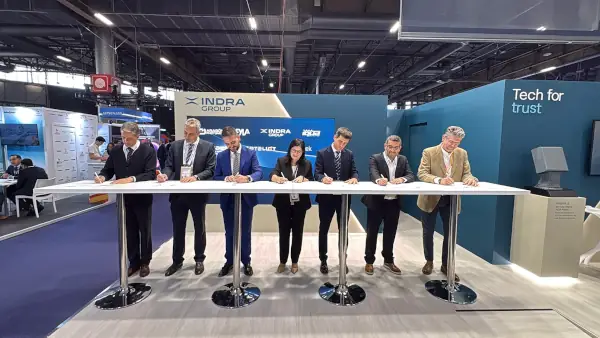
The agreement, signed during the Euronaval naval defense exhibition held in Paris from November 3 to 6, brings together seven Spanish companies specializing in artificial intelligence, acoustic sensors, fiber optics, autonomous vehicles, and communications. The initiative aims to develop an integrated and modular solution capable of detecting activity and anomalies in the underwater environment, strengthening Spanish and European technological autonomy in this strategic area.
Indra will integrate the underwater surveillance system
Indra will coordinate the project, define the architecture, and integrate the various technologies that will comprise SIPRIS. The solution will leverage SEADEF, Indra's family of naval mission systems, and IndraMind, its artificial intelligence and data exploitation platform. The company will also contribute unmanned aerial vehicle (UAV) capabilities and communications management to connect the different surveillance elements.
According to Ana Belén Buendía, director of Indra's Naval Business Unit, SIPRIS aims to strengthen European technological sovereignty through a solution that allows for observing, understanding, and monitoring the underwater domain.
Acoustic sensors and fiber optics to detect threats
SAES will contribute its expertise in underwater acoustics, using sensors and advanced sonar processing technologies for the detection and classification of underwater threats and activities.
Aragon Photonics, for its part, will incorporate high-fidelity distributed acoustic sensing technology via fiber optics (HDAS). This technology allows for the detection of acoustic events using submarine communication networks as the sensing infrastructure, with a range of tens of kilometers. The combination of these capabilities will facilitate the monitoring of large areas and the identification of potential incidents in critical infrastructure.
Autonomous vehicles for underwater inspection
The project will also integrate autonomous platforms to expand coverage and conduct inspections.
UTEK will develop autonomous surface vehicles (USVs) adapted to the system's needs, which will allow for extended surveillance operations and provide additional inspection capabilities.
Iqua Robotics will be responsible for the autonomous underwater vehicles (UUVs), designed to inspect underwater infrastructure and automatically identify anomalies. The combined use of surface and underwater platforms will allow for the monitoring of large areas alongside targeted inspections of the monitored elements.
Underwater optical communications and satellite connectivity
To facilitate information exchange between teams deployed underwater, FYLA will contribute its underwater optical communications technologies. These capabilities will be complemented by Sateliot's satellite communications and information systems, designed to extend coverage and facilitate the coordination of distributed operations.
The integration of different communication technologies will be one of the necessary elements to connect the sensors, autonomous vehicles and analysis platforms of SIPRIS.
A technological ecosystem open to new companies
The memorandum represents the first step in organizing an industrial ecosystem capable of developing and validating a common underwater surveillance solution. SIPRIS is envisioned as a modular and open architecture, ready to incorporate new technologies and adapt to future operational needs. The initiative anticipates the progressive participation of other companies, technology centers, and specialized entities.
Following the signing of the agreement, the companies plan to move forward with operational demonstrations, integration activities, and validation testing, as preliminary steps to the commercialization of the system.
With SIPRIS, the seven companies seek to boost a national capacity for persistent surveillance and protection of critical underwater infrastructure, combining advanced sensors, artificial intelligence, autonomous platforms, and optical and satellite communications.