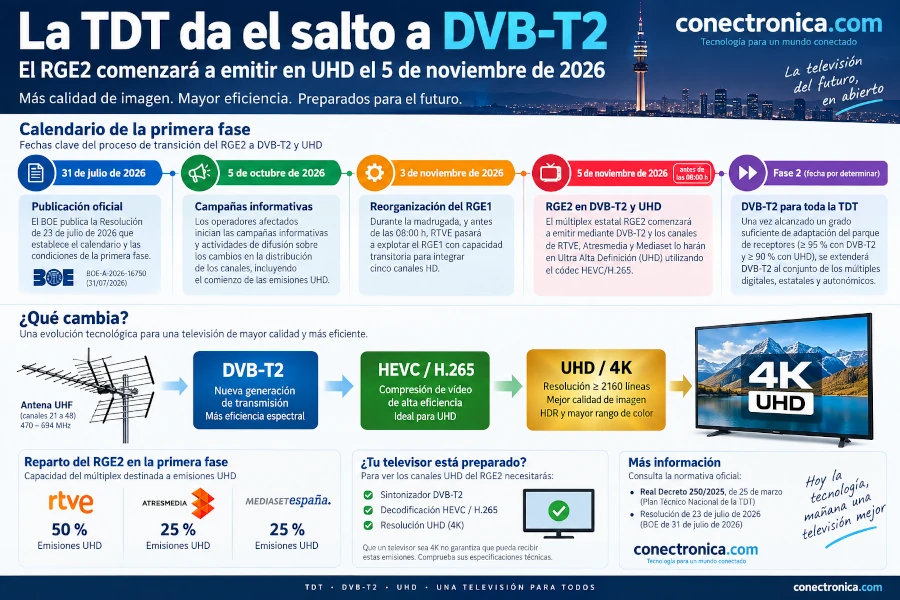
The technological evolution of Spanish digital terrestrial television (DTT) enters a new phase this autumn. The Resolution of July 23, 2026, from the State Secretariat for Telecommunications and Digital Infrastructure, published in the Official State Gazette (BOE) on July 31, establishes the timetable for implementing the first phase foreseen in the new National Technical Plan for DTT.
The key date will be November 5, 2026. During the early morning hours and, in any case, before 08:00 hours —peninsular time—, the state multiplex RGE2 must operate using DVB-T2 and broadcast its television services in UHD.
It's not simply a matter of adding 4K channels. The change simultaneously introduces two technological elements that are crucial for the future of Spanish terrestrial television:
DVB-T → DVB-T2 in transmission
H.264/AVC → H.265/HEVC for UHD emissions
The combination of both technologies allows for a much more efficient use of the available radio spectrum and constitutes the technical basis on which the rest of DTT will subsequently evolve.
What exactly is RGE2?
Spanish DTT is distributed through different multiplexes or digital multiplexes. Each one occupies a radio channel and simultaneously carries several television services.
The National Technical Plan includes seven state digital multiplexes: RGE1, RGE2, MPE1, MPE2, MPE3, MPE4 and MPE5, in addition to the corresponding regional multiplexes.
RGE2 has been chosen as the platform to start the technological migration because it allows for a first controlled implementation of DVB-T2 before extending this system to the rest of DTT.
RTVE is responsible for the technical management of RGE2. During this first phase, its capacity will be distributed as follows:
| Operator | RGE2 Capacity | Utilization |
| ------------------------- | -----------------: | --------------------- |
| RTVE | 50% | UHD Broadcasts |
| Atresmedia | 25% | UHD Broadcasts |
| Mediaset España | 25% | UHD Broadcasts |
The three operators will use this capacity to broadcast UHD simultaneously and at the same time as their corresponding HD content.
In practice, RGE2 thus becomes the **first state multiplex designed as the spearhead of the new technological generation of Spanish DTT**.
Why DVB-T2?
DVB-T2 is the evolution of DVB-T, the system that has supported Spanish digital terrestrial television for years.
The fundamental advantage lies not only in achieving a higher resolution image. DVB-T2 allows for a significant increase in spectral efficiency, meaning that more information can be transmitted using a limited resource: the radio bandwidth.
The National Technical Plan states that a multiplex operating with DVB-T can integrate four HD channels, while a DVB-T2 multiplex can have capacity for up to four UHD channels.
This gain is essential because a UHD signal needs to carry considerably more information than an HD signal.
The transition therefore relies on two complementary improvements:
DVB-T2 improves the efficiency of radio transmission.
HEVC improves the efficiency of video compression.
The combination of both allows the introduction of UHD without proportionally increasing spectrum requirements.
HEVC/H.265: the other essential component
DVB-T2 and HEVC perform different functions and should not be confused.
DVB-T2 is the radio frequency signal transmission system, while HEVC/H.265 is the system used to compress the video.
Royal Decree 250/2025 establishes a vertical resolution of 2160 active lines or higher for UHD broadcasts, with a 16:9 aspect ratio, and stipulates that the video encoding must conform to H.265/HEVC. The signal may also incorporate technologies such as high dynamic range (HDR), extended color gamut, and high frame rate.
Therefore, the fact that a television has a 4K panel does not in itself guarantee that it can receive these broadcasts.
The receiver needs to be compatible with:
DVB-T2 + HEVC/H.265 + UHD resolution.
This point will be especially important in early generation 4K televisions, because there may be devices capable of playing UHD content from HDMI or streaming applications but that do not incorporate a DVB-T2 tuner suitable for the new DTT.
Calendar: Key migration dates
The transition does not begin directly on November 5th. The resolution establishes several interconnected actions.
July 31, 2026 — official publication
The Official State Gazette (BOE) publishes the Resolution of July 23, 2026, which definitively establishes the dates and conditions of the first phase.
From this point on, the timetable for the change is legally established.
October 5, 2026 — information campaigns begin
The affected operators must develop **information campaigns and dissemination activities** about the changes that will occur in the distribution of the channels.
In the case of services intended for RGE2, the campaigns must also expressly inform about the start of UHD broadcasts.
For users, property managers, and installers, this will be the time to pay special attention to the notices that appear on the screen.
November 3, 2026 — RGE1 reorganization
During the early morning of November 3, and before 08:00 hours, RTVE will begin operating the RGE1 with the temporary capacity to integrate five HD channels.
This move is part of the reorganization necessary to release and prepare the final configuration of the RGE2.
November 5, 2026 — the DVB-T2 era begins on the RGE2
This is the crucial date.
In the early hours of November 5th, and always before 08:00 peninsular time, RTVE, Atresmedia and Mediaset will begin to exploit 50%, 25% and 25% of the RGE2 respectively for simultaneous UHD broadcasts with their HD content.
That same day, movements will also be carried out among multiple other state-level ones.
Atresmedia will temporarily integrate five HD channels into MPE2, and Mediaset will do the same in MPE3. Both operators will vacate the capacity they had reserved in MPE5.
Radio Blanca will begin its HD broadcasts on the capacity allocated in MPE5 and will cease its broadcasts on RGE2.
Integrated Television Entertainment Services will also begin its HD broadcasts in the capacity allocated to MPE5.
Therefore, November 5 should not be interpreted solely as the activation of some UHD services: it involves a coordinated reorganization of several national multiplexes.
Will it be necessary to retune the television?
The reordering may require a retuning of the channels so that the receiver correctly updates the available services.
The resolution itself stipulates that the CNMC may reuse, when technically possible, certain existing service identifiers in order to minimize the impact on users until they retune their service.
Consequently, after the change it will be advisable to perform an automatic channel search or retuning if services appear to be missing, duplicated or incorrectly located.
Will the community antennas need to be modified?
Here it is important to differentiate between a change in frequency and a change in transmission technology.
DVB-T2 does not automatically mean that a UHF antenna will no longer be valid. Digital terrestrial television (DTT) will continue to use the 470 to 694 MHz band, corresponding to radio channels 21 to 48.
However, collective installations must be able to correctly distribute the corresponding signals and the headend equipment must be compatible with the configuration used.
Therefore, in homeowner associations with programmable central units, headend modules, old installations or reception problems, it is advisable to have a telecommunications installer check the installation.
The change that the receiver undergoes is more profound: to view the RGE2's UHD broadcasts, you will need a DVB-T2 tuner and HEVC decoding.
Attention: DVB-T2 does not mean the immediate switch-off of all current DTT
One of the aspects that may generate the most confusion is thinking that on November 5th all Spanish channels will abandon DVB-T.
It won't be like that.
The new National Technical Plan divides technological evolution into two major phases.
Phase 1: RGE2 as the first DVB-T2 multiplex
It is the phase that begins in November 2026.
The RGE2 adopts DVB-T2 and its channels begin broadcasting in UHD. The rest of the platform maintains a transitional configuration during this period, allowing HD broadcasts to continue and ensuring that current receivers can continue accessing the corresponding services.
Phase 2: DVB-T2 for all DTT
The second phase will be much more ambitious: DVB-T2 will be implemented in all digital terrestrial television multiplexes, both state and regional.
Once completed, all multiplexes will use DVB-T2 and capacity will be reserved to allow all channels to evolve to UHD.
But this second transition does not yet have a set date.
The Government will have to determine it through a subsequent order.
When will Phase 2 arrive?
The National Technical Plan introduces two particularly important indicators before implementing the widespread migration.
As a reference, the degree of adaptation of the receiver park should reach at least:
95% compatibility with DVB-T2.
90% UHD compatibility.
However, the regulations allow the decision to be brought forward or delayed depending on factors such as technological evolution, audiovisual production means, and national and European initiatives.
This explains the chosen strategy: introducing DVB-T2 first in a single multiplex allows for the natural renewal of the stock of televisions and receivers to be accelerated before undertaking a complete migration.
How to check if a TV is ready
Before November 5th, it is advisable to check the technical specifications of the television or external receiver.
Simply finding the word “4K” in the documentation is not enough. You must specifically look for compatibility with:
* DVB-T2 on the terrestrial tuner.
* HEVC or H.265 for video decoding.
* UHD/2160p for resolution.
The National Technical Plan itself requires manufacturers to report on the capabilities of receivers, differentiating, among other characteristics, HD reception via DVB-T/H.264 and UHD reception via DVB-T2/H.265-HEVC.
If your TV has a 4K screen but lacks DVB-T2 or HEVC, you don't technically need to replace the entire set. You can use an external DVB-T2/HEVC digital terrestrial television receiver compatible with UHD, usually connected via HDMI.
What happens to coverage extension facilities?
The resolution also introduces a specific technical requirement for stations belonging to public initiatives for extending RGE2 coverage.
From 08:00 hours on November 5, all corresponding active stations must form a **single frequency network (SFN)** in accordance with the National Technical Plan, transmitting via DVB-T2 and with UHD broadcasts.
Stations that do not meet these conditions must stop broadcasting RGE2.
This aspect is especially relevant in rural areas or territories where coverage is supplemented by extension centers promoted by public administrations.
UHD does not necessarily mean that all content is native 4K
There is another important technical detail.
Just because a channel is distributed as UHD does not mean that absolutely all of its programs were originally produced in UHD.
The Royal Decree expressly allows UHD channels to broadcast programs that do not meet UHD specifications when the original content has not been produced in Ultra High Definition.
Therefore, during this stage, native 4K productions will foreseeably coexist with HD content upscaled to UHD broadcast resolution.
The difference will be especially noticeable when the entire chain —capture, production, editing, contribution, encoding and distribution— is native UHD.
DVB-T2 + HEVC: more than just a resolution upgrade
The change has consequences that go beyond the well-known commercial term “4K”.
The technological leap allows DTT to be prepared for 2160-line images, HDR, wider color spaces, higher image frequencies, and advanced audio systems.
But above all, it increases the efficiency of a platform that has a limited amount of spectrum.
Following the release of the 700 MHz band for mobile services, Spanish terrestrial television operates between 470 and 694 MHz. Achieving greater capacity within this same frequency range requires increased efficiency in both modulation and compression.
That is where the strategic importance of DVB-T2 and HEVC lies.
A transition comparable to the jump from SD to HD
Spain completed the phase-out of standard definition digital terrestrial television (DTT) broadcasts in February 2024. The next logical step is to gradually increase the presence of UHD and modernize the transmission system.
But there is an important difference.
The 2026 transition begins gradually.
On November 5th, there will not be a general DVB-T switch-off. A first phase will be implemented in which RGE2 will act as the DVB-T2/UHD platform while the rest of the DTT network temporarily maintains the necessary compatibility with the existing installed base.
The real structural transformation will come with the future Phase 2, when DVB-T2 is extended to all digital multiplexes.
What should users, communities, and installers do?
For home users, the first check should focus on the television: verify that it has DVB-T2, HEVC/H.265, and UHD capability. After the transition, it may be advisable to retune if the new services do not appear correctly.
In individual homes with a UHF installation in good condition, the change does not in itself imply replacing the antenna.
In collective installations, especially those with programmable headend equipment or older configurations, it is advisable to review the distribution of the multiplexes and check signal levels and quality.
For telecommunications installers, October and November will be particularly important months: they will need to correctly differentiate between tuning problems, receiver incompatibility, and possible issues in collective installations.
Conclusion
November 5, 2026 will be a key date for digital terrestrial television in Spain.
The RGE2 will become the first major state multiplex of this new era, combining DVB-T2 as the transmission system, HEVC/H.265 as the video codec, and UHD as the broadcast format.
The migration is designed to be phased in. RGE2 will arrive first; later, when technical conditions and the penetration rate of compatible receivers allow, Phase 2 will arrive and DVB-T2 will be extended to the rest of the platform.
For the telecommunications sector, this is not simply the arrival of more “4K” channels. It is the first step in a complete overhaul of the technical architecture of Spanish digital terrestrial television (DTT).
Official sources
The main regulatory reference is Royal Decree 250/2025, of March 25, which approves the new National Technical Plan for Digital Terrestrial Television.
The specific schedule for November 2026 is established by the Resolution of July 23, 2026 of the State Secretariat for Telecommunications and Digital Infrastructures, published in the BOE of July 31, 2026.