The IEEE 802.3bs standard for media access control, physical layer, and management parameters for 200 Gb/s and 400 Gb/s fiber includes various methods for delivering these speeds over single-mode fiber using duplex or parallel options. The standard also includes a multimode variant, although this is expected to see limited adoption as the industry-wide shift to single-mode for higher speeds is likely to outpace this technology.
The new standard supports:
200GBASE-DR4: 200 Gb/s using 200GBASE-R encoding and 4-level pulse amplitude modulation over four single-mode fiber channels, with a minimum range of 500 m.
200GBASE-FR4: 200 Gb/s using 200GBASE-R encoding and 4-level pulse amplitude modulation over four WDM channels over single-mode fiber, with a minimum range of 2 km.
200GBASE-LR4: 200 Gb/s using 200GBASE-R encoding and 4-level pulse amplitude modulation over four WDM channels over single-mode fiber, with a minimum range of 10 km.
400GBASE-DR4: 400 Gb/s with 400GBASE-R encoding and 4-level pulse amplitude modulation on four single-mode fiber channels, with a minimum range of up to 500 m.
400GBASE-FR8: 400 Gb/s with 400GBASE-R encoding and 4-level pulse amplitude modulation on eight WDM channels in single-mode fiber, with a minimum range of up to 2 km.
400GBASE-LR8: 400 Gb/s with 400GBASE-R encoding and 4-level pulse amplitude modulation on eight WDM channels in single-mode fiber, with a minimum range of up to 10 km.
400GBASE-SR16: 400 Gb/s with 400GBASE-R encoding on more than sixteen multimode fiber channels, with a minimum range of up to 100 m.
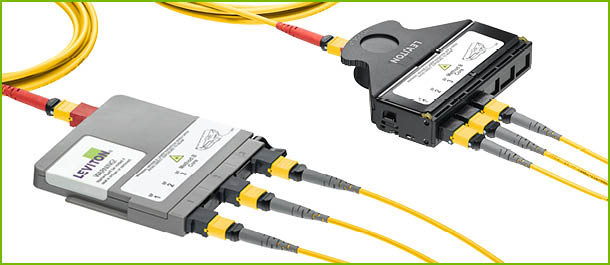
Regardless of the type or size of the data center, IT managers are looking for cabling systems that can support multiple generations of technology upgrades with minimal disruption, dark fibers, or changes. Leviton's single-mode and multi-mode cabling systems not only meet current bandwidth requirements but also provide the flexibility needed to accommodate future network demands, including 200 Gb/s, 400 Gb/s, and beyond.