It provides:
Article 1. Minimum fire safety requirements for telecommunications cables inside buildings.
Telecommunications cables installed in buildings, properties, and real estate complexes must comply with the minimum fire safety requirements set out in the annex to this ministerial order.
Article 2. Amendment of certain Annexes of the Regulation governing common telecommunications infrastructure for access to telecommunications services inside buildings, approved by Royal Decree 346/2011, of March 11.
Annexes I, II and III of the Regulation governing common telecommunications infrastructure for access to telecommunications services inside buildings, approved by Royal Decree 346/2011, of March 11, are amended as follows:
1. In Annex I, the following footnote is added to the table in point 4.4.2: "(*) The response levels for AM-TV signals are given solely for the purpose of being taken into account as a reference in the event that signals not mandatory in the ICT are distributed with this type of modulation."
2. In Annex II, the following modifications are introduced:
a) Section 2.5.1.c) is worded as follows: "c) Fiber optic cable interconnection point – (Main optical register).
For operator feeder networks consisting of fiber optic cables, the fibers must be terminated with SC/APC connectors and their corresponding adapters, grouped in an input connector splitter, which will also serve as a patch panel or input terminal block.
All optical fibers in the building's distribution network will be terminated with SC/APC connectors and their corresponding adapters, grouped in a common output connector panel for all service providers.
The connection between the building's common network outlet panel and the incoming connector splitters of the different operators will be made using fiber optic patch cords terminated at both ends with SC/APC connectors.
The incoming connector splitters of all operators and the building's common network outlet panel will be located in the main optical distribution frame (RDF) in the RITI or RITU. The interior space allocated for the main optical distribution frame must be sufficient to allow for the installation of twice the number of incoming connectors at the interconnection point, as well as additional space for routing the interconnecting patch cords and storing excess cable length.
b) The second paragraph of section 2.5.3.e) is worded as follows:
"Likewise, in order to enable certification between the outlet strips of the interconnection point and all the terminal access bases (TABs) of the twisted-pair user's internal network, a category 6 passive multiplexer accessory will be installed in the network termination register, which, on the one hand, will be equipped with a removable flexible patch cord and terminated in an eight-way miniature male connector, plugged in turn into a termination connector or rosette of one of the lines of the dispersion network and, on the other hand, will have at least as many eight-way miniature female ports (RJ45) as rooms served by the twisted-pair user's internal network. When operators are going to install the optical network termination unit outside the network termination register (NTR), the functions of the passive multiplexer accessory may be assumed, if necessary to compensate for possible attenuation, by an equivalent active device installed in said register that has sufficient ports to provide connectivity to the dwelling rooms.
c) A new paragraph g) is added to section 2.5.3 with the following wording: "g) Internal user network of fiber optic cable.
In the case of a dispersion network made up of fiber optic cables, an internal drop of an optical fiber terminated in an SC/APC type connector must be provided, allowing optical continuity to the fiber optic rosette or fiber optic BAT, with sufficient length to allow connection with any of the SC/APC type adapters of the PAU rosette."
d) A new paragraph c) is added to section 2.5.4 with the following wording: «c) In the case of fiber optic cabling, the fiber will be terminated in a fiber optic BAT with an SC/APC type adapter.»
e) The first paragraph of section 3.1 is worded as follows: "3.1 DEMAND FORECAST.
In general, the values indicated in this section shall be considered mandatory minimums. References in this section to common areas or facilities shall be understood to exclude the elevator, as it has the specific treatment detailed in section 3.1.5."
f) A new section 3.1.5 is added, with the following wording: “3.1.5 Elevators.
The demand forecast for elevators shall comply with the specific regulations applicable to this type of installation, particularly for safety reasons. Demand forecasts for additional, courtesy, or other services may be freely determined.
In any case, a conduit consisting of a 25 mm diameter pipe shall be installed in the machine room of each elevator, control mechanism box, or equivalent space. This conduit, starting from the main RITI (or RITU) access panel and equipped with the corresponding guide wire, shall terminate in a connection box with a blanking plate. The connection panels or terminal blocks located in the main access panels shall be made appropriately for all installed technologies to provide service to this room.”
g) The last paragraph of section 3.3.4.a) is worded as follows: “In the case of buildings with a distribution/dispersion network serving 20 or fewer PAUs, the distribution/dispersion network may be implemented using two-fiber optic drop cables directly from the distribution point located in the main distribution box. From this point, drop cables will run, where applicable, up to the floors to terminate directly at the PAUs.
In the case of buildings with a distribution/dispersion network serving more than 20 PAUs, the distribution/dispersion network may also be implemented using two-fiber optic drop cables directly from the distribution point located in the main distribution box, provided that the main conduit design allows it, and this is justified in the project.”
h) Section 3.5 is worded as follows: «3.5 MINIMUM SIZING OF THE USER'S INTERNAL NETWORK.
Appendix 13 of this standard shows a typical example of the user's internal network configuration.
3.5.1 Twisted Pair Network.
a) Dwellings.
In the main room (living room), the number of outlet boxes equipped with a BAT (Battery Access Terminal) will be at least two. One of these will be equipped with a BAT with two sockets or female connectors fed by independent twisted pair drops from the PAU (Point of Access Unit), which may be supported by separate conduits if required by the chosen location of the sockets. One of these sockets must be located less than 50 centimeters from the fiber optic outlet. In the remaining rooms, excluding bathrooms and storage rooms, there will be an outlet box equipped with a BAT. At least one other room will have a BAT in its outlet box with two sockets or female connectors, fed by independent twisted pair drops from the PAU, with the same characteristics as the one indicated for the main room. Each of the double sockets mentioned in this paragraph may be replaced by two single sockets.
b) Premises or offices, when their interior distribution into rooms is defined.
The number of outlet registers will be one per room, excluding bathrooms and storage rooms, equipped with BAT with two outlets or female connectors, fed by independent twisted pair connections from the PAU.
c) Premises or offices, when their floor plan is not defined.
No internal user network will be installed. In this case, the design and sizing of the internal user network, as well as its future implementation, will be the responsibility of the owner of the premises or office, when the room layout project is executed.
d) Common areas or facilities of the building.
The designer will define the dimensions of the internal network in these areas taking into account the purpose of the areas and the performance planned for the building.
3.5.2 Coaxial cable network.
a) Dwellings.
Two outlet boxes, equipped with the corresponding outlet, will be installed and supplied with the corresponding coaxial cable from the PAU in two different rooms of the dwelling.
b) Premises.
No internal user network will be installed. In this case, the design and sizing of the coaxial cabling network, as well as its future implementation, will be the responsibility of the owner of the premises or office, when the distribution project in rooms is carried out.
c) Common areas.
The designer will define the dimensions of the internal network in these areas taking into account the purpose of the areas and the performance planned for the building.
3.5.3 Fiber Optic Cable Network.
In the main room of the dwellings, near the twisted-pair BAT (Basic Access Terminal) with two outlets, a fiber optic wall plate or fiber optic BAT will be installed, terminated with an SC/APC adapter. This adapter will be powered by a fiber optic drop that will terminate in an SC/APC connector connected to one of the SC/APC adapters of the fiber optic wall plate located in the PAU (Point of Access Unit).
i) A new paragraph c) is added to section 5.1.2, with the following wording: “c) Fiber optic cable network.
The individual fiber optic cable for installation in the user's internal network shall consist of 1 optical fiber. The cables and the optical fibers they incorporate shall be the same as those indicated in section 5.1.1.di), except with regard to the reinforcing elements, which must be sufficient to ensure that, under a tensile force of 450 N, no permanent elongation of the optical fibers or increase in attenuation occurs. Their diameter shall be around 4 millimeters and their minimum bending radius shall be 5 times the diameter (2 cm).”
j) Section 5.2.4 is worded as follows: “5.2.4 Connection elements for the fiber optic cable network.
a) Fiber optic cable interconnection box.
The fiber optic cable interconnection box will be located in the RITI or RITU, and will constitute the physical implementation of the interconnection point, performing the functions of the main optical register.
The fiber optic cable interconnection box will consist of two zones or compartments:
– Output zone or compartment to terminate the building's fiber optic network. This zone will allow the placement of 24 or 48 connector terminal blocks where the connections will be made with the fibers of the building's distribution network, which in turn must be terminated in their corresponding connectors.
– Input zone or compartment to terminate the operators' feeder networks.
Depending on the number of PAUs, the following characteristics of the fiber optic cable interconnection boxes are established:
i. In general, and without prejudice to the recommendations below for installations with more than 20 PAUs:
– The necessary outlet areas or compartments for terminating the building's network fibers will be provided in the fiber optic cable interconnection box. This box must also have the necessary means for wall mounting.
– Adjacent to the outlet areas or compartments, sufficient space will be provided for the creation of separate inlet areas or compartments for terminating the operators' networks. These locations will be equipped with the necessary fiber pass-through elements to allow the inlet areas or compartments of the different operators to be connected to the outlet areas or compartments of the building's fiber optic network using fiber optic patch cords.
– To standardize and facilitate the way of linking the building network's output connectors and the input connectors of the different operators using patch cords, it is recommended that the different types of zones or compartments (input and output) have on their right side an outlet and passage space for fiber optic cables, in order to create a common guiding channel between the different zones or compartments, only in the case of being installed stacked vertically.
ii. For installations with more than 20 PAUs:
– It is recommended that the fiber optic cable interconnection box be a 19" rack cabinet or one with ETSI standard profiles, with minimum dimensions of 600 mm wide x 300 mm deep, where both the building network and the operators' networks terminate.
– This rack cabinet will allow for the mounting of removable trays with front-mounted connector panels (SC/APC). The trays will contain the necessary components for independently terminating the fibers of the building's distribution network or the different operators' networks, as applicable.
– As a general rule, it is recommended that the trays required to terminate all the fibers of the building's distribution network with SC/APC connectors be placed at the top of the rack cabinet, on the front adapter panel of the trays, leaving the lower portion free for mounting trays for terminating the operators' networks.
– Additionally, the rack cabinet must have sufficient space to accommodate the routing, storage, and management of the patch cords that will connect the building network's output connectors to the operators' network input connectors. This routing may take the form of cable guides or trays attached to the rack cabinet to collect excess cable from the interconnecting patch cords.
– It is recommended that the rack cabinet be allocated vertical space for routing, storage, and management of the patch cords, equivalent to the space used by the building's fiber optic network termination panels.
– If it is not possible to implement the main optical distribution frame functions using a single rack cabinet, the input connectors of all operators must be located as close as possible to the building network's output connector panel. This will require the installation of routing elements, such as cable trays or similar, to enable communication between the two elements via interconnecting patch cords.
iii. In all cases:
– Fiber optic cable interconnection boxes must have passed the cold, dry heat, temperature cycling, humidity, and salt spray tests, in accordance with the relevant part of the UNE-EN 60068-2-2:2008 standard family (Environmental tests. Part 2-2: tests).
– If the boxes are made of plastic, they must meet the self-extinguishing test and have passed the liquid and dust resistance tests in accordance with the UNE-EN 60529:2018 standard [Degrees of protection provided by enclosures (IP Code)], where the required degree of protection will be IP30 for indoors or IP54 for outdoors. They must also have passed the impact test according to standard UNE-EN 50102:1996 [Degrees of protection provided by enclosures for electrical equipment against external mechanical impacts (IK code)], where the required degree of protection will be IK7 (indoor or outdoor).
– The boxes must have passed the static load, bending, axial load on cables, vibration, torsion and durability tests, in accordance with the relevant part in force of the UNE-EN 61300-2 family of standards (Optical fiber interconnecting devices and passive components - Basic tests and measurement procedures. Part 2: tests).
b) Fiber optic cable segregation box.
The fiber optic segregation box will be located in the secondary distribution frames and will constitute the physical implementation of the optical distribution point. Segregation boxes may be indoor (for 4 or 8 optical fibers) or outdoor (for 4 optical fibers), in the case of ICT for single-family dwelling complexes.
The boxes must have passed the same tests for cold, dry heat, temperature cycling, humidity and salt spray, self-extinguishing properties, resistance to liquids and dust, degree of protection, and tests for static load, impact, bending, axial load on cables, vibration, torsion, and durability, as described in section 5.2.4.a).
All elements of the segregation box will be designed to guarantee a minimum bending radius of 15 millimeters along the optical fiber's path within the box.
c) Fiber optic rosette.
The rosettes must have passed the same tests for cold, dry heat, temperature cycling, humidity and salt spray, self-extinguishing properties, resistance to liquids and dust, and static load, impact, bending, axial load on cables, vibration, torsion, and durability, as described in section 5.2.4.a).
When the optical rosette is equipped with a pigtail for splicing to the fiber optic drops of the distribution network, the pigtail with connector to be positioned in the PAU must be made of bend-optimized fiber optic cable, type G.657, category A2 or B3, and the splice and loops of the optical fibers must be housed in a box. All elements of the box must be designed to guarantee a minimum bend radius of 20 millimeters along the path of the optical fiber within the box.
The optical rosette box will be designed to accommodate at least two optical connectors with their corresponding adapters.
 d) Connectors for fiber optic cables.
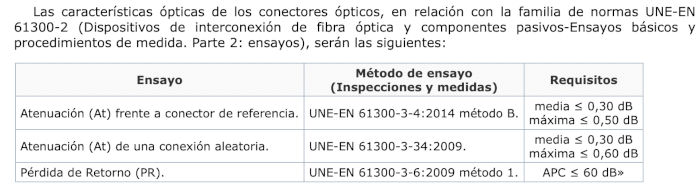
The connectors for fiber optic cables shall be of the SC/APC type with their corresponding adapter, to be installed in the patch panels pre-installed at the interconnection point of the main optical distribution frame and in the optical rosette of the PAU, where they will be equipped with the corresponding adapters. The characteristics of the optical connectors shall comply with the draft standard UNE-EN 50377-4-2:2015 (Connector assemblies and interconnecting components for use in fiber optic communication systems).
The optical characteristics of the optical connectors, in relation to the UNE-EN 61300-2 family of standards (Fiber optic interconnecting devices and passive components - Basic tests and measurement procedures. Part 2: Tests), shall be as follows:
Test
3. In Annex III, the following modifications are introduced:
a) Section 4.5.3 is worded as follows: "4.5.3 Single room (RITU).
i. For buildings or real estate complexes of up to three stories plus a ground floor and a maximum of sixteen PAUs, and for groups of single-family homes (without limitation on the number of PAUs), the possibility is established of constructing a single telecommunications installation room (RITU), which combines the functionality of the two described above (RITI and RITS).
ii. For buildings or real estate complexes of more than three stories plus a ground floor and a maximum of 16 PAUs, and for those with between 17 and 30 PAUs, without limitation on the number of stories, the possibility is established of constructing a single, expanded telecommunications installation room (RITU-A), provided that it has an accessible width that is twice that which would correspond to one of the rooms it replaces, maintaining the other dimensions, and that it is located where any of them would be.
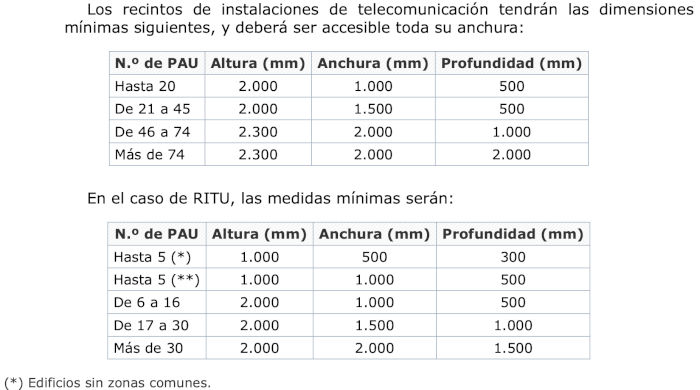 b) Section 5.5.1 is worded as follows: «5.5.1 Dimensions of the RIT.
The telecommunications installation rooms shall have the following minimum dimensions, and their entire width must be accessible:
(*) Buildings without common areas.
(**) Buildings with common areas.
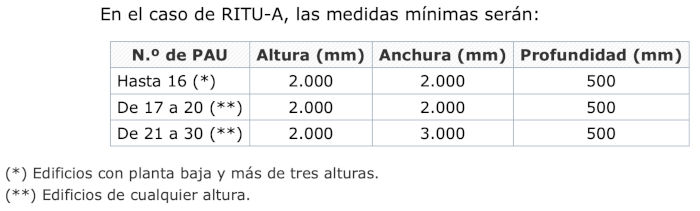 In the case of RITU-A, the minimum dimensions will be:
(*) Buildings with a ground floor and more than three stories.
(**) Buildings of any height.
In any case, the width and height dimensions of the enclosures may be modified at the discretion of the designer, provided that the accessible surface area and minimum depth are maintained.
c) Section 5.6.4 is worded as follows: “5.6.4 Main fiber optic cable distribution box.
The main fiber optic cable distribution box shall have sufficient space to house the input connector splitter, which will also serve as a patch panel, and the output connector panel. The interior space provided for the main optical distribution box must be sufficient to allow the installation of a number of input connectors that is twice the number of output connectors installed at the interconnection point. Sufficient space must also be provided to allow the installation of storage elements for the excess length of the patch cords.”
d) Section 5.13.a) is worded as follows: «a) In each of the two main rooms: 2 outlets for twisted pair cables, 1 outlet for coaxial cables for TBA services and 1 outlet for coaxial cables for RTV services. In one of the main rooms, preferably the living room, 1 outlet for fiber optic cable.»
Article 3. Amendment of Order ITC/1644/2011, of June 10, which implements the Regulation governing common telecommunications infrastructure for access to telecommunications services inside buildings, approved by Royal Decree 346/2011, of March 11.
Order ITC/1644/2011, of June 10, which implements the Regulation governing common telecommunications infrastructure for access to telecommunications services inside buildings, approved by Royal Decree 346/2011, of March 11, is amended as follows:
1. Paragraph 2 of Article 2 is worded as follows: “2. The owner, or their representative, shall electronically submit a copy of the technical project to the electronic registry of the Ministry of Economy and Business, following the procedures established for this purpose on its website, so that the resulting installation may be inspected when the competent authority deems it appropriate.
In cases where the State Secretariat for Digital Advancement detects non-compliance in the drafting of the technical project, it may electronically request the correction of the detected anomalies, without prejudice to any other actions that may be initiated regarding infringements and penalties.
2. Paragraph 7 of Article 6 is worded as follows: “7. The owner, or their representative, shall submit electronically to the electronic registry of the Ministry of Economy and Business, following the procedures established for this purpose on its website, the installation certificate, the testing protocol and, where applicable, the certificate of completion of the installation and annexes to the technical project, or the modified technical project, as appropriate. The State Secretariat for Digital Advancement shall electronically return a stamped copy of the submitted documentation, with the exception of the annexes. The owner shall be obliged to receive, keep and transmit a copy of these documents, which shall become part of the Building Logbook.” In cases where any detected non-compliance in the drafting of the technical project has not been remedied, or where non-compliance is detected in the construction of the infrastructure or in the content of the installation's completion certificates, installation reports, or test protocols, the State Secretariat for Digital Advancement may deny the sealing provided for in the preceding paragraph, without prejudice to any other actions that may be initiated regarding infringements and penalties. To this end, the State Secretariat for Digital Advancement will include the inspection of installations in its verification and inspection programs.
3. Paragraph 8 of Article 6 is worded as follows: “8. In the case of newly constructed buildings or groups of buildings, it shall be an essential requirement for the granting of occupancy licenses and permits to submit to the competent Administration, along with the certificate of completion of works relating to the building, the aforementioned telecommunications installation report and test protocol and, where applicable, the certificate of completion of works for the installation, stamped by the State Secretariat for Digital Advancement. This documentation may be replaced by the certification referred to in paragraph 9 of this Article, provided that it states that the corresponding stamped copies were returned at the appropriate time.
Likewise, in the case of housing developments or groups of buildings that, as a result of their delivery in several phases, require partial occupancy licenses, partial reports, protocols, and certifications relating to the part of the common telecommunications infrastructure already completed and corresponding to said phases may be submitted.” In these cases, it will be stated in the partial reports, protocols, and certifications that their validity is conditional upon the presentation of the corresponding installation report or final certification, once the works contemplated in the technical project have been completed. Both partial and final completion certifications will conform to the models contained in Annex IV of this order.
4. Paragraph 9 of Article 6 is worded as follows: "9. At the request of the owner of the property or his/her representative, upon payment of the established fees, the State Secretariat for Development shall issue a certificate for the sole purpose of accrediting that the promoter or builder has submitted to the Ministry of Economy and Business the technical project that covers the infrastructure, the site layout report, the installation bulletin and the testing protocol and, where applicable, the certificate of completion of works and the annexes, which guarantee that the execution thereof conforms to the aforementioned technical project."
Transitional Provision. Fire reaction requirements for telecommunications cables.
Without prejudice to the marking obligation for telecommunications cables arising from the application of Regulation (EU) No 305/2011 of the European Parliament and of the Council of 9 March 2011 laying down harmonised conditions for the placing on the market of construction products and repealing Council Directive 89/106/EEC, and its implementing regulations, which establish the CE marking obligation for cables placed on the market from 1 July 2017, the fire safety requirements set out in the Annex to this Order shall take effect within 12 months from the date of entry into force of this Order, and shall not apply to telecommunications cables that are already installed.
Final Provision. Entry into force.
The amendments to the Regulation governing common telecommunications infrastructure for access to telecommunications services inside buildings, approved by Royal Decree 346/2011 of March 11, introduced in Article 2, shall take effect one month after the entry into force of this Order.
The remaining provisions contained in this Order shall enter into force on the day following its publication in the Official State Gazette.
ANNEX
Fire reaction characteristics of telecommunications cables used in ICT and in the indoor deployment of final segments of ultra-fast access networks
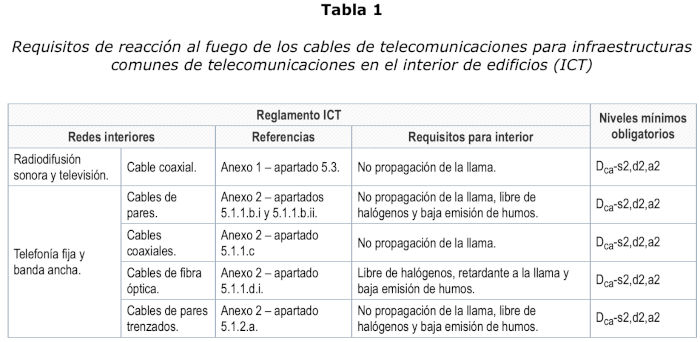 1. The fire reaction characteristics of telecommunications cables used in common telecommunications infrastructures regulated by the Regulation governing common telecommunications infrastructures for access to telecommunications services inside buildings, approved by Royal Decree 346/2011 of 11 March, shall be those specified in the following table (column for mandatory minimum levels). The minimum requirements listed replace those established in the annexes to the aforementioned Regulation.
The abbreviations used in the column on minimum levels correspond to the fire reaction classes of electrical cables described in Table 4 of the Annex to Commission Delegated Regulation (EU) 2016/364 of 1 July 2015 on the classification of the reaction to fire properties of construction products. The characteristics of the cables, testing methods and marking system are described in the harmonised standard UNE-EN 50575:2015 (Power, control and communication cables: Cables for general applications in buildings subject to reaction to fire requirements).
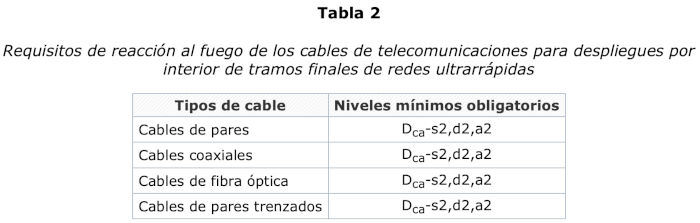 2. The fire reaction characteristics of telecommunications cables used in the deployment of final sections of fixed ultra-fast access networks running inside buildings, properties, and real estate complexes, as referred to in Article 45.4 of Law 9/2014 of May 9, the General Telecommunications Law, shall be those specified in the following table (column for mandatory minimum levels). The abbreviations, cable characteristics, test methods, and marking system are those described in point 1 of this annex.
Note: The mandatory minimum levels shall be considered the minimum required, without prejudice to other specific regulations that may establish stricter levels for specific situations or locations. Additionally, if telecommunications cables are installed in contact with, or in the same conduit or duct as, other types of cables regulated by different legislation, to which they may transmit fire in the event of a fire (such as electrical cables), the entire set of cables must comply with the requirements established by the stricter legislation.
Legal Framework:
Regulation (EU) No 305/2011 of the European Parliament and of the Council of 9 March 2011, repealing Council Directive 89/106/EEC, establishes conditions for placing construction products on the market, laying down harmonised rules on how to express the performance of these products in relation to their essential characteristics, and on their CE marking. This Regulation applies, among other products, to telecommunications cables.
To implement this Regulation, Commission Delegated Regulation (EU) 2016/364 of 1 July 2015 was published on the classification of the reaction to fire properties of construction products in accordance with Regulation (EU) No 305/2011 of the European Parliament and of the Council. This regulation stipulates that when the intended use of a product is such that it may contribute to the generation and spread of fire and smoke, its fire performance will be classified in accordance with the provisions of its annex. Table 4 of the aforementioned Annex establishes the possible fire reaction classes for electrical cables within the European Union.
In Commission Communication 2016/C 209/03 within the framework of the application of Regulation (EU) No 305/2011 of the European Parliament and of the Council, laying down harmonised conditions for the placing on the market of construction products and repealing Council Directive 89/106/EEC, a reference is included to the harmonised standard EN 50575:2014 (and its Addendum 1) 'Power, control and communication cables. Cables for general applications in construction subject to reaction to fire requirements'. The Resolution of June 21, 2016, from the Directorate General for Industry and Small and Medium-Sized Enterprises, cites standard UNE-EN 50575:2015 and Addendum 1 (UNE-EN 50575:2015/A1:2016), which covers, among other things, telecommunications cables (copper, coaxial, fiber optic, etc.) used in ICT (Information and Communications Technology) within buildings. From this regulatory framework, the CE marking requirement for telecommunications cables used in ICT and in their final sections, in relation to their fire resistance, is derived.
At the national level, the Regulation governing common telecommunications infrastructures for access to telecommunications services inside buildings, approved by Royal Decree 346/2011, of March 11 (ICT Regulation), establishes in its annexes some requirements for fire behavior of telecommunications cables, which must be adapted to the new fire reaction classes established in the European regulatory framework.
Likewise, Article 45.4 of Law 9/2014, of May 9, General Telecommunications Law, regulates the installation of final sections of fixed electronic communications networks of ultra-fast access, with the aim of facilitating the deployment of final sections of wired fixed networks of ultra-fast access, such as those based on fiber optic carriers or coaxial cable, whose minimum fire behavior characteristics must also be defined.
Finally, Order ITC/1644/2011, of June 10, which develops the Regulation governing common telecommunications infrastructures for access to telecommunications services inside buildings, approved by Royal Decree 346/2011, of March 11, needs to be adapted in relation to certain administrative aspects of the presentation and execution of the technical project, in light of the experience acquired since its entry into force, with a view to streamlining the processing of documentation submitted to the Administration.
Article 45.6 of Law 9/2014, of May 9, establishes that the Ministry of Industry, Tourism and Trade (currently the Ministry of Economy and Business) will determine the technical aspects that operators must comply with when installing the resources associated with ultra-fast fixed electronic communications networks, as well as the associated civil works, with the aim of reducing inconvenience and burdens to citizens, optimizing network installation, and facilitating their deployment by the various operators.
The second final provision of Royal Decree 346/2011, of March 11, authorizes the Minister of Industry, Tourism and Trade (currently the Minister of Economy and Business) to issue the regulations necessary for the development and implementation of its provisions, as well as to modify, when technological innovations so advise, the technical standards contained in the annexes of the ICT Regulation that it approved.
This Order complies with the principles of good regulation set forth in Article 129 of Law 39/2015, of October 1, on the Common Administrative Procedure of Public Administrations (necessity, effectiveness, proportionality, legal certainty, transparency, and efficiency) and has been processed in accordance with Article 133 of Law 39/2015, of October 1, on the Common Administrative Procedure of Public Administrations. Likewise, a report has been obtained from the National Markets and Competition Commission in accordance with the provisions of Article 5.2.a) of Law 3/2013, of June 4, establishing the National Markets and Competition Commission.
Furthermore, this order has been subject to the information procedure regarding technical standards and regulations and rules relating to information society services provided for in Directive 2015/1535 of the European Parliament and of the Council of 9 September 2015, laying down a procedure for the provision of information in the field of technical regulations and rules relating to information society services, as well as in Royal Decree 1337/1999 of 31 July, which regulates the submission of information regarding technical standards and regulations and rules relating to information society services.