 Over the past few years, the number of VDSL2 connections has increased rapidly. However, with the increasing number of subscribers on the same cable bundle, the 100 Mbps data speeds achievable with VDSL2 have quickly become merely theoretical due to interference.
With each new customer, network operators find it increasingly difficult to offer highly reliable data rates. As a result, the technical advantage of VDSL2 transmission can no longer be fully realized.
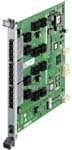
Without vectoring, the 100 Mbps of the VDSL2 standard is only possible when lines are very short and there are no other subscribers in the cable bundle. The main source of interference is crosstalk between each of the wires in the bundle (or more precisely, far-extended crosstalk - FEXT), which limits the range and data rate. KEYMILE is a leading provider of communication technology solutions for access and transmission systems. Its new vector controller card for its MileGate multi-access service platform successfully eliminates most of the interference in the cable bundle. Data rates increase, and the variation in achievable data rates along the cable decreases. Therefore, even with many subscribers and when lines are 400 m long, network operators can achieve higher bandwidths.
To achieve effective interference reduction, all VDSL2 signals within a cable bundle must be incorporated into the real-time vectoring process. This is made possible by a system-level vectoring approach that integrates multiple VDSL2 cards into the vectoring process. The KEYMILE vectoring card allows up to four 48-port VDSL2 cards to be connected to a single vectoring controller card. Consequently, a MileGate rack can support up to 768 VDSL2 interfaces integrated into the vectoring process.
Keymile's 48-port VDSL2 cards for MileGate are ready for system-level vectoring. 1.5m of these ports are already deployed and can be connected to the vector control card, which will be available by early 2013.