Configurable line width laser
AMS Technologies presents configurable linewidth lasers with low noise and a compact package. Pure Photonics produces configurable 1550nm lasers with a 10kHz linewidth and ultra-low FM noise.


 By Carlos Martinez
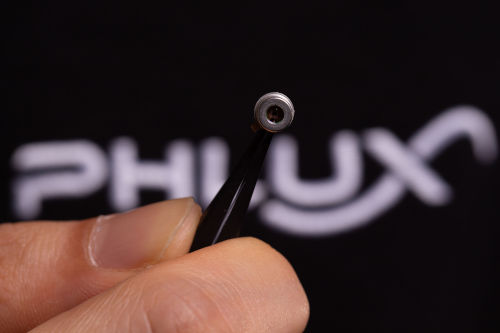
 Phlux Technology announces its first products, the Aura family of 1550 nm devices based on the company's Noiseless InGaAs™ APD technology. The sensors are 12 times more sensitive than traditional, best-in-class InGaAs APDs. As a result, the operating range of LiDAR, laser rangefinders, and fiber optic test equipment can be extended by up to 50% with Phlux sensors, which directly replace surface-mount or TO-packaged components.
AMS Technologies presents configurable linewidth lasers with low noise and a compact package. Pure Photonics produces configurable 1550nm lasers with a 10kHz linewidth and ultra-low FM noise.
Banner Engineering introduces a powerful fiber amplifier, featuring a dual display and a new high-power LED emitter that emits a large amount of light through optical fibers.
ams OSRAM has developed an 850nm thin-film VCSEL platform for optical interconnects in artificial intelligence infrastructures. The company will present the technology at ECOC 2026 in Malaga, where it will also showcase, together with BizLink, a multi-core fiber solution...
Geforest, thanks to LiDAR (Light Detection and Ranging) technology, allows the generation of digital twins that capture parameters and measurements of forests to determine the actual state of these ecosystems. This, combined with artificial intelligence, parameters and automates the...
The ARCspectro VIS-NIR combines a standard multi-channel spectrometer covering the entire visible spectral range (360 to 950 nm) and a Fourier transform spectrometer with a wide-range InGaAs detector, sensitive in the NIR range from 900 to 2500 nm.
Avicena has begun supplying customers and partners with its 1 Tb/s LightBundle evaluation kits, an optical interconnection platform based on microLEDs and aimed at developing next-generation artificial intelligence infrastructures.




PowerON by Sonepar Spain brings together 6,000 professionals and 56 exhibitors in its first edition...
Nokia has signed a definitive agreement for the planned sale of its Enterprise Campus Edge business...
A new report on the evolution of broadband networks identifies the quality of...
Synology presented new solutions related to... at its Solution Day in Barcelona.
Broadband Forum will present seven demonstrations at Network X, held in Vienna, Austria...
Social networks
 |
 |
 |
 |
 |

You can subscribe to the Conectrónica magazine in 2 formats.
Digital Format: 5 downloadable PDF editions at an annual cost of 60 Euros (VAT included)
Paper Format: 5 editions to be received by mail at an annual cost of 180 Euros (VAT included).
Contact our subscription department at[email protected]
Payment via Bizum or bank transfer
D-Link has announced the start of the 30th season of its D-Link Webinars, an online training program...

The season consists of three episodes and features Phoenix Contact and Belden....

Mouser Electronics, Inc. highlights its comprehensive LoRa® resource center as the market accelerates...

Digital transformation has turned data networks into a critical infrastructure for...
Antennas remain one of the most critical and, at the same time, most misunderstood elements in...