What are the advantages and challenges of silicon photonics and integrated photonic circuits?
Integrated photonic circuits (PICs) are tiny optical systems made from materials such as silica (glass), silicon, or indium phosphide. PICs enable everything from complex optical designs that can send and receive billions of bits of information in a package the size of a chocolate bar to artificial noses capable of detecting various compounds and molecules in the surrounding air.
By leveraging the billions of dollars invested in CMOS chips, PICs can unlock new processing scaling potential beyond Moore's Law. However, the PIC market still faces significant challenges, including material limitations, integration complexity, and cost management. Large demand volumes are needed to offset the upfront design and manufacturing costs of PICs, and production lead times can stretch to months. IDTechEx's new report on the topic, "Silicon Photonics and Photonic Integrated Circuits 2024-2034: Market, Technologies, and Forecasts," takes an in-depth look at the PIC market and has identified photonic transceivers for AI as an emerging segment that will soon be the largest source of PIC demand.
What are the PIC materials of the future?
There is a wide variety of materials for the PICs of the future. Most of the current market uses silicon and silica-based PICs for light propagation; however, as an indirect semiconductor, silicon is neither an efficient light source nor a photodetector. Therefore, silicon is often combined with III-V materials for light sources and photodetection. However, thin-film lithium niobate (TFLN), with its moderate Pockels effect and low material loss, is emerging as a strong contender for applications requiring high-performance modulation, such as quantum systems or potential high-performance transceivers in the future. Monolithic indium phosphide (InP) remains a major player due to its ability to both detect and emit light. In addition, innovative materials such as barium titanite (BTO) and rare-earth metals are being explored for their potential in quantum computing and other cutting-edge applications.
How AI is changing the demand for silicon photonics and PICs
The rise of Artificial Intelligence (AI) has spurred unprecedented demand for high-performance transceivers capable of supporting the massive data transmission speeds required by AI accelerators and data centers. Silicon photonics and PICs are at the forefront of this revolution, thanks to their ability to transmit data at speeds of 1.6 Tbps and above. As demonstrated by Nvidia's latest Blackwell CPUs, which, according to IDTechEx research, require approximately two 800G transceivers per GPU, the need for efficient, high-bandwidth communication is becoming increasingly critical for AI, positioning silicon photonics and PICs as essential components in the AI-driven future. The biggest driver of PIC transceiver development is AI, as higher-performance AI accelerators will require higher-performance transceivers, with 3.2 Tbps transceivers anticipated by 2026.
What are the future applications?
There are other applications for silicon photonics and PICs: from high-bandwidth chip-to-chip interconnects to advanced packaging and co-packaging optics. These technologies are paving the way for next-generation computing.
Photonic motors and accelerators: By using certain photonic components, such as Mach-Zehnder interferometers, and controlling these components through electro-optical interconnects, high-performance processors and programmable PIC devices can be designed and manufactured, unlocking performance beyond what is possible with electronic accelerators alone.
PIC-based sensors: Some PIC materials, such as silicon nitride, can be used for a wide range of sensors, from gas sensors to artificial noses. The healthcare sensor sector could benefit from the miniaturization of optical components in PIC devices, which could have applications in point-of-care diagnostics or wearables.
The PIC-based FMCW LiDAR has the potential to transform the automotive and agricultural industries with applications in drones and autonomous vehicles.
Quantum systems: Companies investing in trapped-ion and photon-based quantum computing are looking to PICs for more stable and scalable quantum systems. PICs are used in photonic quantum systems to achieve the precise photon control necessary for quantum computing.
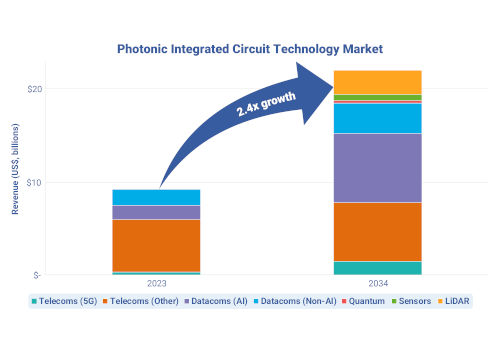
The PIC market's 8% CAGR will be driven by applications in quantum computing, 5G, LiDAR, sensors (such as biosensors and gas sensors), and data communications for AI. Source: IDTechEx
The silicon photonics and PIC market is experiencing strong growth, driven by the rise of AI and the demand for datacom transceivers. Major players in the sector, such as Intel/Jabil, Coherent, and Infinera, are actively using PICs in their transceivers. Innolight, a transceiver company based in China, achieved a transfer rate of 1.6 Tbps in its latest transceivers in late 2023, which will begin shipping for data center applications in 2024. Coherent, which has its own InP wafer manufacturing facilities, is also developing higher-performance transceivers for applications exceeding 1.6 Tbps. Intel Silicon Photonics, which may be acquired by manufacturing company Jabil, sold approximately 1.7 million PICs in 2023, according to analysis by IDTechEx, and continues to develop transceivers for telecom and data communications. IDTechEx predicts that PIC technology will continue to dominate the high-performance transceiver market, further solidifying its position as a critical component in the modern technology landscape.
Author:
Author: James Falkiner, technology analyst at IDTechEx