
Until the mid-1980s, many of the sensors and actuators used were analog. Systems like the 4-20mA current loop could not only provide accurate measurements along long cable runs but also power the device. Thanks to their high noise immunity, they also offered safety, as cable breaks could be easily detected—a key aspect for the safe installation of hazardous processes.
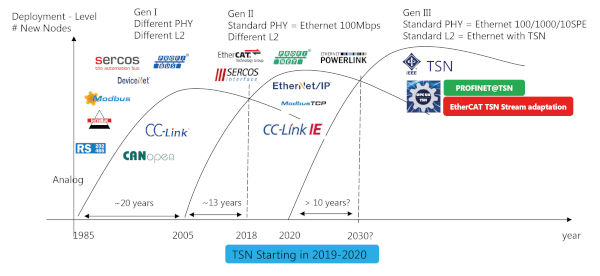 One of the drawbacks of this technology was the need for a cable for each sensor and actuator, resulting in numerous parallel cables being installed in factories and plants. Reducing the complexity and cost of the wiring drove the evolution of network technologies. These technologies coalesced around the serial interface (UART) incorporated into low-cost microcontrollers along with a suitable transceiver (e.g., RS-485) or CAN (Controller Area Networking) technology, widely used in the automotive sector (Figure 1).
These first-generation networks relied on different technologies for the physical layer (PHY) (layer 1 of the OSI model) and different data link layers (layer 2 of the OSI model), so systems were rarely compatible with each other without some type of gateway. However, their key features included robustness, even over distances of hundreds of meters, defined waiting times, determinism, and compliance with security requirements.
These fieldbus technologies are installed in millions of nodes worldwide, but much of the physical layer technology has remained stagnant, thus limiting available bandwidth. At the same time, industrial automation systems have become increasingly complex, incorporating large-scale data sensing, such as cameras, which are integrated into real-time control loops within processing environments. The diversity of installed physical layers makes it impossible to deploy different systems over the same cabling.
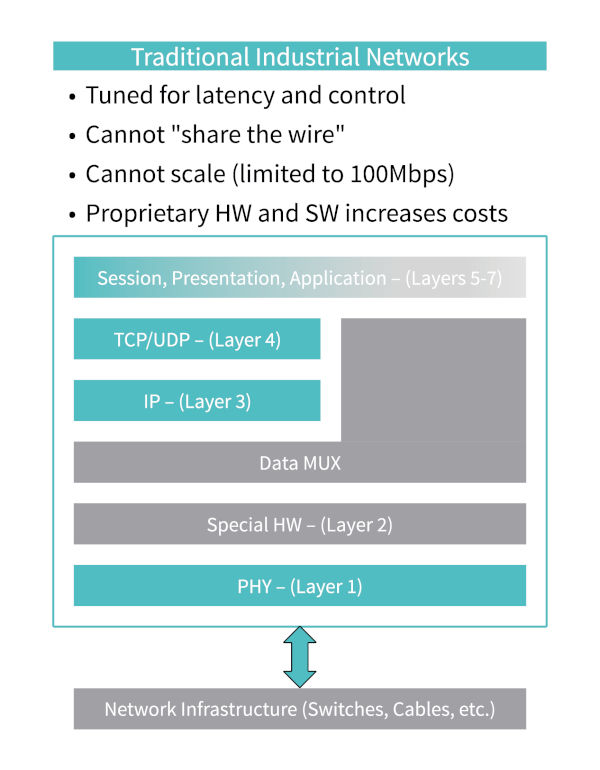 Ethernet, well-established and widely used in buildings and factories for IT installations, offers high bandwidth and numerous suppliers of everything needed, from connectors and cabling to silicon devices. Around 2005, Ethernet-based solutions began to appear on the market, clustered around a single PHY. However, the rest of the OSI model exhibited serious problems related to latency, bandwidth reservation, reliability, and security. As a result, several Layer 2 proposals based on the Ethernet physical layer were developed, but once again, industrial automation systems suffered from incompatibilities between solutions from different vendors (Figure 2).
Goodbye to Proprietary Solutions:
Industrial automation isn't the only market segment eager to adopt Ethernet, but concerns remain about meeting its technical specifications. Professional audio and video, as well as the automotive industry, are keen to leverage these advantages if issues like latency and determinism can be addressed. Furthermore, proprietary second-generation industrial Ethernet systems were built on 100 Mbps physical layers and the corresponding bulky cabling, while other market segments have already achieved gigabit speeds.
The main problems that have hindered the adoption of Ethernet in industry have since been addressed in a set of common standards called Time Sensitive Networking (TSN). As a standard, it will enable commercial solutions, from silicon devices to cables, to interact with each other, driven by demand from many industrial sectors with similar needs. It also envisions the use of physical layers that allow data transmission speeds of up to 1 Gb/s, as well as the use of single-pair Ethernet (SPE), which will significantly reduce cabling space and costs.
These are some of the main TSN standards that provide the synchronization and timeout required by industrial networks:
• IEEE 802.1AS – timing and synchronization for time-sensitive applications. A mechanism shares synchronization data between a master network node and other nodes to provide a common reference clock that serves as a common, synchronous base. It is an IEEE 1588 profile.
• IEEE 802.1Qbv – this standard provides further improvements to ensure end-to-end timeouts in applications by blocking low-priority traffic during defined time windows. This allows its use in applications such as closed-loop Ethernet control using a time-based scheduler.
• IEEE 802.1Qbu – this standard defines the Layer 2 OSI lookahead methodologies that enable Interspersed Express Traffic (IET) under IEEE 802.3br. This allows for a reduction in the waiting time of certain traffic in a mixed traffic environment, such as the interception of long, low-priority traffic.
 These changes, along with efforts to group these standards based on applications within TSN's IEC/IEEE 60802 profile for industrial automation, should help form the basis of third-generation industrial networking technology.
Industrial Networks with TSN:
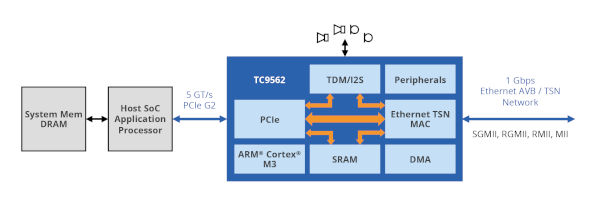
Compact, highly integrated system-on-chip (SoC) solutions are ideal for modernizing installations that can leverage TSN. The TC9562 is such a device, incorporating a PCIe interface and extending the functionality of large SoCs into PLCs (programmable logic controllers) or as plug-in cards for industrial PCs (Figure 3). It features all the functions of TSN, from IEEE 802.1AS synchronization to IEEE 802.1Qbv time-aware shaper (TAS) with six queues and flexible buffer management across all queues. Hardware support for all gate control provides high granularity for controlling the defined time slots used by the TAS within a single machine cycle. IEEE 802.1Qbu and IEEE 802.3br add anticipation capabilities to ensure priority handling of time-critical data packets.
The firmware required for operation is downloaded via PCIe during initialization, which also allows for future updates such as changes or ratifications to the relevant TSN standards (Figure 4). SGMII, RGMII, RMII, and MII interfaces are supported, achieving speeds of 10 Mb/s, 100 Mb/s, and 1000 Mb/s, respectively, as well as SPE T1 physical layers to accommodate the trend toward lighter and simpler cabling.
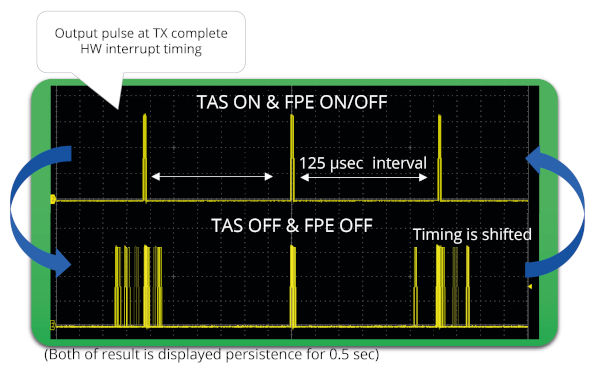
 Initial evaluation of the device can be performed using the PCIe reference card, which can be used with an industrial PC running Fedora 27. Toshiba offers a full range of drivers and other utilities, as well as sample applications and TSN demonstrations (Figure 5). These include examples of TAS in operation to allow visualization of anticipation capabilities, and the effect on transmission speed can be analyzed with standard tools such as iPerf.
With standardized physical layers and Layer 2 Ethernet implementations meeting the real-time needs of industrial automation, it's reasonable to wonder what to expect from fourth-generation industrial networking technology. As in other sectors, the upper layers of the OSI model are also expected to evolve toward standardization. Organizations like the OPC Foundation have established a working group to address field-level communication (FLC) with the goal of creating a machine-to-machine communication protocol with a unified architecture (OPC UA). 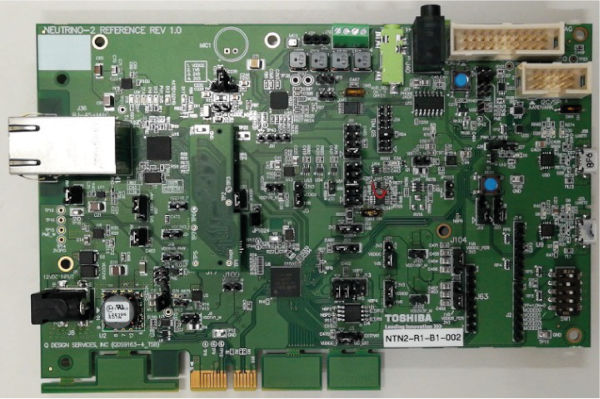 This open, cross-platform approach, coupled with robust security, has the potential to greatly simplify much of the complexity engineers currently face. Installing new equipment would simply require the machine to declare its capabilities (such as a robot's degrees of freedom, maximum payload, etc.) using simple, standardized data structures that allow other systems to quickly understand and integrate its capabilities into the task at hand.
Abstract:
While Ethernet has begun to displace many traditional networking technologies at the physical layer of industrial automation systems, the various solutions proposed for Layer 2 are poised to address Ethernet's traditional weakness, which has limited its adoption in many applications. The advent of TSN adds the necessary standardization to ensure interoperability of equipment from different vendors, which will also reduce costs. Devices like the TC9562, compatible with open-source software, provide an excellent foundation for the adoption of industrial networks using TSN.
Article provided by Toshiba Electronics Europe GmbH


