
It is important to emphasize that operating expenses (OPEX) have become one of the major factors differentiating the services offered by operators. Cognitive networks open up a range of possibilities for operators seeking to differentiate their services in the market, streamlining their operations and incorporating new economic models to compete in the region.
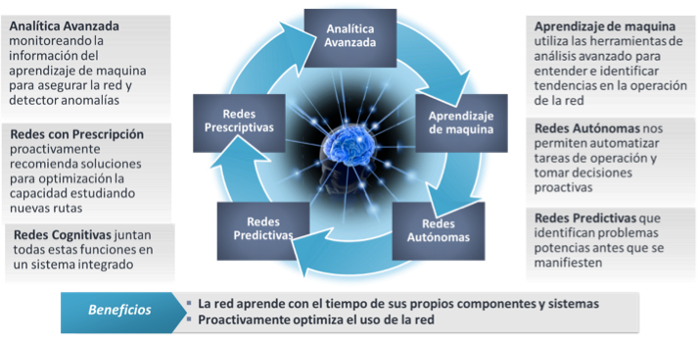 What are they?
The future of information transport networks will rely on cognitive networks, which are built on five main pillars: advanced analytics tools, machine learning, autonomous networks, predictive networks, and prescriptive networks. These networks use analytics tools and machine learning to understand the network's actual state. They automate routine tasks that would normally require human intervention, providing autonomy for their operation and maintenance. They predict potential problems and prescribe possible solutions to optimize transport routes or mitigate risks. A cognitive network brings these five pillars together into a coherent system, allowing the network to learn over time about its components and how to proactively react to potential changes.
Where are we now?
The first step toward cognitive networks is ensuring that transport networks are flexible and dynamic. To date, many optical transport networks in Latin America are static and rigid. Perhaps the most fundamental step toward achieving this dynamism is the adoption of software-defined capacity (SDC) models. Software-defined capacity is the feature that allows users to utilize network capacity as a flexible and adaptable resource. This technology enables bandwidth to be acquired on demand, moved to where it is most needed, and reduces the network planning process from months to minutes.
Infinera has been a pioneer in defining flexible consumption models for the photonic layer. In 2012, it introduced Instant Bandwidth to the market, providing the industry with the ability to consume prepaid bandwidth using its photonic integration technology. In 2017, it introduced a new way to automate these consumption models with Instant Network, which incorporates the ability for photonic networks to adopt automated provisioning models by incorporating Instant Bandwidth as a pay-as-you-grow consumption model.
As an industry, we still have a long way to go to achieve cognitive networks, but undoubtedly, with the arrival of SDN/NFV and the adoption of software-defined capacity models, we are at the beginning of a significant transformation toward a new era in telecommunications. Latin America is ready and is in the process of taking the first steps toward achieving cognitive networks in the future.
Andres Madero – Director, Service Provider Architecture