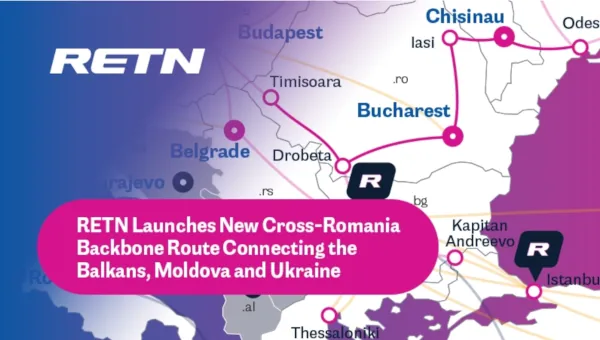
The route is part of RETN's broader strategy to strengthen its optical network in Central and Eastern Europe. By connecting Romania and Moldova to RETN's existing Balkan corridor linking Budapest, Timișoara, and Sofia, the expansion creates a new geographical route across the region and offers greater physical route diversity along its international backbone network. It also enables alternative routes to Ukraine via Moldova and to the Balkans via Bulgaria, providing additional options for regional and international traffic flows. This is particularly relevant for customers seeking physical route diversity in Eastern and Southeastern Europe.
“This project is an important step in strengthening the resilience of connectivity in Romania,” said Olena Lutsenko, Business Development Director at RETN. “Bucharest and Iași are rapidly developing business, education, and technology hubs, and the demand for resilient, high-capacity infrastructure is growing rapidly. By offering a direct route from Timișoara to Bucharest and then on to Chișinău, we are enabling faster and more scalable access to the region from the Balkans, Ukraine, and Central and Eastern Europe in general, for operators, ISPs, businesses, and international customers.
The expansion comes at a time of rapid growth in fiber optics and infrastructure modernization across Romania and Eastern Europe. According to Romania's National Authority for the Management and Regulation of Communications (ANCOM), Romania is among the region's leaders in fiber optics: 6.9 million fixed broadband connections by mid-2025, with 37% capable of gigabit speeds and continued growth in the adoption of ultra-high-speed internet.
Average per capita fixed broadband traffic is also increasing, indicating a growing demand for greater bandwidth. At the same time, internet adoption in Romania remains high, reaching approximately 94% of the population by the end of 2025, reflecting widespread online participation across the country.