Several bandwidths have been defined in SPE. The first part of the name indicates the Mbit/s: 10BASE means 10 Mbit/s. There are standards for 10BASE-T1S (S stands for “Short”), 10BASE-T1L (L for “Long”), 100BASE-T1, 1000BASE-T1, and even higher data transmission speeds: 2.5, 5, and 10 Gbit/s. SPE reduces system costs by decreasing the weight and complexity of the cabling.
The megatrend in networking is moving from distributed systems, defined primarily by the hardware used, to more centralized, software-defined systems. The trend is to connect everything with Ethernet
• Hardware architectures designed for a specific area are giving way to interconnected zones and a centralized computing platform.
• The multiple application-specific buses are replaced by a ubiquitous, IP-based Ethernet network.
• Gateways or controllers needed for conversion between different types of hardware, as well as their complex cabling, are eliminated. Low-cost, single-pair cabling brings Ethernet to the network edge.
All of this results in a more powerful and flexible network to meet the challenges of the industry.
Ethernet offers the possibility of developing connected infrastructures between the cloud and the network edge. Traditional IT networks at the top enable communication at the highest levels. OT (Operational Technology) networks are used within buildings to control processes and assembly lines. As we move closer to the edge of the enterprise network, we find sensors, actuators, and other low-level devices.
Ethernet provides a common pathway for connecting and communicating with all these elements, making their data available to the highest levels of the organization. This allows for leveraging large volumes of data (Big Data) to improve business operations. It also simplifies system configuration and control. The mechanisms established for Ethernet can protect these elements. Authentication, encryption, and secure updates are increasingly important requirements for modern networks.
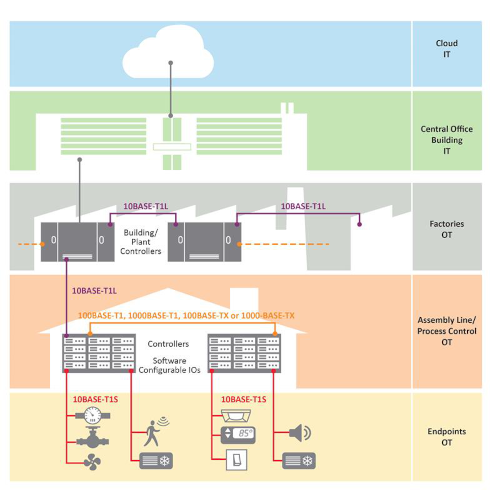 Microchip helped develop the IEEE standards and has simultaneously developed a comprehensive catalog of flexible and scalable SPE solutions. Whether for 10 Mbps, 100 Mbps, or 1000 Mbps, Microchip offers a PHY, MAC-PHY, or Ethernet switch capable of managing a single pair of wires for data transmission.
10BASE-T1S technology is one of the most recent types of Ethernet interconnection defined by the IEEE.
The IEEE 802.3cg standard was published in 2019. Microchip was a key contributor to its development within the IEEE. This standard was developed to bring Ethernet to the edge of Operational Technology (OT) or OT networks. Existing systems have bandwidths on the order of hundreds of kilobits per second, so moving to megabits per second allows for future growth.
The technology uses half-duplex communication and provides a flexible topology from point-to-point configurations to multidrop, in which case it involves multiple devices connected to a bus line consisting of a single pair of wires.
10BASE-T1S is defined to use a single balanced pair of conductors. This can consist of a single pair of twisted wires, other wire-pair configurations, or even parallel traces on a printed circuit board or server backplane.
The new 10BASE-T1S standard defines a physical layer that creates new business opportunities for companies adopting all-Ethernet systems. Data from any point in the system can be used in innovative ways in new applications.
The cost can be reduced because 10BASE-T1S uses simple components, software, and cabling. A new MAC-PHY 10BASE-T1S Ethernet controller, now available on the market, allows even the simplest microcontrollers to become part of the Ethernet world. 10BASE-T1S eliminates the need for gateways that were previously required to convert data between different hardware systems. The multidrop feature reduces the number of ports on switches since devices connect to a single bus line.
The use of well-established security mechanisms and unified Ethernet interfaces reduces risk when creating applications at the edge of industrial networks. These security mechanisms are familiar to a large number of designers and installers. Any problems can be quickly identified and resolved because many people work with the technology. Design, software development, testing, and maintenance resources at all levels of OT and IT networks can be concentrated on the same fundamental communication mechanisms.
Microchip offers a complete range of SPE PHYs, from 10 Mbps to 1000 Mbps, all for industrial temperature ranges. Its enhanced support for industrial applications includes protection, safety, and long-distance cabling. Complete SPE network solutions can be implemented with a broad portfolio of SPE switching devices. Microchip offers intelligent switches compatible with Time Sensitive Networking (TSN) and integrated SPE PHY technology. Our latest innovation is the first single-chip SPE switch available on the market. This device is TSN-compliant and uniquely integrates the switching structure, CPU, RAM, and FLASH code memory. Designers can now implement single-pair switching solutions even with little or no experience with T1 PHY technology or AVB and TSN specifications.
Author: Henry Muyshondt, Senior Manager, Microchip Technology, Inc.