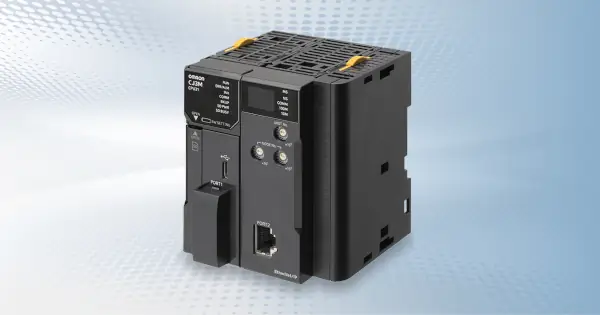
The OMRON CJ3M is designed for large-scale industrial automation applications, with a modular architecture that allows the configuration to be adapted to the needs of each machine or installation. Its main technical features include:
Up to 5,120 I/O points.
Up to seven expansion racks.
Program memory of up to 100,000 steps.
Up to 40,000 steps for function blocks.
Basic instruction execution time of 0.04 µs.
Communications capacity of up to 12,000 packets per second (pps).
Compatibility with EtherNet/IP, Modbus/TCP and socket communications.
Simple positioning of up to four axes using a pulse I/O block.
The range comprises ten CPU models, with or without integrated EtherNet/IP and program memory capacities ranging from 5,000 to 100,000 steps.
The CJ3M controller incorporates standard industrial cybersecurity features designed to protect systems against unauthorized access, data manipulation, and information leaks. These features include encrypted communications, user authentication, role-based account management, IP packet filtering, and port opening and closing control.
The device complies with mandatory GB standards in China and is planned to be compatible with the European Union's Cyber Resilience Act (CRA).
The CJ3M is programmed using CX-Programmer, OMRON's engineering tool included in the CX-One software package. The environment supports Ladder Logic, Structured Text (ST), and Sequential Function Chart (SFC) programming languages.
Trace variables can be logged directly from the Ladder program or the Watch window, while CPU label sets for EtherNet/IP data links are generated automatically. Furthermore, the expanded trace memory simplifies program diagnostics and debugging.
The new PLC allows for battery-free operation, eliminating the periodic maintenance and replacement tasks associated with this component. A battery will only be required when using the clock function and there is a possibility of prolonged power outages. The controller also incorporates USB Type-C and SD card interfaces, facilitating the purchase of accessories in various international markets.
One of the main advantages of the CJ3M is its compatibility with the programs, memory maps, and I/O units of the previous generation CJ2M. This feature allows existing systems to be modernized by replacing the CPU unit without requiring a complete redesign of the installation.
The migration procedure is carried out in four steps:
Reading of the existing project.
Data conversion.
CPU unit replacement.
Project transfer and verification.
OMRON also offers a replacement option for CS series controllers.