
 The reason why zone cabling is ideal: We reproduce on this occasion the article included in the CrossTalk newsletter of July/August of this year and published on the C3 Communications website; given the interest that its content presents when designing the cabling of industrial buildings or with a high density of data circulation.
 When Power over Ethernet (PoE) was introduced in 2003, it was only available for a few devices and low-power operations. Today, PoE is one of the fastest-growing networking applications. A wide range of projects for devices and technologies rely on PoE, including lighting, access control points, laptops and computers, IP devices, cameras, information kiosks, industrial automated equipment, and wireless access points (WAPs). With the advent of smart buildings and the Internet of Things (IoT), PoE is poised for unprecedented expansion across the industry.
To take advantage of PoE's many capabilities, network designers are increasingly using zone cabling architectures as an alternative to conventional cabling in smart buildings.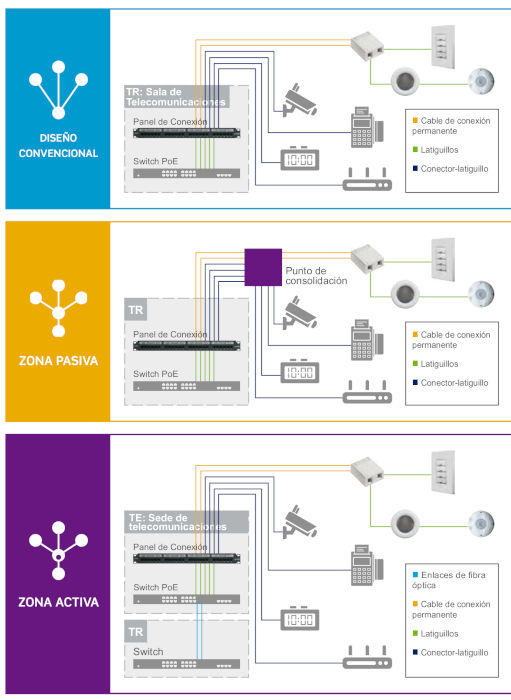 There are three basic topologies typically implemented when designing a system for PoE: conventional, passive zone, and active zone.
In this network architecture, all active elements are located in the telecommunications room (TR), with permanent cabling running from the patch panel in the room to each device.
A surface-mount box or other type of port termination can be included, with patch cords connected to the devices.
Like conventional design, this type of architecture places all active elements in the telecommunications room (TR). However, a consolidation point is added within the telecommunications room and at the devices to facilitate changes, moves, and additions.
In this type of design, the PoE device is located in a telecommunications building (TE) to enable long-distance transmission between the room and the TE, or to facilitate the transmission of large amounts of data.
The cabling between the room and the TE is typically fiber optic, with copper cabling running from the TE to the devices.
There is no single established topology for PoE, and each architecture has its advantages and disadvantages. However, for high-power PoE, both active and passive zone architectures offer significant benefits.
While a conventional design makes managing active equipment and power easy because everything is centralized in the telecommunications room (TR), the cabling infrastructure is much less flexible, hindering any future changes, moves, or additions.
In a passive zone topology, all active equipment and power are also centralized in the telecommunications room. However, unlike the conventional design, a consolidation point is added, creating the flexibility that was lacking when all cabling originated from the telecommunications room. Instead, an intervention point is placed in the middle, allowing for modifications. This provides a significant advantage in environments like open-plan offices, where workspaces or cubicles change and are frequently relocated.
The active zone reduces the required size of the telecommunications room by running fiber optic cable from the room to a telecommunications site and copper cabling from the site to the device connectors. Moving the PoE switch from the TR to a telecommunications site, and closer to the end device, reduces power loss in the cables. In addition, the smaller PoE switches typically used in headquarters areas are usually less expensive than the larger switches used in meeting rooms.
Zone cabling options also have lower long-term costs. However, using zone cabling also has several disadvantages. These include a higher initial cost and fewer tangible benefits in stable workspaces where changes, moves, or additions are infrequent.
OPTIMIZED POE CONNECTIVITY FOR ZONE ARCHITECTURES
Digital building technology can significantly reduce energy consumption, but selecting cabling that delivers optimal performance for the bandwidth and application requirements of the system is crucial. High-quality connectivity must meet the PoE performance requirements of digital building applications.
Leviton's end-to-end PoE systems, including compatible cables, connectors, patch cords, and patch panels, are qualified components, third-party tested and verified to exceed conventional industry performance standards, including higher bandwidth and power levels. Leviton's Atlas-X1 connectivity has been successfully demonstrated to be 100-watt PoE-ready, enabling the transmission of power and data to a wide range of remote devices.
Furthermore, the Atlas-X1 Cat 6A connectors feature the only UTP connectors on the market with a solid metal body. By using a metal body instead of the common ABS plastic, these connectors achieve higher performance and a 53% improvement in heat dissipation.
The connectors are designed with Leviton's optimized pin geometry, which prevents contact damage to the pins caused by higher-voltage PoE applications. Leviton's patented force retention technology maintains consistent contact force at the connector and contact interface, preventing unintended intermittent disconnections. This increases system lifespan and prevents costly repairs.
Zone cabling receptacles are a good solution for providing flexibility in an open-plan office design. Active zone receptacles are usually a ceiling node and should be used when there is active equipment at a consolidation point. Passive zone receptacles can be used in open environments or with unterminated ceilings, where passive cabling is used at the consolidation point.
Additional documentation:
Cross-Talk Newsletter No. 10 July-August 2019: Full text, which includes a regulatory update about structured cabling
Considerations for network infrastructure in a digital building: Leviton's white paper developing the content of the article.
For more information on this matter, please contact the technical specialists at


