


Next, we'll analyze the latest regulatory developments underway that will make this technology the foundation of a market sector with enormous potential, one that structured cabling has been striving to dominate for years.
Then, we'll examine what it physically is and how quickly it will become a set of standard products that we use every day.
Where did this interest come from?
In 2016, the IEEE convened an 802.3 working group to discuss a request for interest in 10 Mb Single Twisted Pair Ethernet. The initial meeting was attended primarily by companies in the Industrial Automation and Automotive sectors. The intention was to explore market needs and solution requirements, along with target markets, their size, and potential, before studying the technical feasibility of a solution.
Industrial automation was the first sector explored. This interest can be explained in three ways:
- A desire for convergence under a single network protocol
- Ethernet adoption was already a reality where possible
- Non-Ethernet fieldbuses were still needed to complete edge communications in some cases.
The challenges to overcome this were the following:
- Cable lengths greater than 1 km
- Very low bandwidth ≤1 Mbps
The final point is complicated by the number of available fieldbus options, each of which creates maintenance and installation issues that are best avoided for operating expense (OPEX) reasons, if possible.
The advent of Industry 4.0 will require higher data rates at the edge, faster data logging, monitoring of environmental conditions and power consumption, along with optimized data for both equipment and maintenance.
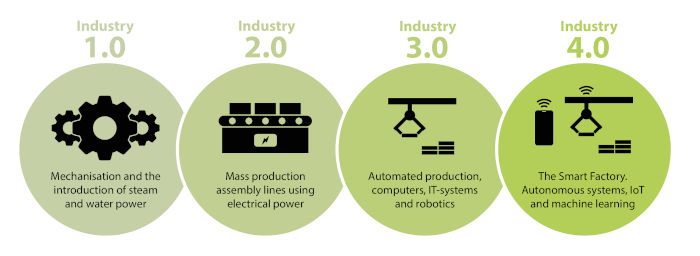 Industry 1.0 Mechanization and introduction of steam and water power.
Industry 2.0 Mass production assembly lines using electric power.
Industry 3.0 Automated production, computers, IT systems, and robotics.
Industry 4.0 The smart factory. Autonomous systems, IoT, and machine learning.
The automotive sector is also fully in favor of 10Mb single-twisted-pair Ethernet; in fact, it could be argued that they are ahead of the curve, with nine organizations operating in this sector represented at the initial meeting, some with multiple delegates, including BMW, Toyota, Nissan, and Renault, to name just four.
With the increasing complexity of vehicle electronics, with more ECUs and sensors, there are clear advantages to global IP communications.
What is driving the surge in SPE adoption?
The rationale for "Ethernet to the Edge" in industrial automation is that it will lead to a single network protocol and eliminate the need for the complex gateways required to convert from multiple different fieldbus protocols, such as MODbus, HART, and Interbus. This, in turn, will accelerate commissioning, diagnostics, and troubleshooting. All of this, combined with the greater economies of scale that come with its adoption, will result in a lower total cost of ownership (TCO) and a better return on investment (ROI).
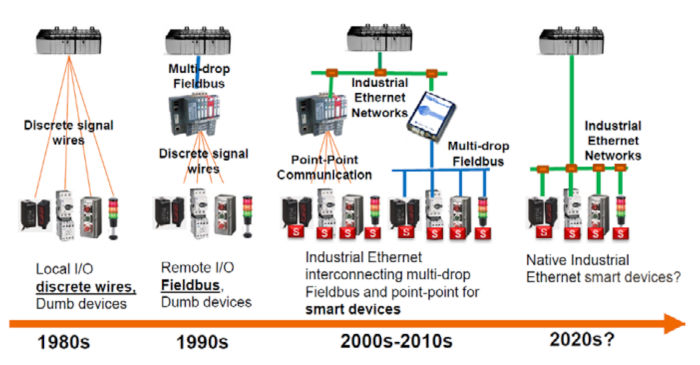 10 Mbps single-twisted-pair Ethernet handles most fieldbus applications up to 1200 m. Many devices also require power, which can easily be provided by the cables currently being proposed. Most of these cables will use a larger conductor size of 18-24 AWG, depending on the distance, and will primarily feature shielded construction.
Building automation, while not part of the original call for proposals, has a number of very similar challenges and requirements. A transition is already underway with technologies like BACnet IP, but there is also a strong desire to converge on a single network type and, in some cases, move away from proprietary protocols.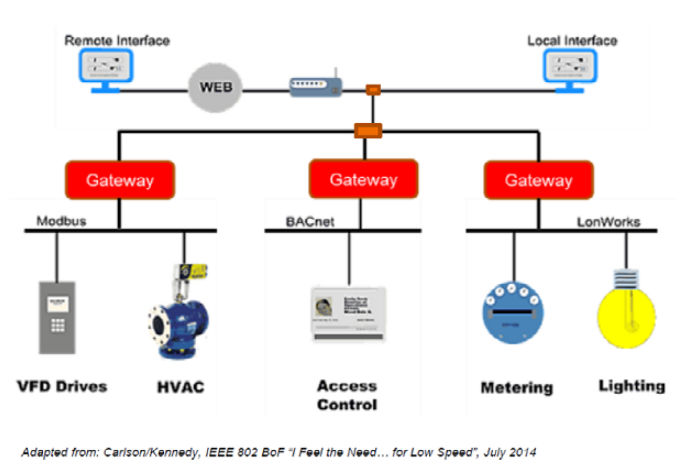
In the automotive sector, many legacy vehicle networks (IVNs) use lower data rates than those proposed for SPEs, so the transition from legacy IVNs to Ethernet requires not only lower costs but also lower power, which could reduce emissions and solve multiple problems in this sector.
The transition to Ethernet is well advanced with:
- 802.3bp - 2016 - Gigabit Ethernet over single twisted pair, automotive and transportation environments.
- 15m Automotive
- 40m Aircraft, railways, buses and trucks
- 802.3bw - 2015 - 100Mb Ethernet over single twisted pair, automotive environments
- 15m Automotive
There is now a clear push towards "ubiquitous IP" to reduce the number of IVNs and multiple gateways.
Target markets
The key markets for SPE are not to replace existing 4-pair networks, but to work alongside them and exploit markets that have been considered mainly outside the scope of traditional structured cabling.
Industrial automation
- Process automation
- Factory automation
Building automation
- HVAC
- Security/Access control
- Fire protection
- Lighting control
- Residential
Automotive
- Ubiquitous IP Network
- Legacy IVN Consolidation
Market Potential:
The industrial automation and control market experienced significant growth in 2016. One report stated that the traditional fieldbus market represented 58% of the total market and was growing at a 7% CAGR. However, the Ethernet market, at 38%, was projected to grow at a 20% CAGR. Based on several reports, a total of 180 million ports were forecast to be supplied in 2020 (pre-COVID-19), 50% of which could be addressed by SPEs.
The size of the building automation market could be even more exciting, with a 2016 forecast from IHS predicting that approximately 15 million controllers, each with two ports, would be shipped worldwide by 2020. On average, each controller could connect to 10 sensors/actuators, resulting in 300 million connected devices (the next section explains how this is achieved in more detail). A 10Mb SPE could serve more than 50% of this market.
The figures cited in the two previous examples pale in comparison to the automotive sector, where approximately 4 billion IVN ports were supplied in 2019. However, it's important to note that these will involve higher bandwidth over very short distances and are more specialized than the main focus of this document, which is to discuss the potential impact on the structured cabling market.
If we consider the two key markets of industrial and building automation, the sector targeted by SPE could exceed 250 million ports by 2021.
What exactly is SPE? How it works and how it provides power
IEEE 802.3bu:2016 - Power over Data Line (PoDL)
- Power delivery over a single twisted-pair segment
- Pronounced "poodle"
- Sometimes called SPoE (although technically different from PoE)
- Up to 52W of power, depending on the cable, distance, and number of connections
IEEE 802.3cg: 2019 - 10 Mb/s
- 10BASE-T1S - Link segment (point-to-point), 4 connections, 15 m range, PoDL power
- 10BASE-T1L - Link segment (point-to-point), 10 connections, 1000 m range, PoDL power

- 10BASE-T1S - Link segment (multipoint), 8 nodes, 25m range

IEEE 802.3da - 10 Mb/s Multidrop Enhancements
- Multidrop Segment, 16 Nodes, 50 m Range, PoDL Feed
Channel Lengths
- SP1-400 Channel (23 AWG)

- SP1-1000 Channel (18 AWG)

Connector Technology
There are two basic groups of connector technology that are for 'reinforced' and 'non-reinforced' use.

They are commonly used in the industrial automation sector.
It is based on the LC style footprint and will be used predominantly in building automation and in "non-reinforced environments".
Power Delivery:
There are several factors that affect the power delivery distance and power level, which are as follows:
- Power supply type
- Conductor size
- Number of connections
There are six PoDL power classes for 10Mb SPE applications. Each class defines the voltage (V), current (mA), power (W), and maximum DCR (Ω)*. The DCR value is used to calculate the theoretical maximum power delivery distance. Fortunately, the IEEE 802.3cg standard provides a table to help with this calculation.
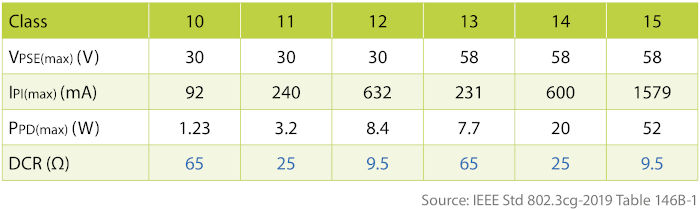
*Resistance - DCRloop = DCRcable + DCRcords + DCRconnections This then allows calculating the following distances.

Maximum channel length determined by the Insertion Loss limit (blue)
Channels exceeding 400m or having more than 5 connections do not meet the SP1-400 channel topology requirements (red)
Frequently Asked Questions
: Will SPE replace 4-pair Ethernet?
- SPE is not a replacement for 4-pair Ethernet computer networks.
- It is a completely new system to replace Fieldbus and other automation-based networks in the industrial and building automation sectors, as well as in the automotive sector.
-
The ability of 4-pair cable to support four SPE links simultaneously is still under evaluation.
Can I buy SPE right now (2020)?
- The answer is no, there are no commercially available systems at this time.
- Although the connection hardware has been approved and the cables should be relatively straightforward, the PHYs
(physical and electronic interfaces) are still under development.
Conclusions
There is a lot of activity surrounding Single Pair Ethernet, with the IEEE and TIA leading the way, although the ISO/IEC is catching up quickly, and the latter is investigating the potential for more variants and distances, including the use of 4-pair cable as a feed for multiple drops of a pair.
In any case, the level of interest in all sectors of the market is extremely high, and not only are cable and connector manufacturers investing heavily, but PHY manufacturers are also putting a lot of pressure on, with announcements from Texas Instruments, which has been able to drive SPEs up to 1.5 km during tests in its laboratory. Nothing was mentioned about power, so it may be a physical limitation that they cannot overcome.
SPE will not replace traditional 4-pair structured cabling in the enterprise computing sector, but will complement it by merging the "experience systems" used by operational technology into a uniform communications platform.
As for the timeline, it's difficult to predict. All the basic standards have been established and the cabling could be implemented very quickly; now it's a matter of equipment suppliers introducing the physical devices, and many predict that we will start seeing systems deployed in 2021.
Looking at past Ethernet adoption curves, the time from early adopters to the mass market is typically around four years. However, in this case, I believe it will accelerate due to the anticipated explosion of smart buildings and connected devices. A recent report states that this figure will reach 75 billion within the next six years.
Therefore, we need to pay close attention to this area. This technology will likely be present in many buildings in the not-too-distant future.
Article provided by Excel






