


The quality of a fiber optic installation depends not only on the cable or active equipment. The method used to terminate the fibers plays a crucial role in network performance, optical losses, long-term reliability, and ease of maintenance.
With the increasing demand for enterprise networks capable of supporting high-speed applications, data centers, unified communications, and cloud services, selecting the most suitable termination system has become a strategic decision for installers, engineers, and infrastructure managers.
The current situation in fiber optic installations:
The evolution of communication networks has driven the increasingly intensive use of fiber optics as the primary transmission medium in corporate buildings, data centers, hospitals, universities, industrial facilities, and business campuses.
Its high transmission capacity, immunity to electromagnetic interference, and ability to reach long distances make fiber optics the technology of choice for current and future infrastructures.
However, the performance of a fiber optic network does not depend solely on the quality of the installed cable. Each termination point is a critical element that can affect the optical budget of the link, increase insertion losses, generate unwanted reflections, or complicate subsequent maintenance.
For this reason, choosing the correct termination method is essential from the earliest stages of the project. Several techniques are available, each with its own advantages, limitations, costs, and specific installation requirements.
The choice will depend on the project's technical characteristics, the installer's experience level, the time available for installation, and future expansion or maintenance needs.
In this article we analyze the main fiber optic termination systems used in business networks, their most common applications and the criteria to consider before selecting the most suitable solution for each installation.
The role of fiber optics in business networks:
In structured cabling infrastructures, fiber optics are primarily used as the network backbone. These links handle the largest volume of data traffic and allow for the interconnection of different areas within a building or business campus.
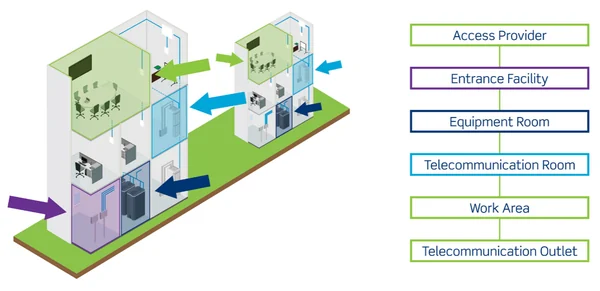
Figure 1: Areas of the structured cabling system from the entrance to the telecommunications outlet.
Typically, backbone cables connect the operator's entry point to equipment rooms, telecommunications rooms, plant distributors, and other service areas, where connectivity is then distributed to workstations via horizontal cabling.
In larger installations, fiber also connects entire buildings within a campus, links data centers, or provides communications between different industrial facilities. In all these scenarios, the reliability of the terminations becomes critically important, as any increase in optical losses can affect the overall operation of the infrastructure.
During the installation of these networks, it is often necessary to adapt different types of cable, perform transitions between outdoor and indoor cabling, or make splices at various points along the route. All of this necessitates the use of termination systems capable of maintaining consistent optical performance and high reliability throughout the installation's lifespan.
Fiber Termination: Much More Than Just Attaching a Connector.
Although it may seem like a simple operation, terminating an optical fiber is one of the most delicate processes in the entire installation. The goal is not only to attach a connector to the end of the cable, but also to ensure that light passes through the joint with the least possible loss and minimal reflection.
Poor termination can cause higher-than-expected insertion losses, reduce the available optical bandwidth, increase link reflectance, and even generate faults that are difficult to locate during maintenance.
Conversely, a properly executed termination helps maintain transmission quality, facilitates future infrastructure expansions, and significantly reduces the costs associated with corrective maintenance.
In today's networks, where speeds of 40, 100, 400, and even 800 Gb/s are common in certain data center environments, the quality of each connection is even more critical.
Tolerances are increasingly tight, and any defect in the termination can directly impact the overall system performance.
Factors to consider before selecting a termination method:
There is no single system suitable for all installations.
Before deciding on a termination method, it is advisable to carefully analyze the specific characteristics of the project.
Available Time and Installation Environment:
One of the first aspects to consider is the time available for installation and the conditions under which the work will be carried out.
Working on a new infrastructure with ample planning margins is not the same as expanding an existing data center, where every minute of downtime can have significant financial consequences.
Other factors include the available workspace, environmental conditions, ease of access to cabling, and the feasibility of transporting specialized equipment to the installation site.
Material and Labor Costs:
The overall budget is another determining factor.
Each termination system involves different costs for materials, tools, and installation time.
In some projects, a higher initial investment may be more cost-effective if it significantly reduces assembly time or simplifies future maintenance.
Therefore, the economic analysis should not be limited to the acquisition cost of connectors or splicing equipment, but should consider the total lifecycle cost of the infrastructure.
Installer Experience:
The training level of the personnel responsible for the installation also plays a decisive role.
Some methods require a high degree of manual dexterity and significant experience to achieve repeatable results, while other systems incorporate more automated processes that reduce reliance on the technician's skill.
Likewise, it is necessary to consider the availability of specialized tools, consumables, measuring instruments, and certification equipment capable of subsequently verifying the quality of each installed link.
Cabling System Characteristics:
The type of network to be built also influences the choice of termination system.
It is advisable to analyze aspects such as the total number of fibers, the possibility of future expansions, maintenance requirements, the optical budgets allowed by the applications, and the type of cable used.
Not all solutions offer the same performance when working with tight-buffered cables, loose-tube cables, shielded cables, or ribbon cables. Each has specific requirements during preparation, splicing, and termination operations.
Likewise, it is recommended to anticipate possible relocations, expansions, or modifications to the installation from the outset. Designing an infrastructure based solely on current needs can significantly increase costs when it becomes necessary to expand the network a few years later.
Plan today to avoid problems tomorrow.
Experience shows that proper planning for fiber optic termination directly impacts the final quality of the infrastructure.
Evaluating the type of installation, the work environment, the available budget, the technicians' training, and future needs beforehand allows you to select the most suitable solution for each project and minimize both execution times and subsequent issues.
Once these criteria are defined, the next step is to analyze the different technologies available for fiber termination. Each has its own characteristics that make it particularly suitable for certain installation scenarios, from traditional adhesive and polished connectors to modern fusion splicing systems and pre-connectorized solutions that currently dominate many high-performance infrastructures.
Main Fiber Optic Termination Methods
Once the factors influencing the choice of a connectivity solution have been analyzed, it's time to study the different techniques available for terminating optical fibers. Although they all pursue the same objective—obtaining a stable connection with low losses and high reliability—each method presents significant differences in terms of cost, installation time, required equipment, and optical performance.
Technological advancements have allowed some solutions traditionally considered temporary to reach very high performance levels, while others, widely used for decades, have lost ground to faster and more reliable systems.
Connectors with adhesive and polishing
For many years, the most common method for terminating an optical fiber consisted of fixing the connector using an epoxy adhesive and then manually polishing the ferrule until a suitable optical finish was obtained.
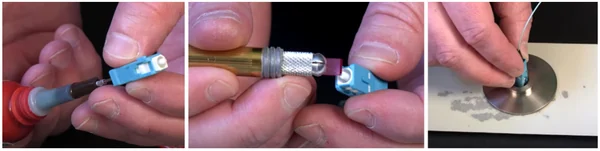
Figure 2: Polishing an SC epoxy connector.
The procedure requires carefully preparing the fiber, inserting it into the connector previously filled with adhesive, waiting for the necessary curing time, and then polishing it using different abrasive films of decreasing grit.
Although this technique continues to be used in certain facilities and laboratories, it has several drawbacks that have progressively reduced its presence in current projects.
The first is the lengthy installation time. Each connector requires multiple manual operations that demand precision and experience, which considerably increases the duration of the work when the number of fibers is high.
Added to this is the need for specific consumables, such as adhesives, polishing films, positioning tools, and cleaning materials, the cost of which must be included in the overall installation budget.
Another important aspect is the dependence on the installer's skill. The final quality of the connector is closely related to the precision of the polishing and the condition of the materials used. A small defect during any of the process phases can result in increased optical losses or insufficient return loss for certain applications.
In single-mode networks, where tolerances are particularly tight, achieving high return loss values through manual polishing is becoming increasingly difficult. This is especially evident when angularly polished connectors are required, such as SC/APC or LC/APC models, whose finish demands a much higher level of precision than that of conventional UPC connectors.
For this reason, when using this system, it is highly recommended to subsequently verify the quality of the termination using specific instrumentation. In addition to standard optical loss tests, the use of an optical time-domain reflectometer (OTDR) allows for checking the reflectance of each connection and detecting potential defects that would go unnoticed with a simple attenuation measurement.
Although it remains a technically valid solution in certain environments, the market trend is moving towards faster, repeatable methods that are less dependent on the installer's manual skill.
Mechanical splice connectors
Mechanical connectors represent a significant evolution over traditional field polishing techniques.

Figure 3: Splicing and termination of a mechanical fiber optic connector.
Its operation is based on precisely aligning the end of the installed fiber with a fiber already integrated into the connector itself.
Both are aligned by a high-precision mechanical system that maintains permanent alignment without the need for fusion splicing.
For many years, these connectors were considered a temporary solution or intended solely for quick repairs. However, improvements made by manufacturers to the alignment systems and the internal design of the connectors have significantly increased their long-term reliability and stability.
One of their main advantages is the speed of installation. Once the fiber is properly prepared, termination can be completed in just a few minutes without the need for adhesives or polishing.
Furthermore, by incorporating factory-polished ferrules, mechanical connectors offer a surface quality far superior to that typically achievable through manual polishing on-site.
This translates into more uniform insertion losses and improved return loss levels, reducing variability between terminations.
Nevertheless, to guarantee these results, it is essential to use high-precision preparation tools, especially a high-quality fiber cleaver capable of making perfectly perpendicular cuts.
Inadequate preparation of the fiber end can seriously compromise connection performance.
Therefore, although installation time is reduced, the success of the process still depends on proper fiber preparation and strict adherence to the manufacturer's instructions.
Fusion splicing: the current standard in professional installations.
Currently, fusion splicing is considered the most widely used termination system in professional fiber optic installations.
Various industry studies show that the vast majority of installers use pre-connectorized pigtails joined by fusion splicing or connectors with fiber fused directly onto the installed cable. This trend is primarily due to the high optical quality achieved and the increasing affordability of modern fusion splicers.
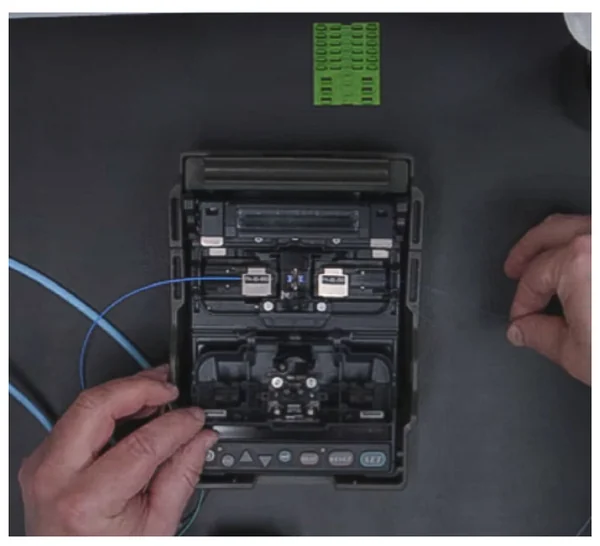
Figure 4: Using a fusion splicer.
Unlike mechanical connectors, where the fibers remain aligned but independent, fusion splicing physically joins both ends using a carefully controlled electric arc.
During the process, the fusion splicer automatically aligns the fibers using high-precision optical systems and generates an electrical discharge that melts the glass at both ends, forming a virtually continuous, permanent joint.
The result is a connection with extremely low losses, typically on the order of 0.1 dB or less, with the latest generation of fusion splicers commonly achieving values close to 0.05 dB under optimal conditions.
In addition to offering lower insertion loss, the physical joining of the fibers provides excellent mechanical stability and minimizes optical reflections, a particularly important aspect in high-performance single-mode networks.
Another significant advantage is that modern fusion splicers automatically estimate the splice loss immediately after the operation.
Although this estimate does not replace subsequent certification using measuring equipment, it provides the installer with an immediate reference point for the quality achieved and allows the splice to be repeated if the result does not meet the expected values.
Technological advancements have also greatly simplified the use of this equipment.
Modern fusion splicers incorporate automatic alignment systems, fiber type recognition, arc adjustment, high-resolution camera focusing, and specific software for different cable types.
All of this has significantly reduced the learning curve compared to previous generations and has made fusion splicing an accessible technique for a growing number of professionals.
Pigtails, SOC connectors and splice modules
The development of fusion splicing has also driven the emergence of different solutions designed to simplify the installer's work.

Figure 5: Splice module.
One of the most widespread methods is the use of pigtails, short lengths of fiber optic cable that incorporate a factory-polished and certified connector. The free end of the pigtail is fused to the fiber coming from the backbone cable, resulting in a high-quality connection without the need to terminate the connector directly onto the cable.
After fusion, the splice is protected by a heat-shrink sleeve that guarantees its mechanical strength and prevents potential damage during subsequent operations.
Another alternative is SOCs (Splice-On Connectors), which integrate a short segment of fiber pre-installed within the connector itself. The installer only needs to fuse this small segment to the fiber of the cable, obtaining a termination very similar to that of a factory-made connector.
These solutions allow combining the quality of pre-terminated connectors with the flexibility inherent in field installations.
Splice modules represent another significant advancement. Instead of using individual trays to house each splice protector, these modules integrate adapters, sleeve holders, and fiber management systems into a single unit.
This design results in a cleaner installation, simplifies subsequent maintenance, and reduces the risk of damaging adjacent fibers during future infrastructure upgrades or modifications.
Massive Fusion Splicing:
The increasing deployment of high-density links has driven the development of fusion splicers capable of simultaneously splicing multiple fibers.
While a conventional splice works with a single fiber, mass fusion splicers can join up to twelve fibers from a ribbon cable at once, drastically reducing the time required to complete large installations.
This capability is particularly valuable in data centers, hyperscale infrastructures, and applications using MPO connectivity, where the number of fibers can reach several hundred or even thousands.
In addition to the significant time savings, simultaneous splicing ensures high uniformity across all fibers and considerably improves installer productivity when working with very high-capacity infrastructures.
Comparison of the main fiber optic termination systems.
Each termination method has advantages and disadvantages that must be evaluated based on the specific needs of each project. There is no one-size-fits-all solution, so it is advisable to assess technical, economic, and operational aspects before making a decision.

Table 1 + Figure 6: Comparison of termination methods.

Insertion Loss and Optical Performance
One of the most important parameters in any fiber optic installation is insertion loss, that is, the attenuation introduced by each connection into the link.
Systems based on factory-terminated connectors, both mechanical and fusion-spliced using pigtails or SOC connectors, offer high uniformity in optical performance thanks to the quality control performed during manufacturing.
In the case of fusion splicing, there is an additional advantage: modern fusion splicers can estimate the loss immediately after splicing, allowing the operation to be repeated if the result does not meet expectations.
Conversely, connectors with adhesive and polishing depend more heavily on the installer's skill and the quality of the polishing process, which can result in greater variability between different terminations.
Planning and Installation Time:
The time required to complete a project is typically calculated based on the total number of fibers to be terminated.
Mechanical connectors are notable for the speed with which each termination can be completed, while fusion splicing systems have significantly reduced their execution times thanks to the automation built into modern fusion splicers.
When using splicing modules that integrate adapters, supports, and fiber management elements, installation becomes even simpler by eliminating numerous auxiliary operations related to preparing individual trays and managing the cable.
In large-scale projects, this reduction in assembly time can translate into significant labor cost savings.
Required Experience Level:
The installer's training and experience are another crucial factor.
Systems using adhesive and polishing demand high manual precision and extensive experience to achieve repeatable results. Any deviation during the process can affect the final quality of the connection.
Mechanical connectors simplify part of the procedure, although they still require proper fiber preparation and the use of precision tools.
In contrast, modern fusion splicers automate much of the process using assisted alignment systems, high-resolution cameras, and software specifically designed for different fiber types, significantly reducing the learning curve and facilitating consistent results.
Waste Management and Sustainability:
Sustainability is also becoming part of the selection criteria in numerous telecommunications projects.
Field-polished connectors generate a greater amount of waste due to the use of adhesives, abrasive films, and other consumables that are not usually reusable.
In contrast, modular splicing systems significantly reduce the amount of disposable materials and facilitate fiber organization throughout the installation's lifespan.
Some manufacturers have also begun using sustainable packaging made from cardboard and paper, progressively eliminating the use of single-use plastics in these types of products.
Equipment Costs:
The initial investment required also varies considerably between systems.
Solutions based on polished connectors require relatively simple tools, although they involve a continuous consumption of auxiliary materials.
Mechanical connectors require more precise preparation tools, especially professional-grade fiber cleavers.
Fusion splicing requires the purchase of a fusion splicer, the cost of which remains higher than that of the other tools. However, the price of this equipment has decreased significantly in recent years, facilitating its adoption even in medium-sized companies.
Furthermore, when working with loose-tube cables or ribbon structures, additional accessories are usually needed to properly prepare the fibers before splicing, such as fan-out kits or other branching elements.
Total Project Cost:
Although fusion splicing requires a higher initial investment, many installers believe the return on investment is becoming increasingly faster.
Reduced installation times, higher quality, and fewer subsequent issues often offset the initial equipment cost.
Furthermore, in installations using loose-tube cables, the additional time required to properly prepare the fibers before splicing should be factored in, as this step also contributes to the project's labor costs.
Maintenance and Future Expansions:
Enterprise networks rarely remain unchanged throughout their lifespan.
It is common to need to add new links, replace equipment, or reorganize parts of the infrastructure to adapt to evolving needs.
In this regard, modular splicing systems offer a significant advantage by allowing easy access to each individual fiber without affecting the other connections housed in the panel.
This organization considerably simplifies maintenance tasks, reduces the risk of errors during expansions, and improves the traceability of the entire infrastructure.
Cleanliness: a decisive factor for the performance of optical fiber
One of the most critical aspects — and, at the same time, one of the most undervalued — in any optical fiber installation is the cleanliness of the connectors.
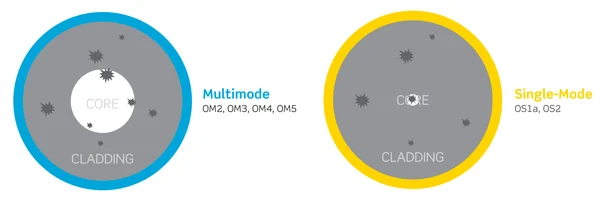
Figure 7: Dust in single-mode and multimode fibers.
A tiny dust particle placed on the surface of the ferrule can significantly increase insertion losses, increase reflectance, and even cause permanent damage to optical transceivers when high-power equipment is connected.
The situation is particularly critical with single-mode fibers.
While the core of a multimode fiber typically has diameters of 50 or 62.5 µm, the core of a single-mode fiber is approximately 8 to 9 µm.
By comparison, a single dust particle can measure between 2.5 and 10 µm, dimensions sufficient to partially block light in a single-mode fiber.
When compared to the thickness of a human hair, which typically ranges from 40 to 100 µm, it becomes easy to understand the extraordinary level of precision required for any optical connection.
For this reason, inspecting and cleaning connectors should be part of the standard procedure for any installation.
The widely accepted recommendation in the industry is very simple: inspect before connecting.
Whenever possible, inspection microscopes—preferably with a video screen—should be used to verify the condition of the connector without risk to the technician and subsequently confirm that the cleaning has been effective.
If contamination is detected, the connector must be cleaned using tools specifically designed for fiber optics and re-inspected before establishing the final connection.
This simple procedure prevents a high percentage of the problems that later appear during certification or network operation.
Pre-connectorized solutions: speed for high-density installations
Another increasingly used alternative is to use systems that are completely pre-connectorized at the factory.

Figure 8: Complete pre-connectorized solutions.
These kits arrive at the installation site with all connectors already assembled, polished, and certified, significantly reducing the time required to deploy high-capacity infrastructures.
Their use is particularly advantageous in data centers, smart buildings, and networks employing high-density MPO and LC connectors, where hundreds or thousands of fibers can be installed in a very short time.
Current systems even allow for on-site modification of certain parameters, such as polarity or the gender of some connectors, providing greater flexibility during commissioning.
However, pre-terminated solutions are not always the ideal option.
In projects where it is difficult to know the final cable lengths precisely or where frequent modifications, expansions, or distribution changes are anticipated, on-site terminations still offer superior flexibility.
An intermediate solution involves installing trunk cables pre-terminated at only one end and leaving the other end ready for termination during installation.
This combines the advantages of factory quality control with the adaptability needed to address the specific requirements of each project.
In summary,
the evolution of termination technologies has profoundly transformed how enterprise fiber optic networks are designed and installed.
While adhesive and polished connectors remain valid for certain applications, the market has shifted towards solutions that offer faster installation, improved optical performance, and much more consistent quality.
Mechanical connectors are an effective alternative when speed and simplicity are paramount, while fusion splicing has become the standard for installations where reliability, low losses, and long-term stability are priorities.
The progressive reduction in the price of fusion splicers, along with the continuous improvement in their automation and ease of use, has been a decisive factor in their expansion across all types of projects.
Regardless of the method chosen, proper planning, the use of quality tools, and the rigorous application of best practices for cleaning and inspection remain essential for achieving an optical infrastructure ready to meet the growing demands of current and future enterprise networks.
For more information on new solutions for fiber optic installers, contact the experts at






