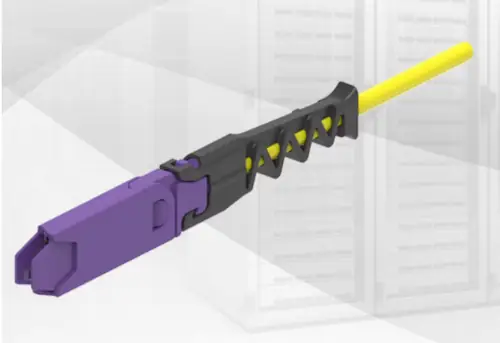
The reduction in available space on panels and chassis is becoming a key factor in the design of new AI infrastructures. In this context, VersaBeam Mini is geared towards applications such as Co-Packaged Optics (CPO), optical backbones, and front-panel connections for switches, where fiber density, thermal management, and ease of maintenance must be addressed together.
One of the key technical attributes of VersaBeam Mini is the integration of 16 fibers into a surface area of just 3.5 × 9 mm. This size reduction allows, according to Molex, up to 3,456 fibers to be placed in a standard 1RU panel, which is three times the density offered by VersaBeam 16 connectivity.
The use of 16-fiber bundles also has implications for infrastructure maintenance. Molex reports a ninefold reduction in the blast radius, which is the amount of connectivity potentially affected during an intervention. Technicians can thus isolate, redirect, or hot-swap specific 16-channel links without having to work on larger fiber bundles.
VersaBeam Mini also optionally incorporates a simultaneous insertion system for up to nine connectors, equivalent to a total of 144 fibers with a single connection operation. This approach aims to accelerate the initial deployment of racks while subsequently maintaining individual service capacity across groups of 16 channels.
The new connector uses Expanded Beam Optics (EBO) technology from the VersaBeam family. Instead of keeping the optical beam concentrated on only a small contact surface, this architecture expands the beam between the connectors, reducing its sensitivity to dust and certain debris.
According to data provided by Molex, this zero-touch EBO technology can reduce deployment, inspection, and maintenance tasks by up to 85%. The company also notes that the reduced need for cleaning and inspection allows certain operations to be performed without specialized optical equipment.
The architecture also includes inherent laser eye safety, a feature designed to protect personnel during maintenance operations and system upgrades.
Another objective of VersaBeam Mini is to facilitate the automation of optical assembly manufacturing. The system utilizes 3M's EBO ferrule groove design, eliminating the need for traditional guide pins and holes.
This design allows the use of high-speed robotic pick-and-place equipment during cable assembly. Reducing the number of components is also intended to simplify the supply chain and lower the cost of the bill of materials (BOM).
The increasing number of accelerators and connected GPUs within AI clusters is increasing bandwidth requirements and optical connection density in both scale-up and scale-out architectures.
VersaBeam Mini aims to address this scenario by combining high physical density, 16-fiber granularity, and maintainability. Its design allows for both front panel and optical backplane integration, and the company envisions its use in CPO systems, where the optics are placed closer to the switching ASIC to shorten electrical paths.