If the problem of dirty or damaged terminations is not systematically addressed, these defects can reduce network performance and eventually ruin an entire connection.
To ensure a common level of connector performance, the International Electrotechnical Commission (IEC) created Standard 61300-3-35, which specifies the quality verification requirements for connector terminations before connection. Designed to be a common reference for product quality, the IEC Standard supports product quality throughout the entire optical fiber lifecycle, but only when the standard is followed at every stage. Consequently, current best practices suggest performing a systematic, proactive inspection of each optical fiber connector before connection. Current research shows that this practice is eliminating the installation of contaminated fibers and improving network performance. However, uncontrollable variables, such as the technician's visual acuity and skill, ambient lighting, and viewing conditions, prevent manual inspection and analysis from being a 100% reliable and repeatable method for ensuring compliance with IEC standards. Furthermore, since manual inspection does not create a record of the inspection process, there is no practical quality certification at the time of installation. Because compliance with the IEC standard is the only way to achieve the high-connectivity networks with quality fibers expected today, this technical report proposes automating the inspection process by adding analysis software, developed according to the standard's evaluation criteria, to the practice of systematic proactive inspection. Automating the systematic proactive inspection process with software developed according to the IEC standard eliminates the variables associated with manual inspection, enables documented recording of connector termination quality at the time of installation, and allows for a 100% repeatable and reliable process. Combined, these benefits make automated connector termination inspection the most effective method for ensuring and certifying compliance with the IEC Standard throughout the lifecycle of fiber optic-related products, and for fulfilling the promise of next-generation networks.
IEC Standard 61300-3-35
IEC 61300-3-35 is a comprehensive set of quality requirements for fiber optic connector terminations to ensure good performance in terms of insertion and return loss. This standard contains evaluative requirements for inspecting and analyzing optical connector terminations and specifies particular criteria for different types of connections (e.g., SM-PC, SM-UPC, SM-APC, and multifiber connectors). For more details about this standard, copies of the copyrighted document are available for purchase at www.ansi.org. Search for “61300-3-35”. These criteria are designed to ensure a common level of performance in an increasingly challenging environment as fiber optic cable is used more and more in networks and handled by more technicians, many of whom may not be familiar with the importance of fiber optic connector end quality or possess the experience or technical knowledge required to properly evaluate it. This standard was designed to be used as a common quality reference between the supplier and the customer, and between work groups, in the following ways: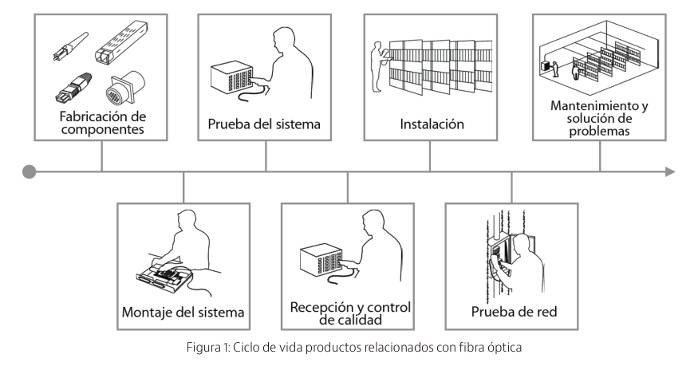 As a requirement from the customer to the supplier (for example, the integrator to the component supplier or the operator to the contractor);
as a guarantee of product quality and performance that the supplier will provide to the customer (for example, the manufacturer to the customer, the contractor to the network owner, or between work groups within an organization);
and as a guarantee of network quality and performance within an organization. As the various stages of the fiber optic product lifecycle are outsourced to different suppliers (as shown in Figure 1), this standard becomes even more important as it ensures optimized performance of today's dense networks.
The development of the IEC Standard
The quality values used in the IEC Standard are the result of years of extensive testing on scratched, damaged, or dirty connectors, conducted by a coalition of industry experts, including component suppliers, contract manufacturers, network equipment providers, test equipment providers, and service providers. This work has been previously published in several documents, as noted in the References section of this report. Understanding the variables and limitations of visual and manual inspection, Viavi Solutions, a manufacturer of measurement and testing solutions for fiber optic connections, contributed its automated software for objective analysis and inspection, FiberChek2™ (as shown in Figure 2), to the IEC for use in developing the visual inspection standard. Automating the evaluation process using research-derived parameters from tests conducted by the aforementioned coalition of industry experts provided the IEC with a repeatable quality standard that ensures a common level of performance, resulting in a positive impact on both product and network performance. After more than eight years of testing on a constantly growing database of optical fibers and devices (e.g., SM, MM, Ribbon, E2000, SFP/XFP, bend-optimized fibers, lenses, and other interfaces), combined with widespread industry use by component manufacturers, integrators/components, original equipment manufacturers, third-party installers, and service providers, Viavi's software is the only proven, automated, objective inspection tool that ensures IEC compliance at every stage of the 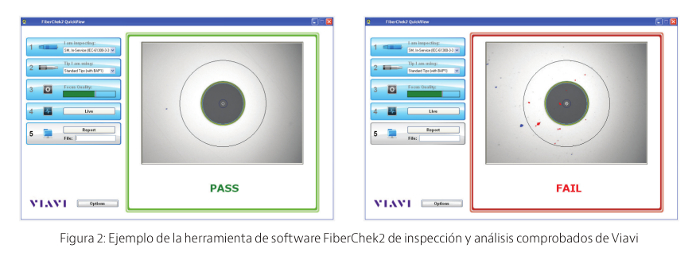 optical fiber lifecycle. Evidence of this is the fact that three of the top five cable manufacturers in the United States, along with six of the largest optical component manufacturers, five of the largest network equipment suppliers, and five of the world's leading network service providers, are currently using this software tool, making FiberChek2 the current global industry standard for automated, objective inspection of optical connector ends.
The IEC Standard criteria require the user to know the exact location and size of surface defects (e.g., scratches, indentations, and dirt) on the optical connector termination. As a result, compliance with the IEC Standard (or the customer's specification) can only be tested and certified through the use of automated inspection and analysis software. The combination of common requirements (the IEC Standard) and automated inspection and analysis (FiberChek2) has significantly impacted product quality throughout the supply chain. This is enabling improved repeatability and stability in analysis and inspection throughout the optical product lifecycle, ensuring consistent product performance regardless of the quantity and experience of suppliers and technicians involved in the manufacturing, installation, and network management processes.
 Proactive inspection model: Step one. Towards compliance with IEC standards
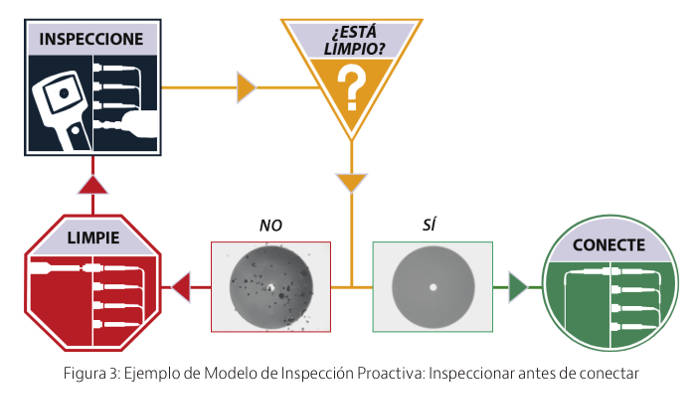
Despite its role in the development of the IEC Standard and its implementation by industry leaders, the use of automated inspection and analysis software is not yet widespread in the fiber optic industry. To enable compliance with the Standard even when using only manual visual inspection equipment, the IEC and industry leaders are supporting the promotion of best practices for handling optical fibers. One example of such an educational effort is the proactive inspection model developed and promoted by optical equipment manufacturer Viavi, "Inspect Before You Connect" (IBYC), as shown in Figure 3.
The simple, four-step IBYC model, which is compatible with and required by the IEC Standard, effectively guides technicians with varying levels of expertise in the proper implementation of systematic proactive inspection.
Step 1. Inspect: Use the microscope to inspect the fiber. If the fiber is dirty, proceed to step 2. If the fiber is clean, proceed to step 4.
Step 2. Clean: If the fiber is dirty, use a cleaning cloth to clean the fiber termination.
Step 3. Inspect: Use the microscope to re-inspect and verify that the fiber is clean. If the fiber is still dirty, proceed to step 2. If the fiber is clean, proceed to step 4.
Step 4. Connect: If both connectors (male and female) are clean, you can connect them. Consistent use of the IBYC model ensures that proactive inspection is always performed correctly and that fiber terminations are clean before joining connectors, eliminating the installation of dirty or damaged fibers in the network and optimizing network performance. As a result, the IBYC model has been incorporated into the manufacturing procedures of most of the world's leading fiber optic organizations and, in addition to raising awareness of this process, has helped make it a routine practice worldwide.
Automated inspection and analysis Scope and certification of compliance with IEC standards
Even with the aid of the IBYC model, manual inspection using only a video microscope can be challenging, as it relies on the technician's skill, which can affect connector quality and network performance. Since it depends on a technician's visual acuity or skill, along with variables such as visibility and ambient lighting, manual inspection and analysis are not 100% reliable, repeatable, or certifiable. Because the manual inspection process does not produce a visual record of the 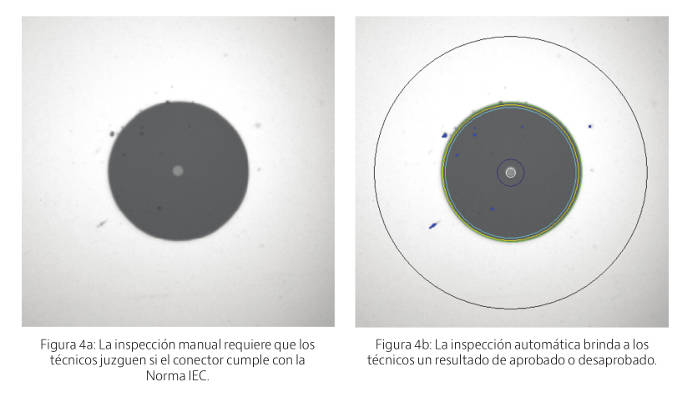 connector termination condition, it is neither reliable nor practical to certify compliance at this point in the installation through images or reports, as shown in Figure 4a. To ensure compliance with IEC standards, the most effective available method is automated inspection of fiber optic connector terminations using inspection and analysis software designed according to the IEC standard's evaluation criteria. Thanks to this software, technicians of all skill levels can achieve both compliance and certification through images and reports, as shown in Figure 4.
Using this software, automated inspection and analysis can produce a visual record of the condition of connector terminations, as shown in Figure 5 (which can then be used in reports and archived for future reference). As a result, automated inspection and analysis offer several clear advantages over subjective inspection:
They eliminate variations in results;
they certify and record product quality at the time of inspection;
they allow technicians of all skill levels to reliably and systematically certify quality;
they make advanced evaluation criteria easy to use;
and they improve product and network performance and capacity. By using a fiber optic inspection and analysis software tool pre-loaded with IEC Standard specifications, such as Viavi's FiberChek2 software, any technician can efficiently perform the following activities: 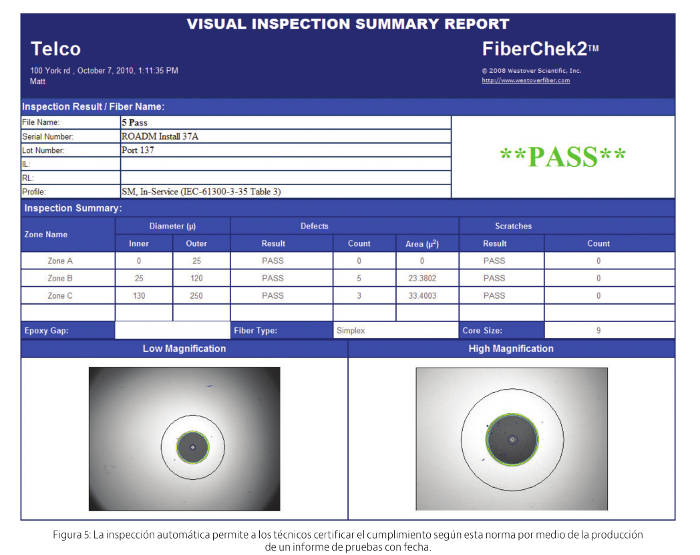 Inspect and certify compliance with IEC 61300-3-35 or other customer-specified standards at each stage of the fiber optic product lifecycle with the push of a button.
Implement simple validation proficiency tests without requiring qualitative judgment.
Generate detailed, archiveable analytical reports.
Conclusion: Business impact of automated connector termination analysis
The combination of common requirements (the IEC Standard) and automated inspection and analysis software (FiberChek2) has positively impacted product quality throughout the supply chain. The business impacts of reliable and repeatable automated inspection and certification of fiber optic connectors include:
Assured and repeatable product quality through quantification of the condition of fiber optic connector terminations in installation; Guaranteed customer satisfaction and supplier protection through reliable documentation of connector termination quality; A competitive advantage for component and system suppliers and installation contractors, who can cost-effectively document termination quality; A common and repeatable system that provides correlation throughout the supply chain; and Easy implementation of customized requirements analysis. Combined, these benefits make automated inspection of connector terminations the most effective method for ensuring and certifying compliance with the IEC Standard throughout the lifecycle of fiber optic-related products, and for fulfilling the promise of next-generation networks.
Author: Matt Brown, Director of Product Management at VIAVI
Article provided by Grupo Cofitel
References
1. “Qualification of Scattering from Fiber Surface Irregularities,” Journal of Lightwave Technology, vol. 20, No. 3, April 2002, p. 634−637.
2. “Optical Connector Contamination/Scratches and its Influence on Optical Signal Performance,” Journal of SMTA, vol. 16, no. 3, 2003, p. 40−49.
3. “At the Core: How Scratches, Dust, and Fingerprints Affect Optical Signal Performance,” Connector Specifier, January 2004, p. 10−11.
4. “Degradation of Optical Performance of Fiber Optics Connectors in a Manufacturing Environment,” Proceedings of APEX2004, Anaheim, California, February 19 and 26, 2004, p. PS-08-1-PS-08-4.
5. “Cleaning Standard for Fiber Optics Connectors Promises to Save Time and Money,” Photonics Spectra, June 2004, p. 66−68.
6. “Analysis on the effects of fiber end face scratches on return loss performance of optical fiber connectors”, Journal of Lightwave Technology, vol. 22, no. 12, December 2004, p. 2749−2754.
7. “Development of Cleanliness Specification for Single-Mode Connectors,” Proceedings of APEX2005, Anaheim, California, February 21 and 26, 2005, p. S04-3-1, 16.
8. “Keeping it clean: A cleanliness specification for single-mode connectors,” Connector Specifier, August 2005, p. 8−10.
9. “Contamination Influence on Receptacle Type Optical Data Links,” Photonics North, 2005, Toronto, Canada, September 2005.
10. “Development of Cleanliness Specifications for 2.5 mm and 1.25 mm ferrules Single-Mode Connectors,” Proceedings of OFC/NFOEC, Anaheim, California, March 5 and 10, 2006.
11. “Standardizing cleanliness for fiber optic connectors cuts costs, improves quality,” Global SMT & Packaging, June/July 2006, p. 10−12.
12. “Accumulation of Particles Near the Core during Repetitive Fiber Connector Matings and De-mattings,” Proceedings of OFC/NFOEC2007, Anaheim, CA, March 25-29, 2007, NThA6, p. 1−11.
13. “Development of Cleanliness Specifications for Single-Mode, Angled Physical Contact MT Connectors,” Proceeding of OFC/NFOEC2008, San Diego, February 24 and 28, 2008, NThC1, p. 1−10.
14. “Correlation Study between Contamination and Signal Degradation in Single-Mode APC Connectors,” Proc. SPIE, Vol. 7386, 73861W (2009); doi:10.1117/12.83754