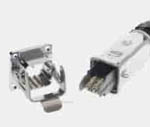
 Optical SFP transceivers are installed as fiber optic interfaces in outdoor antenna units and remote radio heads (RRHs). The term SFP (Small Form Factor Pluggable) refers to powerful, small-sized media converters that act as an interface between electrical and optical signals in both directions of an optical network. The design of SFP modules facilitates the replacement of these transceivers during maintenance. However, they must possess certain properties and be robust enough to withstand extreme conditions in continuous outdoor use.
Environmental Resistance:
The lifespan of a base station is approximately 15 years. Some SFP transceivers are likely to fail and need to be replaced during that time. It should be possible to replace them without opening the remote unit's housing, and the replacement must be a quick and simple operation because the work may have to be carried out on outdoor transmission towers at considerable heights. Special connectors are needed for these applications. To be truly robust, a connector must meet two essential requirements. First, it must compensate for the tolerances of the optical LC contacts at the cable end. Second, the connector materials and finishes must be suitable for outdoor use. The HARTING Han® 3 A SFP connector is the ideal solution. The Han® 3 A SFP can be directly connected to an optical SFP transceiver in the latest generation of mobile communication stations.
It also guarantees a secure connection with IP 65 / IP 67 protection rating. The list of outstanding features includes a rugged design, tolerance compensation, and ease of installation.
Tolerance Compensation:
“The properties of SFP transceivers are defined within the Multi-Source Agreement (MSA). This agreement was created to ensure compatibility between transceivers supplied by different manufacturers. Unfortunately, neither the optical axis in the “y” direction nor the position of the transmitter/receiver element in the “z” direction is defined by the MSA. Consequently, transceivers produced by different manufacturers may deviate by several millimeters in the “z” direction and by more than one millimeter in the “y” direction. Because the optical contacts must be aligned very precisely to minimize attenuation at the connection, the connector must offer adequate tolerance compensation.”
During the design of the Han® 3 A SFP, a special solution was defined for this problem. During cable assembly, the two LC contacts are inserted through the base of the Han® 3 A and held in position by an insulating body. The spring insulator can compensate for millimeter tolerances in the connector insertion direction. A hinge provides sufficient freedom of movement for the insulator to compensate for tolerances on the optical axis. An external collar protects the delicate optical contacts and ensures pre-alignment. The Han® 3 A SFP can be connected directly to a transceiver even under the most challenging conditions.
Materials and Finish:
This new connector is designed for outdoor use and therefore must offer excellent protection throughout its service life in all weather conditions. Harmful gases such as ozone, along with ultraviolet radiation and corrosive precipitation, are the main risk factors. The reinforced surface of the Han® 3 A SFP's cast base has a special nickel-plated finish. The enclosure is made of stainless steel. The gaskets exposed to ozone and ultraviolet radiation are made of materials such as EPDM, which maintain their elasticity for many years.
Advantages of the Han® connector:
- Suitable for outdoor applications.
- Easy to replace during maintenance.
- New connection technology for FTTA (fiber to antenna).
Author: Rainer Bussmann, Senior Product Manager, Germany, HARTING Technology Group.