


Background
Advances in CPU processing power have significantly increased the data processing capabilities of servers. Now, with improved virtualization technology allowing a single CPU to run multiple processes, the volume of data passing between CPUs and between CPUs and peripherals has increased dramatically. While today's servers use optical interconnects capable of achieving data rates of 10 Gbps per channel, future expectations are for servers capable of reaching 25 Gbps. Furthermore, as shown in Figure 1, optical interconnects are also expected to be used not only for data communication between servers but also between boards within a server, since higher data rates are difficult to achieve with electrical communications.
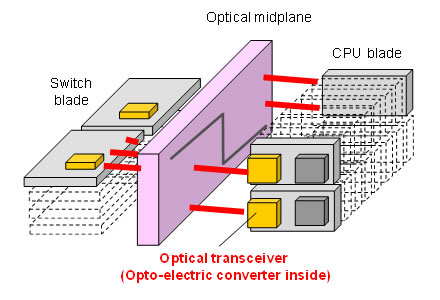 Implementing optical interconnects within a server requires an optical transceiver that converts electrical signals into optical signals. Current optical transceivers have achieved data rates between 10 and 14 Gbps, so the speed of optical transceivers has become a barrier to achieving data rates of 25 Gbps. Furthermore, current optical transceivers are physically bulky, making them difficult to place near CPUs or other devices. This is problematic because the electrical signal traveling between the device and the optical transceiver encounters losses in the transmission line and interference that increases with the length of the electrical circuit. This degrades signal quality and makes it more difficult to increase speeds.
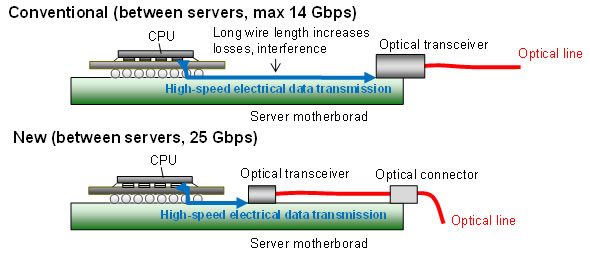 New transceiver developed
To succeed in producing a compact optical transceiver with the interconnect optics required for high-speed, high-bandwidth data transmission, Fujitsu Laboratories has developed an opto-electrical converter to pass electrical (optical) signals to optical (electrical) signals through an optical device.
Technology details.
1. High-speed circuit technology
Fujitsu Laboratories was able to increase speed through circuitry technology in the integrated circuits (ICs) that run optical devices. This allowed them to make the optical signal waveforms rise and fall more sharply, even in low-cost optical devices with insufficiently fast response times. They also implemented circuitry technology that suppresses multiple reflections that degrade the electrical signal waveform. This resulted in an increase in data rates from the current 10-14 Gbps to 25 Gbps per channel.
2. Compact Optical Coupling Technology
Conventionally, efficient optical signal transmission between opto-electrical converters and optical fiber (optical coupling) required an optical coupling unit consisting of a lens component and an optical connector (Figure 3). However, the lens component was large and expensive. This new design comprises an opto-electrical converter with a flexible printed circuit board equipped with optical devices and integrated circuits, enabling a compact optical transceiver. Furthermore, Fujitsu Laboratories has also developed a cost-effective film-like sheet lens that stacks on the underside of the flexible printed circuit board, overcoming the aforementioned limitations.
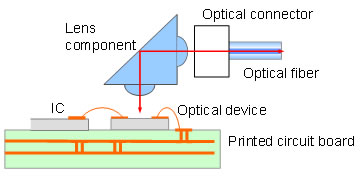
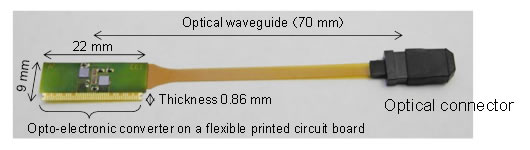
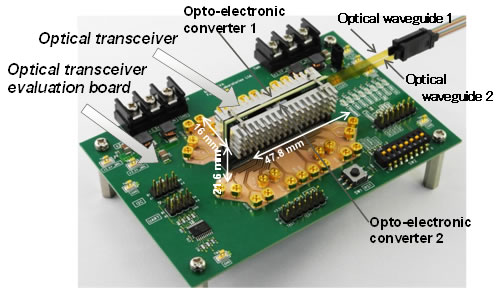
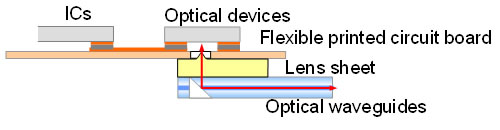 These technologies were used in a prototype 4-channel x 25 Gbps opto-electrical converter. Measuring 22 mm x 9 mm x 0.86 mm (including onboard electrical and optical waveguide components), the lens component is less than one-tenth the size of conventional lens components in opto-electrical converters, while the overall unit has been reduced to one-third of the conventional size. Taking advantage of its slim form factor, Fujitsu Laboratories developed optical transceivers with the prototype opto-electrical converters mounted on either side. Both the transmitters and receivers utilize eight channels, with a compact size of 47.8 mm x 16 mm x 21.6 mm, allowing adjacent devices, such as the CPU on the printed circuit board, to occupy a smaller footprint.
Results
These technologies achieve 25 Gbps per channel in a compact and cost-effective manner, the capacity required for next-generation interconnections. This paves the way for high-speed, high-bandwidth communications in servers.
Plans for the future
Fujitsu Laboratories continues its research and development to apply this technology to high-performance servers, aiming for its practical use in servers within three years. It also plans to extend this technology more broadly to enhance the performance of computing and communications equipment.






