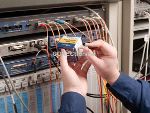
Dry cleaning
Cleaning connector ends without solvents might not be ineffective, but it can actually cause more problems. Dry cleaning is only effective on one type of contaminant: skin oils. For all other contaminants, dry cleaning is dangerous. In the case of dust and debris, the lack of solvent can cause particles to scratch or chip the connector end when wiped away. Using a specialized solvent effectively lubricates the particles and lifts them away from the end surface without causing damage as they are absorbed by an antistatic cleaner. Furthermore, dry cleaning can generate a static charge that can attract more dust to the end while the connector is plugged into the port. Fluke Networks' solvent is oxygenated; therefore, it not only prevents the generation of additional charge but also neutralizes existing static charges.
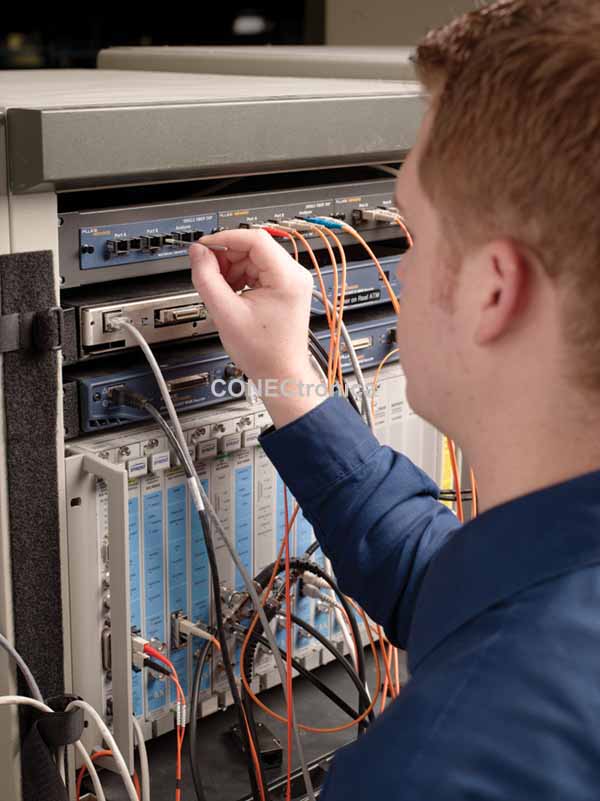 Wet cleaning:
Cleaning with a pre-soaked cloth or with too much solvent leaves a trace of liquid at the end, which also causes problems. When the excess solvent dries, it can leave a film of dissolved contaminants that were not properly removed. In addition, residual isopropyl alcohol can leave a "halo" as it dries, causing not only a dulling effect but also making it very difficult to remove. No trace of solvent should remain after cleaning.
air and cleaning sprays
are ineffective and should not be used for cleaning hose ends. All cleaning sprays do is scatter large particles. This might be effective on a hose, but inside a port, it can cause those same particles to settle elsewhere. Sprays are ineffective against smaller, statically charged particles and are useless for cleaning greasy contaminants such as water-repellent gels or body oils. Finally, sprays often emit a propellant gas that becomes a new contaminant, requiring another effective cleaning process for its removal.
When you think new equals clean:
Don't fall into the trap of assuming that the ends of patch cables or connectors fresh from the factory are clean just because they're new and have dust caps. While these caps are excellent at preventing damage to the end, they can be a source of contamination. The plastic used to create dust caps generates residue as the plasticizers break down over time; in addition, the surface of the cap may contain substances that, during the high-speed production process, have separated from the mold. Don't be surprised if you find a contaminated end when you remove a protective cap.
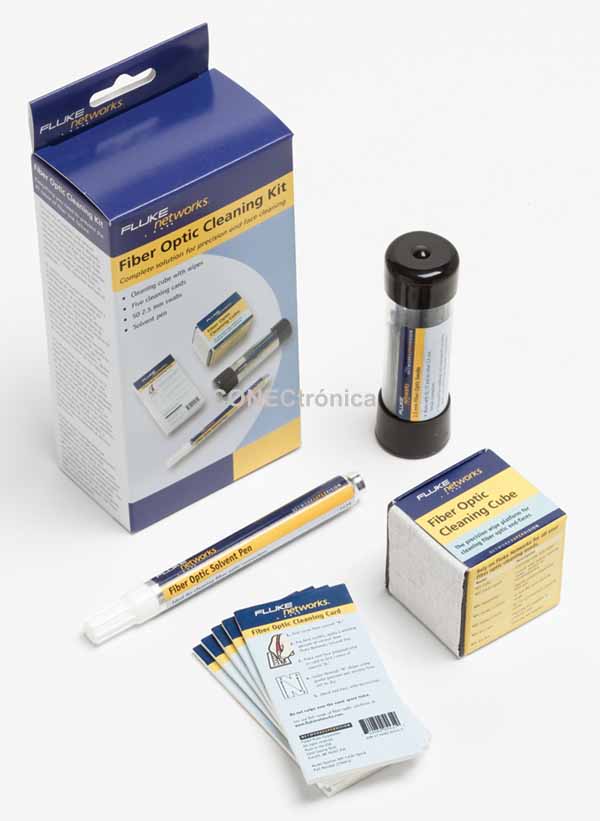 For reliable and repeatable end cleaning, always use Fluke Networks tools and follow the recommended process for both dry and wet cleaning.
Cleaning Instructions
: First, inspect all ends. If they are clean, they can be inserted as is. However, it is very likely that they have accumulated some contamination and should be cleaned before insertion.
To clean patch cables with a cleaning card:
1. Remove the plastic cover from a cleaning area.
2. Apply a minimal amount of solvent to the first corner of the cleaning area.
3. Holding the connector perpendicular to the card, shake the end away from the wet spot to a dry area.
4. Inspect again to ensure it is completely clean. If necessary, repeat these steps on a new cleaning area.
To clean patch cables with a cleaning bucket (Figure 1):
1. Remove a clean rag from the cleaning bucket.
2. Apply a minimal amount of solvent to the edge of the rag.
3. Holding the connector perpendicular to the card, shake the end away from the wet spot to a dry area.
4. Inspect it again to ensure it is completely clean. If necessary, repeat these steps on a fresh section of the cloth in the bucket.
To clean inside the ports with swabs (Figure 2):
1. Remove a clean cloth from the cleaning bucket.
2. Apply a minimal amount of solvent to the cloth.
3. Touch the damp spot of the cloth with the swab for 3 seconds to absorb a minimal amount of solvent. A moistened swab works better than a wet one.
4. Insert the swab into the port and twist it a few times with light pressure.
5. Use a dry swab after using the moistened one, following the same procedure, to remove any remaining solvent from the end and alignment sleeve.
See Figures 1 and 2.
*Remember: Applying solvent directly from the pencil to the swab will result in excess solvent.
Special Solvent:
Isopropyl alcohol (IPA) was long used to clean fiber optic ends; however, there are now specialized solvents that are far superior, such as Fluke Networks Fiber Optic Solvent Pen. The most important feature of this specialized solvent is that it is more effective than isopropyl alcohol at dissolving all contaminants, especially non-ionic compounds like water-repellent gels and lubricants. You will see a higher degree of cleanliness every time, with all contaminants.
In addition, our solvent has a lower surface tension than isopropyl alcohol, allowing it to coat particles and residue, lifting them off the end surface for easy removal with a cloth or swab.
 Many small particles carry a static charge that attracts them to the end cap. Unlike isopropyl alcohol, this solvent is oxygenated to neutralize this charge, allowing the charged particle to be removed and preventing further particles from being attracted to the end cap.
When cleaning end caps inside ports or equipment, the evaporation rate of solvents increases significantly, as it becomes more difficult to ensure complete solvent removal. Fluke Networks' specialized solvent has an evaporation rate that is appropriate for the time it takes to work and disappears before mating. It evaporates much faster than isopropyl alcohol.
Isopropyl alcohol is highly hygroscopic and therefore attracts water vapor, which then dries on the end cap and becomes residue, sometimes giving it a "halo" appearance. Fluke Networks' solvent avoids this problem.
Fluke Fiber Optic Cleaning Kit
Cleaning Cards: Contains 12 individually sealed, ready-to-use cleaning zones; perfect for troubleshooting.
Cleaning Cube: The anti-static wipes inside the mini-cube can clean up to 500 fiber optic ends.
Fiber Optic Solvent Pen: The pen's dispenser allows for precise application of the special fiber optic solvent. The solvent is extremely effective and does not damage the plastic.
2.5 mm Swabs: Used with the solvent, these allow you to clean the ends inside ST, SC, FC, and all 2.5 mm ports.
1.25 mm Swabs: Used with the solvent, these allow you to clean the ends inside LC and MU ports.
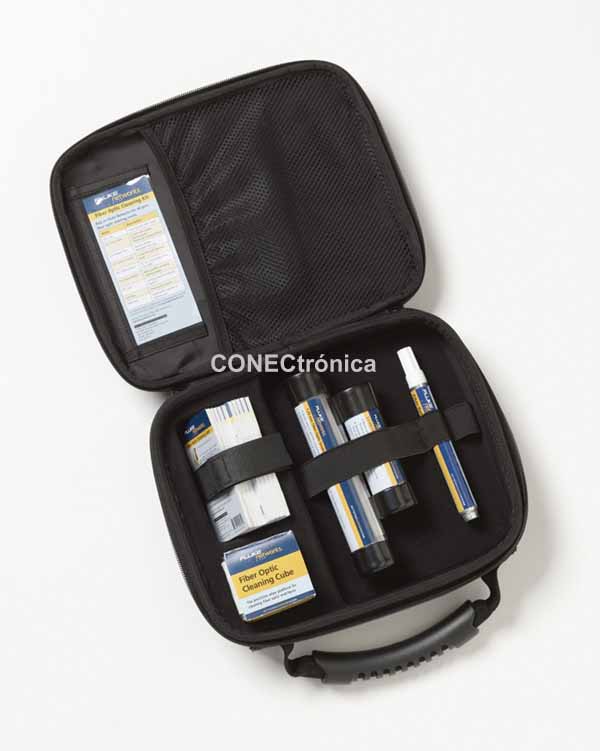
Carrying Case: The hard case (Figure 4) conveniently stores all the cleaning tools, has room for additional accessories, and includes all the information needed to order more accessories.
Author: Article provided by Fluke Networks