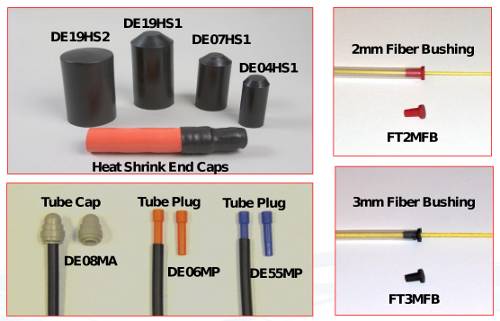
 When installing tube cables, always ensure that the ends of the tube cables are sealed to prevent dirt, dust, mud, water, or any other contaminants from entering the tubes. If the tubes are not sealed and the inside contains contaminants, the end result will be difficulties with the blown fiber bundles. The fiber bundles can still be installed, but at a cost. The main "negative" effects are that more gas will be needed because higher blowing pressure is required to overcome the increased friction and drag forces experienced between the inside of the "dirty" tube and the polyethylene fiber bundle's (PEF) cover. You will also experience a lower blowing speed, resulting in longer downtime. If the tubes are not contaminated, there is a procedure for cleaning them, but it will require time, effort, and labor. The key is to prevent contamination in the first place.
Sealing Open Ends of Cable Tubes:
Heat-shrinkable end caps are available for this purpose and come in four (4) different sizes. These heat-shrinkable end caps should be installed while the cable tube is in storage or at the job site. They should also be left on the end of the cable tube throughout the installation process, especially when installing in wet pipes, conduits, or other similar conditions. To install the heat-shrinkable end cap, you will need a standard 1,000-watt heat gun to reduce the size of the end cap. Sometimes it is not convenient to have a heat gun on hand at the job site, and in that case, one method is to use electrical tape to secure the heat-shrinkable end cap to the cable tube. This way, it can be reused for future installations. Another sealing method is to inject RTV/silicone into the open ends of the tubes, applying complete coverage. Then, wrap the end of the tube with a generous layer of electrical tape. The combination of RTV/silicone and electrical tape will keep water and dirt out of the cable tube. For indoor installations where the cable conduit is not in a damp environment, a generous layer of duct tape will suffice. The same applies when the cable conduit is in storage or in transit to the job site; at a minimum, duct tape will seal the conduit.
Sealing the ends of empty tubes
Tube plugs and tube caps are available for this purpose. A tube cap is a push-fit device that positively seals the open end of an empty tube and is suitable for both indoor and outdoor use. Properly installed, they can withstand up to 200 psi of air pressure and will not pop off. Tube caps are the preferred sealing device for outdoor applications.
Tube plugs are simple plastic plugs used to seal the open end of an empty tube. Installation is accomplished by firmly inserting the plug into the tube, and their use should be limited to indoor applications only, as they are not push-fit devices like tube caps and lack the locking features of caps. Two sizes of plugs are available. The orange plug fits all 6 mm tubes. The blue plug has a slightly smaller diameter and is intended for use with TCxxTP2 Plenum Cover cable tubes, which have the smallest 5.5 mm tubes.
Sealing Full Tubes:
Fiber bushings are available for sealing the end of a full tube. Fiber bushings are tapered rubber pieces with a groove for easy installation or removal of a fiber bundle. Red bushings are used to seal around 2 mm OD fiber bundles. Black bushings are used to seal around 3 mm OD fiber bundles.