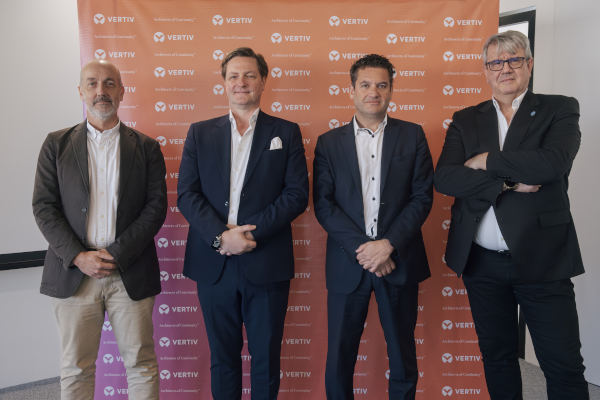
This agreement is an extension of the collaboration established in 2018, which began as a pilot project to reduce energy consumption at one of Telefónica's most important data centers in Madrid. That initiative was a success, achieving a 20% reduction in total energy consumption. Under Phase I of the agreement, the collaboration will be expanded to cover 40 of Telefónica's most critical network sites across Spain.
The Vertiv and Telefónica agreement includes an innovative model called "Energy Savings as a Service" (ESaaS), which requires an experienced technology partner to invest in, operate, and maintain the critical infrastructure. The main objective of this model is to minimize energy consumption and, consequently, the carbon footprint. In this case, Vertiv offers a turnkey solution, upgrading Telefónica's most important facilities with efficient critical infrastructure services and managing their performance and maintenance.
One of the key aspects of the agreement is that Vertiv will manage the maintenance to ensure optimal equipment efficiency across all facilities. Vertiv is responsible for performing corrective and preventive maintenance, using cutting-edge technology, and has committed to introducing artificial intelligence (AI) to monitor data and equipment, enabling proactive measures against potential failures. As a result, the technology's lifecycle will be extended, and the energy efficiency of Telefónica's network will be increased.
Pablo Ledesma, Director of Engineering and Operations for Networks, Services, and IT at Telefónica Spain, says, “There are numerous challenges in this project, and one of them is precisely guaranteeing differentiated infrastructure maintenance. We also want to improve the climate control systems throughout the building, which houses the equipment that provides Telefónica services to our customers, such as fiber optic and mobile, to achieve the maximum possible energy savings. Furthermore, this project provides access to the most advanced cutting-edge technology for the challenges of implementing cloud and edge services.”
Karsten Winther, President of Vertiv in Europe, the Middle East, and Africa, states: “In addition to the advantages in terms of reducing the carbon footprint, this model also has a positive financial impact for the company. Telefónica expects to reduce both its energy costs and its carbon footprint without having to dedicate time to this area, allowing it to invest 100% of its resources in its core business.”
In addition to the exchanges already optimized during the last months of 2023, Vertiv will continue optimizing more than 10 Telefónica buildings across Spain during 2024: from Madrid to Barcelona, including Zaragoza, A Coruña, Málaga, and Valencia, among others. The results obtained are in line with the savings plan, and work is underway to expand the scope to other Telefónica group companies.
“Vertiv is an experienced partner with a deep understanding of our infrastructure, making them the ideal partner for this innovative project. This initiative will help us meet our energy and emissions targets: improving our energy efficiency to reduce our energy consumption per unit of traffic (MWh/PB) by 90% by 2025, cutting Scope 1+2 emissions by 90% by 2030, and achieving net-zero emissions across our entire value chain by 2040. We understand that the best kilowatt is the one we don't use. We don't want to stop here, so we will extend this successful project to as many locations as possible,” commented Enrique Blanco, Global CTIO at Telefónica.
"This pioneering model, successfully implemented in collaboration with Telefónica, is replicable in other locations and countries so that other organizations can benefit from greater efficiency and cost savings. This puts Vertiv in an ideal position to help companies reduce their energy consumption by providing them with state-of-the-art critical infrastructure, technology, and experienced talent," concludes Karsten Winther.