The development was carried out as part of the "Research and Development Project for Enhanced Infrastructures for Post-5G Information and Communication Systems (1)" (2) commissioned by Japan's New Energy and Industrial Technology Development Organization (NEDO).
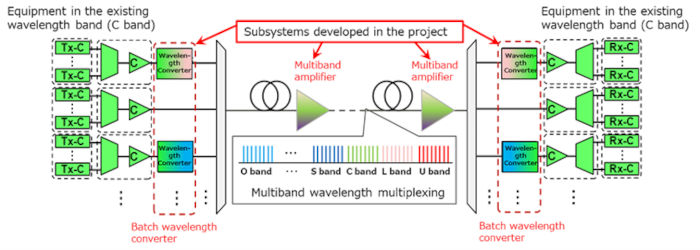
Figure 1: Image of the system applying high-capacity multiband wavelength multiplexing transmission technology
Project Background
Amidst the growing demand for services leveraging IoT, artificial intelligence (AI), and big data analytics, NEDO aims to strengthen Japan's post-5G information and communications systems development and manufacturing base by developing core technologies for these systems. As part of this effort, from October 2020 to October 2023, Fujitsu and KDDI Research are participating in a project to improve the performance of post-5G optical networks. Conventional commercial fiber optic communication networks use single-mode fibers, in which light passes only through the center of the fiber, and utilize the C-band (wavelength band: 1530 nm to 1565 nm) (3) as the optical network signal transmission band. However, as the amount of communications traffic increases, the C-band alone is expected to have insufficient transmission capacity. To increase fiber transmission capacity, the two companies set out to increase the wavelength band used from the C band to the L band (1,565 nm to 1,625 nm), the S band (1,460 nm to 1,530 nm), the U band (1,625 nm to 1,675 nm) and the O band (1,260 nm to 1,360 nm), with the aim of making it multiband.
Project results
As part of the project, Fujitsu built a simulation model that accounts for transmission performance degradation factors in multiband transmission, enabling the design of multiband wavelength multiplexing systems. The simulation model reflects the results of measurements of commercial optical fiber characteristics and transmission parameters obtained through verification of the experimental integrated multiband amplifier/wavelength converter system. With this model, Fujitsu has performed high-precision simulations that reduce actual measurement errors to 1 dB, allowing for the consideration of interband interaction and transmission performance degradation.
KDDI Research has made it possible to use twice the frequency bandwidth in the O-band compared to the conventional C-band, a capability never before employed in high-density wavelength-division multiplexing (DWDM) transmission (4). Combining both technologies, the two companies conducted real-world transmission experiments using existing optical fibers and demonstrated wavelength-division multiplexed multiband transmission (transmission distance 45 km) in the O, S, C, L, and U bands (Figure 2), proving that wavelength-division multiplexing is possible with a multiplicity of wavelengths 5.2 times greater than that of conventional C-band-only transmission. The two companies also confirmed wavelength-division multiplexed multiband transmission (transmission distance 560 km) in the S, C, L, and U bands through simulation.
The main findings of the research are described below:
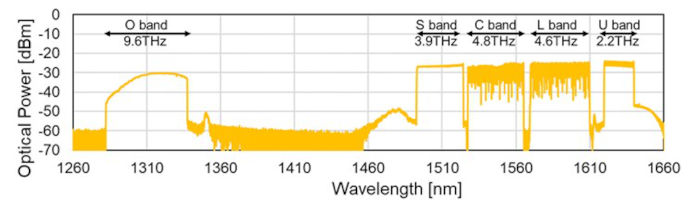
Figure 2: Optical spectrum received from a single installed fiber when the O, S, C, L and U bands are transmitted simultaneously.
1. Establishment of Dense Wavelength Division Multiplexing (DWDM) Multiband Transmission Technology.
In the conventional design of a C-band transmission system, parameters that could be treated as constants would not present practical problems. However, in the case of multiband transmission in the S-band + C-band + L-band + U-band, the difference in transmission performance between wavelength bands cannot be ignored, and a design that takes wavelength dependence into account is required. For example, nonlinear degradation factors become more pronounced as the optical power input to the transmission line increases and as the transmission distance increases, thus limiting transmission performance. In particular, stimulated Raman scattering (5), cross-phase modulation (6), and four-wave mixing (7) caused by the interaction of light with multiple wavelengths are prominent at high wavelength multiplicities, significantly impacting the transmission performance of multiband wavelength-division multiplexing systems.
In this project, Fujitsu and KDDI Research established a design method for multiband wavelength-division multiplexing systems by constructing a simulation model that accounts for the interaction between different bands and transmission performance degradation factors. Furthermore, since the wavelength-division multiplexing (WDM) optical signals in the S and U bands are generated using all-optical signal processing technology from optical signals in the C and L bands, respectively, there is no need for dedicated S and U band transmitters and receivers. The integration of these technologies has enabled DWDM transmission in the S band + C band + L band + U band using coherent transmission technology, which leverages the phase of light, thus allowing for high-speed, high-capacity communication.
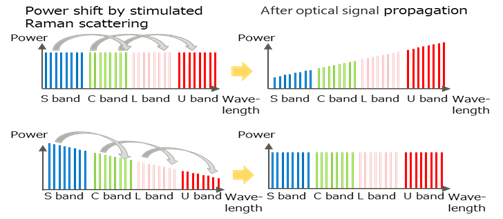
Figure 3: Optical power transition of the signal between multibands using stimulated Raman scattering.
Top: The uncontrolled case. Bottom: The controlled case to ensure uniform optical power distribution after fiber propagation.
2. Establishment of coherent DWDM transmission technology in the O band
Traditionally, coherent transmission technology tends to distort O-band transmission signals due to the influence of other optical signal components. Furthermore, nonlinear noise, which is common in the O-band, is often difficult to eliminate with digital signal processing technology, thus reducing overall system performance. Consequently, implementing coherent transmission technology in the O-band has been quite challenging.
Minimizing nonlinear noise in the O-band is possible by appropriately adjusting the transmitted optical power for each densely multiplexed wavelength signal. This approach minimizes the effects of nonlinear noise and achieves coherent DWDM transmission of over 9.6 THz in the O-band, even without signal compensation at the transmitter side and wavelength dispersion compensation at the receiver side. The O-band, being a wavelength band with near-zero dispersion, is less affected by wavelength dispersion (8) and has the advantage of reducing the load on digital signal processing and improving energy efficiency.
Grades
- 1] Post-5G: This is the mobile communication system that improves upon the ultra-low latency and multiple simultaneous connections of the 5th generation (5G) mobile communication system.
- 2] Project: Project Name (JPNP20017): Research and Development Project for Enhanced Infrastructure for Post-5G Information and Communication Systems (commissioned by the New Energy and Industrial Technologies Development Organization (NEDO)).
- 3] C-band: Abbreviation for conventional band. It refers to the 1530–1565 nm wavelength band used for optical communication.
- 4] DWDM: Acronym for Dense Wavelength Division Multiplexing, it is a method of dense wavelength multiplexing in WDM (Wavelength Division Multiplexing) technology that increases transmission density by multiplexing multiple optical signals of different wavelengths into a single beam of light.
- 5] Stimulated Raman Scattering: A phenomenon in which an intense optical signal (pump light) propagating through an optical fiber excites the molecules of the fiber's glass material, resulting in the generation of new light (Stokes light). This Stokes light has a lower frequency than the pump light and propagates in the same direction. Stimulated Raman scattering often contributes to noise in the transmission of high-power optical signals and affects communication quality.
- 6] Cross-Phase Modulation: Multiple optical signals propagating in an optical fiber affect each other, changing the phase of each signal. Specifically, a change in the intensity of one optical signal (optical pulse) changes the phase of other optical signals propagating in the same optical fiber. This phase modulation is caused by the nonlinearity of the optical fiber. Cross-phase modulation can cause signal distortion and interference in systems where several optical signals propagate simultaneously, such as DWDM systems.
- 7] Four-wave mixing: Multiple light waves propagating in an optical fiber interact to generate new light waves. This new light wave propagates at the same speed and in the same direction as the original light wave, but its frequency is determined by the combination of the frequencies of the original light waves. Four-wave mixing is caused by the nonlinearities of the optical fiber, especially in the presence of high-power optical signals or widely spaced optical signals (e.g., DWDM). This can cause signal distortion and interference, affecting the performance of optical communication systems.
- 8] Wavelength dispersion: A phenomenon in which the speed of light waves propagating through optical fibers varies with wavelength.