The reason is that both copper and aluminum are reaching their limits, and therefore new options are being sought to counteract this shortage at a time when the electricity market is more in vogue than ever due to the rise of electronics, renewable energy and electric mobility.
In this context, carbon nanotubes appear as a promising option due to their properties: “Carbon nanotubes have long been considered ideal building blocks for the manufacture of electrical conductors, due to their combination of low density and excellent electrical, thermal and mechanical properties,” explains Javier Llorca, a researcher in the Department of Materials Science at the Polytechnic University of Madrid (UPM) and scientific director of IMDEA Materials, another of the institutions participating in the study.
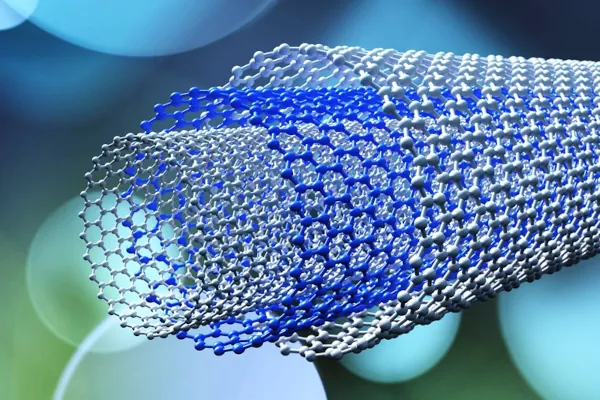
However, until now they had not reached the levels of electrical conductivity necessary to constitute a real alternative on an industrial scale to traditional materials, particularly copper and aluminum.
Now, for the first time, a project involving researchers from the UPM has succeeded in developing carbon nanotubes that overcome these limitations, achieving electrical conductivity superior to that of copper and greater resistance than steel.

High-resolution transmission electron microscopy image showing the section of carbon nanotubes (left) and the Cl and Al atoms sandwiched between the carbon nanotubes (right).
“These limitations have been overcome through a scalable manufacturing process that allows the doping of a carbon nanotube fiber with tetrachloroaluminate (AlCl₄). This molecule is intercalated between the carbon nanotubes that form the fiber without altering its mechanical properties. However, the transfer of charge from the carbon atoms to the chloride ions results in an increase in electrical conductivity of up to 24.5 MS/m (MegaSiemens per meter), almost half that of copper, but with a density six times lower,” explains the UPM researcher.
Applications in electric vehicles, drones and aircraft
The importance of this work, published in the prestigious international journal Science, lies in the fact that the properties achieved for the nanotubes are "especially relevant for the electrification of transport, whether electric vehicles, drones or aircraft, which require a large number of conductors with the lowest possible density and also present great potential for overhead power cables, whose performance is usually limited by their own weight," conclude the authors of this research.
In addition to UPM, researchers from IMDEA Materials and the Institute of Nanoscience and Materials of Aragon (a joint center between CSIC and the University of Zaragoza) have participated in the research.
Reference: AI de Isidro-Gómez, V. Vassilev-Galindo, A. Mikhalchan, M. Peláez-Fernández, J. LLorca, R. Arenal, JJ Vilatela. Intercalated carbon nanotube fibers with specific electrical conductivity above metals. Science, 392 (6796) 395-400, 2026