This innovative design approach allows metamaterials to influence electromagnetic, acoustic, and other types of waves, opening up new possibilities in fields ranging from optics to telecommunications. The IDTechEx report, "Metamaterials Markets 2024-2034: Optical and Radio-Frequency," offers an in-depth analysis of the evolving field of electromagnetic metamaterials. The report forecasts that the combined market for optical and radio-frequency metamaterials will reach $15 billion by 2034. This article delves into the key applications driving the expansion of the radio-frequency (RF) metamaterials market.
What will be the size of the radiofrequency metamaterials market in 2034 and what will be its flagship application?
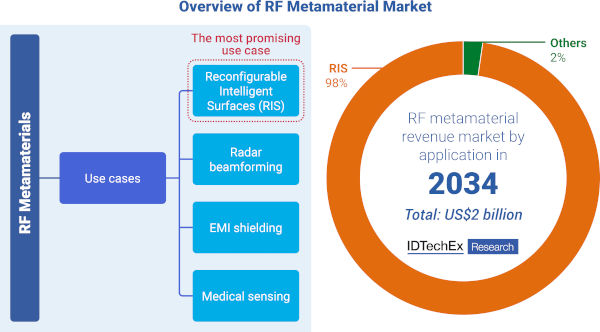
Radiofrequency metamaterials are designed to interact with electromagnetic waves in the 600 MHz to 1 THz frequency range. Their potential applications span the telecommunications, security, aerospace, automotive, and healthcare sectors. IDTechEx's analysis highlights key applications in each category, such as reconfigurable smart surfaces (RIS), radar beamforming, electromagnetic interference shielding, and medical detection. IDTechEx forecasts that the RF metamaterials market will reach $2 billion by 2034, with reconfigurable smart surfaces (RIS) driving 98% of this growth.
What are reconfigurable smart surfaces (RIS)?
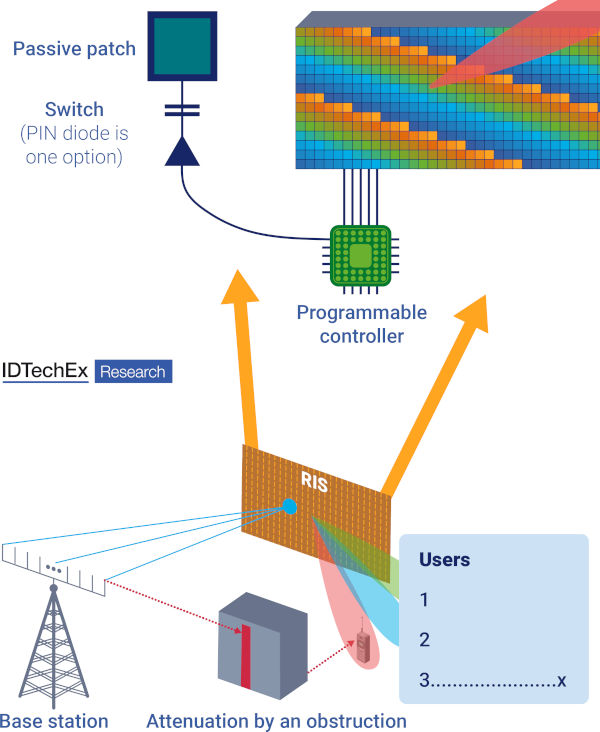
RIS, an acronym for Reconfigurable Intelligent Surfaces, comprises a 2D array of metasurfaces that can be dynamically adjusted to manipulate radio frequency wave propagation in real time through programmable control, enabling precise interaction with the signal waves and guiding them toward the intended users or receivers. These surfaces offer a cost-effective and low-power method for significantly improving the energy efficiency (EE) and spectral efficiency (SE) of wireless communication systems.
A typical RIS consists of three layers. The outer layer features numerous metallic patches printed on a dielectric substrate to interact directly with incoming waves. A copper plate acts as an intermediate layer, preventing signal energy leakage. The inner layer houses the control circuit board, which manages the adjustment of the reflection amplitude and phase shift of each element. These adjustments are controlled by an intelligent controller connected to the RIS, which uses components such as FPGAs, PIN diodes, resistors, and other integrated circuits.
Applications of RIS in various environments
RISs can be used in a variety of environments to enhance wireless communication capabilities. For example, at base stations, RIS technology facilitates multi-beam transmission, reducing the need for numerous antennas and increasing base station capacity by multiplexing signals from multiple users. Additionally, RISs can be installed on central beamforming towers in outdoor urban areas to precisely direct cellular signals to specific users, thereby improving signal strength and security through more focused electromagnetic radiation. Transparent RIS variants, when mounted on windows and walls, effectively direct beams around obstacles, improving signal propagation. Indoors, integrating RISs into walls and ceilings enhances signal coverage, eliminates dead zones, and improves overall signal quality by redirecting beams toward users, ensuring reliable connectivity. RIS technology thus offers a versatile solution for optimizing wireless communication performance in diverse environments.
Why is RIS technology the star application?
High-frequency communications, such as 5G mmWave networks and the upcoming 6G networks, offer immense data transfer speeds and low latency, but they suffer from long-distance propagation problems and difficulty penetrating obstacles like buildings and foliage. Maintaining signal strength and quality is crucial to harnessing the full potential of these advanced wireless technologies.
RISs are emerging as a key technology for overcoming these challenges. Strategically deployed RISs can redirect signals around obstacles, effectively eliminating coverage gaps and improving signal penetration through buildings in a cost-effective manner.
Among the advantages of RISs is the ability to dynamically adjust signal phases and amplitudes, compensating for long-distance propagation losses, which improves the efficiency and reliability of signal transmission in high-frequency bands. Furthermore, SIFs contribute to improving the signal-to-noise ratio (SINR), thereby increasing signal strength, extending coverage range, and enhancing overall network performance. Their ability to manipulate signal propagation makes them essential tools for optimizing the performance of high-frequency communication networks.
In addition to their technical advantages, SIFs operate with low power consumption, requiring a minimum of active components, making them energy-efficient alternatives to traditional relay systems. Their integration into existing infrastructure, such as building surfaces, further simplifies deployment and reduces the cost of establishing robust high-frequency telecommunications networks.
In conclusion, RISs represent a key enabling technology for high-frequency communications in 5G and 6G networks, as they solve propagation problems and optimize signal performance to unleash the full potential of advanced wireless technologies in terms of speed, capacity, and reliability.
Author: Yu-Han Chang, Principal Technology Analyst at IDTechEx