A look at 6G and its current state
First, it's important to understand 5G frequency bands to grasp why 6G frequency bands appear so promising. 5G frequency bands include the sub-6GHz band (3.5 to 6 GHz) and the millimeter wave (mmWave) band (24 to 40 GHz). While these 5G bands can offer faster data rates, lower latency, and greater reliability for end users, 6G may go a step further. 6G is likely to include frequency bands extending into the THz (terahertz) range (0.3 to 10 THz), which will be able to deliver Tbps (terabits per second) data rates, microsecond latency, and high network reliability. Compared to 5G, 6G is expected to have a 50x higher data rate and 100x faster speeds.
With such advantages, it's no surprise that 6G technology research has accelerated since 2019. The first major milestone occurred in 2017 when Huawei began its 6G research. Since then, key government authorities such as the US Federal Communications Commission (FCC) have opened THz frequencies for research, while the Chinese government has also begun its 6G research activities. Furthermore, partnerships and consortia are emerging as important innovation hubs for future 6G technologies. The AI-RAN Alliance was recently launched with the goal of effectively combining artificial intelligence (AI) with wireless communication technologies; its founding members include Samsung Electronics, Arm, Ericsson, Microsoft, Nokia, NVIDIA, SoftBank, and Northeastern University.
Overcoming the main technical challenges of 6G
The two biggest challenges that 6G technologies will have to face are:
1. Very short signal propagation range
2. Signal loss due to obstacles in the line of sight (buildings, trees, etc.).
To address the first challenge, minimizing transmission loss will require various technical advancements, including innovations in 6G materials. Generally speaking, materials innovation is a fundamental pillar upon which other technical advancements can be built. In the case of THz communications, low-loss materials that help minimize signal loss will be crucial for enabling new 6G technologies and applications.
Low-loss materials approaches for 6G
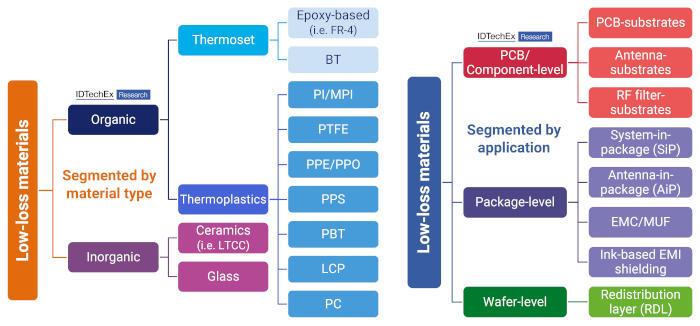
Although the specific performance targets required for 6G are still unknown, the next generation of low-loss materials is expected to at least outperform current ultra-low-loss materials. Therefore, some researchers are addressing the challenge of 6G low-loss materials by starting with existing commercially available low-loss materials. These material approaches may incorporate novel structures or modifiers into industry-standard dielectric materials such as PTFE (polytetrafluoroethylene) and reinforced epoxy thermosets.
Others are studying the need for low-loss materials for integrated packages. As telecommunications components continue to be integrated into smaller packages, the need for materials that facilitate such packaging increases. Organic materials such as polyimide (PI) and poly p-(phenyl ether) (PPE) are being developed as construction materials for substrates.
However, research into inorganic materials for integrated packages is more intensive. Numerous studies have been published demonstrating the feasibility of using glass as a substrate in an integrated package with an antenna, which can reduce signal loss at interconnects. Furthermore, many articles explore new ceramic compositions for low-temperature co-firing (LTCC) in 6G applications.
Finally, other research approaches utilize less conventional materials, such as low-cost thermoplastics, silica foams, or wood composites. The diversity of approaches explored by IDTechEx demonstrates not only the level of interest in low-loss materials for 6G, but also offers a glimpse into the potential diversity of the future landscape for these materials.