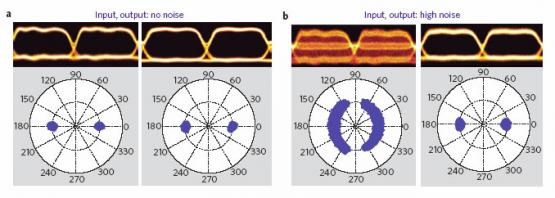
The PHASORS project (“Phase Sensitive Amplifier Systems and Optical Regenerators and Their Applications”) secured nearly €3 million in funding under the European Union’s Seventh Framework Programme (FP7) Information and Communication Technologies (ICT) program. The system was presented in the journal Nature Photonics.
Data transmission over optical networks is limited by phase noise from optical amplifiers and crosstalk, induced by the interaction of the signal with the signals of many others simultaneously circulating through the network.
Phase noise consists of rapid, short-term, random fluctuations in the phase of a signal that affect the quality of the transmitted information and result in data transmission errors. Crosstalk refers to any signal that unintentionally affects another signal. The partners in the PHASORS project, under the auspices of the Optical Research Centre at the University of Southampton, have taken a significant step towards eliminating this interference.
Traditionally, optical data has been transmitted as a sequence of bits encoded in the amplitude of the light beam—a system that was simple and practical, but inefficient in its use of bandwidth. This wasn't a problem in the past, given the enormous data-carrying capacity of an optical fiber. But the continued growth of the internet, and in particular the introduction of high-bandwidth video applications such as YouTube, has led to increased demands for more efficient data signal formats, especially formats that encode data in the phase rather than the amplitude of an optical signal.
The PHASORS consortium developed the first practical phase-sensitive amplifier and regenerator for high-bit-rate binary phase-encoded signals. This device, unlike others developed in the past, eliminates phase noise directly without the need for conversion to an electronic signal, which inevitably slows down the achievable speed. The device takes a noisy input data signal and restores its quality by reducing the buildup of phase noise and also reducing amplitude noise simultaneously.
“This result is an important first step towards the practical application of all-optical signal processing of phase-coded signals, which are being commercially exploited due to the improved data-carrying capacity relative to the amplitude of conventional coding schemes,” said PHASORS project leader and Optical Research Centre professor David Richardson.
“Our regenerator can clean noise from incoming data signals and should enable systems with greater endurance and physical capacity. Achieving this result, a key objective of the PHASORS project, has required significant advances in optical fiber and semiconductor laser technology across the consortium.”
Commenting on the impact of the device, Professor Richardson said: “We believe this device and the associated component technology will have important applications across a wide range of disciplines beyond telecommunications, including optical sensing, metrology, as well as many basic testing and measurement applications in science and engineering.”
Key contributions to PHASORS, which began in 2008 and is scheduled to end in 2011, are being made by institutes across the EU, nominated by the Optical Research Centre at the University of Southampton (ORC), Chalmers University of Technology (Sweden), the Tyndall National Institute at University College Cork (Ireland), and the National and Kapodistrian University of Athens (Greece). Expertise is provided by Onefive (Switzerland), Eblana Photonics (Ireland), and the Danish fiber optics specialist OFS.
The PHASORS project improves optical communication networks
Unlabeled
-
Apollo and Alcatel-Lucent have announced an industry milestone: a successful demonstration of data transmission at approximately 3 terabits per second (Tbit/s), based on 40 Gbit/s channels, per fiber pair in a submarine network. Apollo is a...
-
Cloud-TM, the EU's cloud computing project, presents an initial prototype
After three years of hard work, the Cloud-TM (Transactional Memory) Platform prototype has been launched. This announcement marks the final stage of one of the largest cloud computing research projects in the European Union.
-
The M2M boom is driving massive growth in the value-added services market
The tremendous expansion of machine-to-machine (M2M) connections in the coming years will cause the market for services associated with value-added services (VAS) to expand by a factor of seven and reach $10 billion in 2017. -
WLAN monetization and 802.11ac, the most important Wi-Fi trends in 2015
Location-based services, social networks as user registration credentials between companies that provide guest access, or Hotspot 2.0 roaming consortia have been some of the most talked-about Wi-Fi trends during 2014.
-
Mateo Valero, awarded an ERC Advanced Grant, which is the most prestigious aid for a scientific project
The European Research Council (ERC) has awarded Mateo Valero, director of the Barcelona Supercomputing Center – National Supercomputing Center (BSC-CNS), an Advanced Grant in the physical sciences and engineering category for his project 'Riding on... -
How does coherent optics increase data speed? - Modulation and polarization multiply the data capacity in optical networks.
In the early days of optical networks, all optical signals relied on a simple mechanism known as on-off keying (OOK). Simply put, this mechanism works by turning a light on and off to transmit data. OOK is a broader term used to describe...
Newsletter
Latest News
ACUTELAN files complaint against DIGI with the CNMC for predatory pricing
On April 22, 2026, the ACUTELAN association submitted a formal application to the CNMC to...
Demonstration of free-space optical communication with PCSEL: a breakthrough from Vector Photonics
Vector Photonics, the Scottish start-up that is leading the way in the use of surface emission lasers with crystal...
AI for Good Global Summit 2026: Innovation and Leadership in Artificial Intelligence in Geneva
As governments accelerate their strategies on artificial intelligence, sovereign AI, and...
Iceland's Parliament modernizes its security with Genetec Security Center and IoT sensors
The Parliament of Iceland, Alpingi, one of the oldest democratic institutions in the world,...
Commvault strengthens data and AI security in Commvault Cloud with new governance and classification capabilities
Commvault has announced an expansion of its data security and AI capabilities within...
Subscribe to CONECtrónica magazine
You can subscribe to the Conectrónica magazine in 2 formats.
Digital Format: 5 downloadable PDF editions at an annual cost of 60 Euros (VAT included)
Paper Format: 5 editions to be received by mail at an annual cost of 180 Euros (VAT included).
Contact our subscriptions department at subscriptions@conectronica.com
Payment via Bizum or bank transfer
Technical Courses and Seminars
Taoglas launches The Antenna Podcast, a new technical space about antenna design and innovation
Antennas remain one of the most critical and, at the same time, most misunderstood elements in...
ISE 2026 Barcelona: Summits, Megatrends and the most ambitious content program in the AV sector
Returning to Barcelona in February 2026, Integrated Systems Europe (ISE) presents its program of...
E-book: the future of satellite communications
Mouser Electronics, Inc., in collaboration with Qorvo and other technology innovators...
European project “Engineers of the Future” with free online training for young people and teachers on cybersecurity, green energy and automation
The GAIA Cluster has participated in the European project "Engineers of the Future", co-financed by...
E-book on wireless connectivity
Mouser Electronics, Inc. presents a new e-book in collaboration with STMicroelectronics that explores...
Optical Networks
Evolution of optical networks: ROADM, OpenROADM and OpenZR+ in the 400G and 800G era
The rapid increase in data traffic is driving the construction of new infrastructure worldwide...
Legrand launches Chroma Link, the fiber optic solution for high-density AI networks
Legrand has announced the launch of Chroma Link™, a fiber optic cabling solution with...
Hollow Core Fiber (HCF) Deployment and Testing
Hollow Core Fibers (HCF) represent a significant evolution...
Network infrastructure in the age of AI: why fiber optics is key beyond bandwidth
New requirements for network infrastructures: why, in the age of AI, fiber optics...
Nokia drives optical networks for the AI era with new coherent solutions and multi-fiber amplifiers
Nokia has announced a suite of new optical network innovations designed to address...
Fiber optic network testing in hyperscale data centers: keys to ensuring performance and reliability
Hyperscale data centers represent the backbone of the digital infrastructure...
High-Speed Network Demands: Architectures, Challenges and Technological Evolution in the Era of Exponential Traffic
The rapid growth of IP traffic, driven by applications such as 4K/8K video, computing...