A NASA technology experiment on the International Space Station completed its first laser link with an orbiting laser relay system on December 5, 2023. Together, they complete NASA's first end-to-end, bidirectional laser relay system. NASA's Laser Communications Relay Demonstration (LCRD) and the space station's new demonstrator, ILLUMA-T (Integrated LCRD Low Earth Orbit User Modem and Amplifier Terminal), successfully exchanged data for the first time. LCRD and ILLUMA-T are demonstrating how a user mission, in this case the space station, can benefit from a laser communications relay located in geosynchronous orbit.
Laser communications, also known as optical communications, use infrared light instead of traditional radio waves to send and receive signals. The shorter wavelength of infrared light allows spacecraft to carry more data in each transmission. Using laser communications greatly increases the efficiency of data transfer and can accelerate the pace of scientific discovery.
Quadrant chart showing the advantages of laser communications. In order: Efficient, Lighter, Secure, Flexible.
On November 9, NASA's SpaceX Commercial Resupply Services mission launched cargo and new science experiments, including ILLUMA-T, to the International Space Station. Upon arrival, the payload was installed in the station's Japanese Experiment Module.
ILLUMA-T and LCRD are part of NASA's Space Communications and Navigation (SCaN) program effort to demonstrate how laser communication technologies can significantly benefit science and exploration missions.
"ILLUMA-T's first link with LCRD—known as first light—is the latest demonstration proving that laser communications are the future," said Dr. Jason Mitchell, director of the Advanced Communications and Navigation Technology division at SCaN. "Laser communications will not only return more data from science missions, but could serve as NASA's critical two-way link to keep astronauts connected to Earth while they explore the Moon, Mars, and beyond.".
NASA's ILLUMA-T payload achieved first light with the LCRD. In this video, Matt Magsamen explains the First Light milestone.
Shortly after the space station was installed, operations engineers began conducting in-orbit tests to ensure the ILLUMA-T payload was functioning correctly. It is now communicating with LCRD, a repeater launched in 2021 that has performed more than 300 experiment configurations to help NASA refine laser communication technologies. LCRD and ILLUMA-T are exchanging data at 1.2 gigabits per second.
"We have demonstrated that we can overcome the technical challenges to successful space communications using laser communications. Now we are conducting operational demonstrations and experiments that will allow us to optimize our infusion of proven technology into our missions to maximize our exploration and science," said David Israel, NASA's space navigation and communications architect.
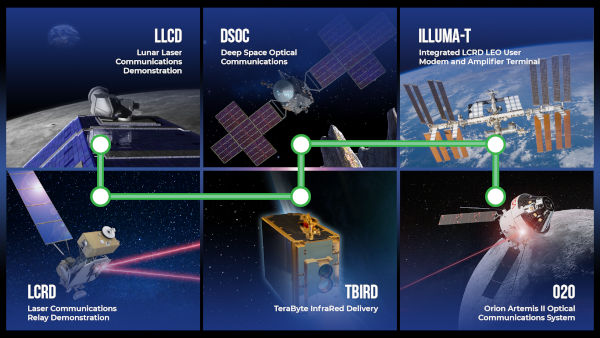
NASA's laser communications roadmap. This image includes the 2013 LLCD mission, the 2021 LCRD mission, the 2022 TBIRD mission, the 2023 DSOC mission, the 2023 ILLUMA-T mission, and the 2024 O2O mission.
LCRD experiments are conducted in collaboration with industry, academia, and other government agencies. ILLUMA-T is now LCRD's first user experiment in space. NASA continues to accept experiments to work with LCRD.
ILLUMA-T is funded by NASA Headquarters’ Space Communications and Navigation (SCaN) program in Washington. The payload is managed by NASA’s Goddard Space Flight Center in Greenbelt, Maryland. Partners include the International Space Station program office at NASA’s Johnson Space Center in Houston and the Massachusetts Institute of Technology’s Lincoln Laboratory in Lexington, Massachusetts.