It is mmWave 5G that enables extremely low latency and substantial bandwidth, thus allowing for greater data throughput, both necessary to support the aforementioned new applications. As such, a network of 5G-enabled devices and infrastructure is growing worldwide, especially in key markets like China, which leads the global rollout of mid-band 5G with over 68% market share, according to IDTechEx.
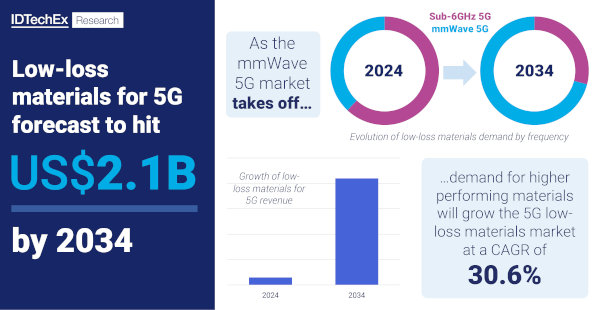
The global rollout of 5G is no easy task; there are many technical challenges to overcome, particularly for the higher-frequency millimeter-wave bands that are of great interest for many applications. Among these technical challenges is a key material problem: the high transmission losses of the materials used in 5G components such as filters and antennas. High transmission loss leads to poor signal propagation, which would severely limit the effectiveness of 5G communications. Reducing this transmission loss is crucial for the advancement of 5G telecommunications, making it essential to improve the dielectric performance of the materials found in all 5G devices, including the printed circuit board (PCB), antenna, IC package, and more. This demand for low-loss transmission materials, or low-loss materials, for 5G applications is driving the market to exceed $2.1 billion by 2034, according to predictions in the new IDTechEx report, "Low-Loss Materials for 5G and 6G 2024-2034: Markets, Trends, Forecasts.".
The transition from sub-6 GHz 5G to mmWave 5G to 6G and beyond
Given that sub-6 GHz 5G is the most widely deployed 5G frequency band to date, low-loss materials used in sub-6 GHz applications are projected to account for approximately two-thirds of the 5G market by revenue in 2024, according to IDTechEx estimates. With performance requirements only slightly higher than those of 4G, sub-6 GHz applications effectively utilize existing low-loss materials such as epoxy-based FR-4 and BT.
However, the performance leap from sub-6 GHz to mmWave 5G demands dielectric materials with even lower dielectric losses than current materials. This is creating opportunities for materials innovation in this market to displace existing materials. Organic materials such as PI, PTFE, and PPE offer a balanced combination of dielectric performance, cost, and ease of manufacture. Meanwhile, inorganic materials such as glass and low-temperature fired ceramics (LTCCs) offer the opportunity to create miniaturized and highly integrated components. The strengths of each of these low-loss materials for 5G applications will need to be weighed to determine their suitability for key applications such as smartphones, customer premises equipment, and base stations.
As the rollout of 6G approaches, with its frequency spectrum expected to include bands below 100 THz (100-300 GHz), innovation continues to explore ultra-low-loss materials that will enable this next generation of telecommunications. IDTechEx delves into all these different approaches to low-loss materials for 5G and 6G in its new report, "Low-Loss Materials for 5G and 6G 2024-2034: Markets, Trends, Forecasts," to understand how innovation will allow the industry to grow exponentially in market size by 2034.
Market forecasts for low-loss materials for 5G and 6G
IDTechEx’s latest report, “Low-Loss Materials for 5G and 6G 2024–2034: Markets, Trends, Forecasts,” explores the technological developments and market trends driving the growth of the low-loss materials market for next-generation telecommunications. IDTechEx forecasts future revenue and surface demand for low-loss materials for 5G, carefully segmenting the market by frequency (sub-6 GHz vs. mmWave), six material types, and three application areas (smartphones, infrastructure, and CPEs) to provide sixty different forecast lines. For more information on low-loss materials for 5G and 6G, including material benchmark studies, player analysis, market drivers and restraints, and granular 10-year market forecasts, please visit www.IDTechEx.com/LowLossMats. Downloadable sample pages are available.
Sona Dadhania, Senior Technology Analyst at IDTechEx