Built from a set of spatially engineered thin surfaces, deep diffractive neural networks (D2NNs), also known as diffractive networks, form a newly emerging optical computing architecture capable of passively performing computational tasks at the speed of light through an ultrathin volume. These task-specific optical computers are digitally designed by learning the spatial characteristics of their constituent diffractive surfaces. Following this unique design process, the optimized surfaces are fabricated and assembled to form the physical hardware of the diffractive optical network.
In their recent publication in Advanced Photonics Nexus, a team of researchers led by Aydogan Ozcan, Professor and holder of the Volgenau Chair in Engineering Innovation at UCLA, presented a method for performing complex-valued linear operations on diffraction gratings under spatially incoherent illumination. The same group had previously shown that diffraction gratings with sufficient degrees of freedom can perform arbitrary complex-valued linear transformations with spatially coherent light with negligible error. In contrast, with spatially incoherent light, these gratings can perform arbitrary linear transformations of the input optical intensities if the array elements defining the transformation are real and non-negative. As spatially incoherent light sources become more prevalent and readily available, there is a growing need for spatially incoherent diffraction processors to handle data beyond non-negative values.
By incorporating preprocessing and postprocessing steps to represent complex numbers using a set of non-negative real numbers, UCLA researchers have extended the processing capabilities of spatially incoherent diffractive gratings to the domain of complex numbers. They demonstrated that these incoherent diffractive processors can be designed to perform an arbitrarily complex-valued linear transformation with negligible error if there are a sufficient number of phase-only, optimumable diffractive features within the design, which scales with the dimensions of the input and output complex vector spaces.
The researchers demonstrated the application of this novel scheme by encrypting and decrypting complex images using spatially incoherent diffractive gratings. Beyond visual image encryption, these spatially incoherent diffractive processors could also be useful in other applications, such as in autonomous vehicles for ultrafast, low-power processing of natural scenes.
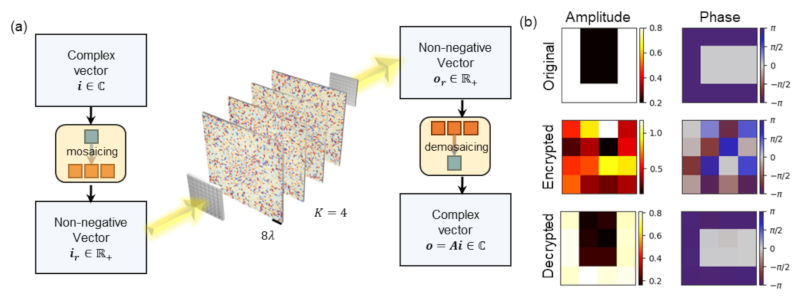
Implementation of linear complex-value transformations using spatially incoherent diffractive gratings (a) Workflow of the spatially incoherent diffractive grating model: A complex-value element of the input vector is represented by a set of real, non-negative intensity values (mosaic). The resulting input intensity pattern is fed into the incoherent diffractive grating. At the output, a complex-value vector element is synthesized from a predefined set of intensity pixels (demosaicing). (b) Application of image encryption. The letters "U" and "C" are encoded in the amplitude and phase of a complex image, which is digitally encoded and then decoded using the spatially incoherent diffractive grating. The decrypted complex image closely matches the original image.
Image credit: Ozcan Lab @ UCLA.
See the article:
Xilin Yang, Md Sadman Sakib Rahman, Bijie Bai, Jingxi Li and Aydogan Ozcan, "Complex-valued universal linear transformations and image encryption using spatially incoherent diffractive networks", Advanced Photonics Nexus (2023) https://doi.org/10.1117/1.APN.3.1.016010.