At the LTE World Summit in Amsterdam (June 24-26), IDATE presented its latest analysis and forecasts for the global LTE market, including an overview of the 700 MHz band.
IDATE forecasts that by the end of 2016, there will be more than 915 million LTE subscriptions worldwide. Asia-Pacific is expected to account for 41.6% of the total, North America 21.6%, Africa/Middle East 7.5%, Eastern Europe 4.9%, and Western Europe 15.8%.
LTE is now mainstream, with the largest deployments in each geographic area. The TD-LTE ecosystem is still awaiting a decision from China and can anticipate seeing the first LTE Advanced networks in the second half of this year. The 700 MHz band, under the APT band plan, has already been allocated in countries such as Australia and Japan, with intense regulatory activity expected in Europe, the Middle East, Africa, and Latin America surrounding this new frequency band.
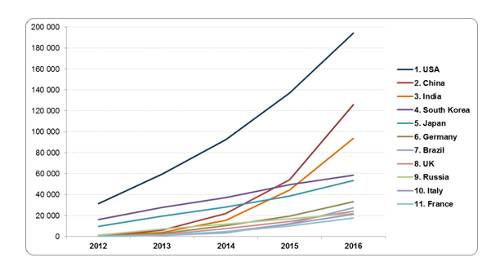
LTE subscribers worldwide (in thousands): Ranking by country in 2016
'
'
The 700 MHz Band: A New Harmonized Frequency Band for LTE?
The latest IDATE report addresses the issue of the 700 MHz band for future use in mobile services.
The growth of mobile broadband traffic is putting pressure on mobile networks and driving the need for more spectrum in the sub-1 GHz frequency bands for LTE and LTE-Advanced networks. Harmonization across many geographical areas is crucial, as it would enable economies of scale for LTE devices and facilitate international roaming. The first digital dividend has already freed up new spectrum for the mobile sector. It is worth noting that the 700 MHz band in the US and the 800 MHz band in Europe are currently used for commercial LTE services.
Following the 2012 World Radiocommunication Conference (WRC-12), the 700 MHz band now appears to be the most promising option for a harmonized frequency band across Asia-Pacific, Europe, the Middle East, Africa, and Latin America. IDATE anticipates further discussions at WRC-15, and the technical conditions will need to be defined in Europe before then.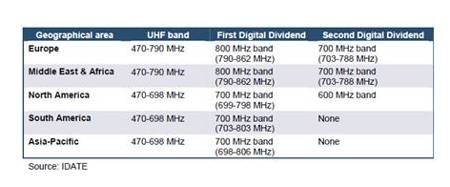 First and Second Digital Dividends Worldwide
• The Asia-Pacific region is taking the lead in this field and has already defined the "APT band plan," which will likely be adopted in Latin America, Africa, the Middle East, and Europe. This plan is not compatible with the US plan, which was defined before the 2008 auction and does not allow for any compatibility or roaming for future LTE phones. The 700 MHz band, with the APT band plan, could become a harmonized frequency band for LTE worldwide.
The 700 MHz band corresponds to the first digital dividend in the US and Asia-Pacific, while it could become the second digital dividend in the EMEA region. At WRC-12, African and Middle Eastern countries requested that the 694-790 MHz spectrum be allocated for mobile broadband services.
• Many observers insist that Europe must not repeat the same mistake it made with the band. 800 MHz – in auctions conducted without coordination, which led to undesired initial launches in some countries with a limited number of compatible devices. The harmonization process in Europe must be clear, with precise technical parameters and a realistic plan that takes into account the schedule of existing broadcasting services. 2020 seems a realistic target for the launch of LTE services in the 700 MHz band in Europe, but some countries, such as France and Germany, may already be planning to hold auctions in 2015, even though the spectrum will only be available at a later date.
Public safety networks, which want to support mobile broadband services, are also beginning to use parts of the 700 MHz band in the US, and the UAE already allocated spectrum for its use earlier this year. Some discussions are taking place in Europe to address this issue.
In the US, the Federal Communications Commission (FCC) has suggested an auction format. This innovative approach, called "incentive auctions," aims to change the use of the UHF band (470-700 MHz) from the 600 MHz band and enable new services through authorization. The process would begin with a reorganization of the UHF band and a reassignment of licensed mobile services, such as 3G and LTE.