The new formula is a form of machine learning that selects a wireless frequency range, known as a channel, based on past experience in a specific network environment. Described at this week's online conference (link is external), the formula could be programmed into software on transmitters in many types of real-world networks.
The NIST formula is a way to help meet the growing demand for wireless systems, including 5G, through the sharing of unlicensed frequency ranges, also known as bands. Wi-Fi, for example, uses unlicensed bands—those not assigned by the Federal Communications Commission to specific users. The NIST study focuses on a scenario in which Wi-Fi competes with cellular systems for specific frequencies, or subchannels. What makes this scenario challenging is that these cellular systems are increasing their data transmission rates by using a method called License-Assisted Access (LAA), which combines unlicensed and licensed bands.
"This work explores the use of machine learning to make decisions about which frequency channel to transmit on," says NIST engineer Jason Coder. "This could make communications in unlicensed bands much more efficient.".
The NIST formula allows transmitters to quickly select the best subchannels for the successful and simultaneous operation of Wi-Fi and LAA networks in unlicensed bands. Each transmitter learns to maximize the overall network data rate without communicating with each other. The scheme quickly achieves overall performance close to the result based on exhaustive trial-and-error channel searches.
The NIST research differs from previous machine learning studies in communications by taking into account multiple network "layers," physical equipment, and channel access rules between base stations and receivers.
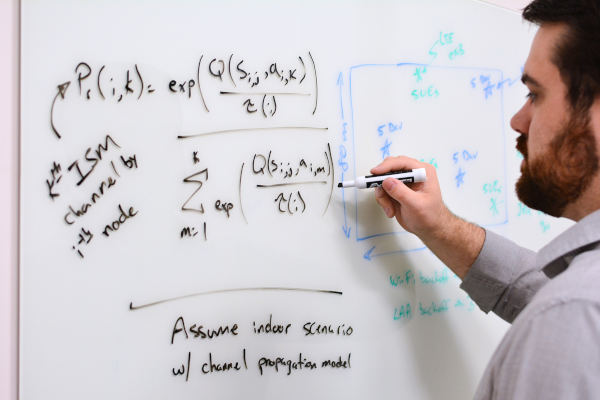
The formula is a "Q-learning" technique, meaning it maps environmental conditions, such as network types and the number of transmitters and channels present, to actions that maximize a value, known as Q, which yields the best reward. By interacting with the environment and testing different actions, the algorithm learns which channel provides the best result. Each transmitter learns to select the channel that produces the best data rate under specific environmental conditions.
If both networks select channels appropriately, the efficiency of the combined network environment improves. This method increases data rates in two ways. Specifically, if a transmitter selects an unoccupied channel, the probability of a successful transmission increases, leading to a higher data rate. And if a transmitter selects a channel that minimizes interference, the signal is stronger, resulting in a higher received data rate.
In computer simulations, the optimal allocation method assigns channels to transmitters by searching all possible combinations to find a way to maximize the network's overall data throughput. The NIST formula produces near-optimal results but in a much simpler process. The study found that an exhaustive effort to identify the best solution would require about 45,600 trials, while the formula could select a similar solution by testing only 10 channels—just 0.02 percent of the effort.
The study addressed indoor scenarios, such as a building with multiple Wi-Fi access points and cell phone operations in unlicensed bands. The researchers now plan to model the method in large-scale outdoor scenarios and conduct physical experiments to demonstrate the effect.
Document: S. Mosleh, Y. Ma, JD Rezac, and JB Coder. Dynamic Spectrum Access with Learning Boost for Unlicensed Access in 5G and Beyond. Virtual online presentation at the 91st IEEE Vehicle Technology Conference (link is external), May 25-28, 2020