Thus, ITU Member States have rejected calls to make the lower UHF spectrum co-primary for mobile broadband services; this means that services other than broadcasting would have to operate on a secondary basis in those bands. This important decision sets the stage for the globally harmonized deployment of digital television in the 470 MHz to 694/698 MHz bands, the licensing of mobile broadband services on a primary basis in the 694/698 MHz to 862 MHz bands, and the deployment of TV whitespace technologies (TVWS) that will be able to operate across the entire range of unassigned or unused UHF frequencies between the 470 MHz and 862 MHz bands (as well as in the VHF bands) on a secondary basis.
Delegates from more than 150 countries reached the decision to maintain the lower UHF frequency band (470 to 694 MHz) primarily for broadcasting in ITU Region 1 (comprising Europe, the Middle East, and Africa), as opposed to allocating it for mobile broadband on a primary or co-primary basis. This aligns ITU Region 1 with decisions already made by ITU Region 2 (the Americas) and Region 3 (Asia). The lower UHF bands are currently allocated for digital terrestrial television (DTT), and this decision means the broadcasting industry can extend its services as part of the transition to fully DTT broadcasting. A significant number of investments in DTT network deployments are underway across ITU Region 1, for example in Africa, with the aim of reaching Europe, which has largely completed its DTT transition.
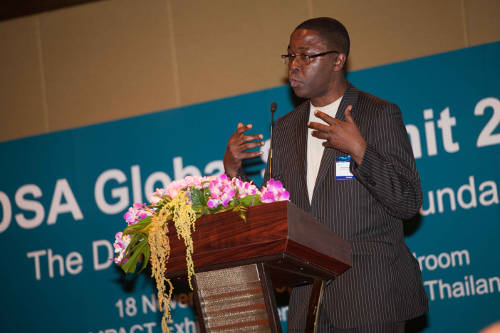
“The Dynamic Spectrum Alliance welcomes this sensible decision by the WRC for Region 1 to retain the lower 470-694 MHz band, primarily for television broadcasting, as large parts of the region complete their digital conversion programs over the next five years,” said Professor H. Nwana, Executive Director of the Dynamic Spectrum Alliance (DSA). “Alongside this decision, the conference has also decided globally to harmonize the 700 MHz band (694-790 MHz) for mobile broadband services. A much-needed second digital dividend is also guaranteed in Region 1, following the first 800 MHz dividend (790-862 MHz). This is a win-win scenario for both the broadcasting and mobile industries in Region 1, and retaining the lower UHF bands for TV enables dynamic sharing via TV whitespace regulations.”
Nwana continues: “The UK regulator Ofcom has recently published its draft regulations to allow whitespace access devices to unused frequencies in the UHF TV band. These regulations would allow TV band sharing in the UK and other countries within Region 1, and elsewhere should follow suit in their efforts to bridge the digital divide. I am pleased to note that countries such as Malawi in Africa, Singapore and the Philippines in Asia are already doing this successfully, and South Africa has recently published a TV whitespace discussion paper.”
Both the US and Canada in Region 2 have already enacted TV whitespace (TVWS) regulations, and commercial deployments are beginning. Several countries in Region 3, Asia, will be working on similar regulations in 2016. For more dynamic spectrum access sharing in Latin America, the Alliance recently announced that the 2016 DSA World Summit will be held in Bogotá, Colombia (April 26–28, 2016).
TVWS technology uses unallocated or unused spectrum in the UHF and VHF bands, or other available modes, for transmission. TVWS technologies operate as secondary users, without causing interference to primary users, such as broadcast licensees. TVWS technology has been deployed in dozens of projects worldwide, demonstrating its ability to provide low-cost broadband and other forms of connectivity across large geographic areas. Many commercial applications are expected for the TVWS regulations, which will be published globally in 2016. New versions of Wi-Fi operating in TV bands are expected to leverage these TVWS regulations in these commercial deployments.
ITU Region 1 includes Europe, Africa, the Middle East (west of the Persian Gulf), Armenia, Azerbaijan, the Russian Federation, Georgia, Kazakhstan, Mongolia, Uzbekistan, Kyrgyzstan, Tajikistan, Turkmenistan, Turkey, and Ukraine.