This is possible thanks to the future connected vehicle's use of dedicated "V2X" safety communication channels. V2X (Vehicle-to-Everything) uses Wi-Fi or cellular technology to facilitate communication with other vehicles and traffic infrastructure. If regulations or safety standards mandate this technology, V2X will become the "digital seatbelt" of the future.
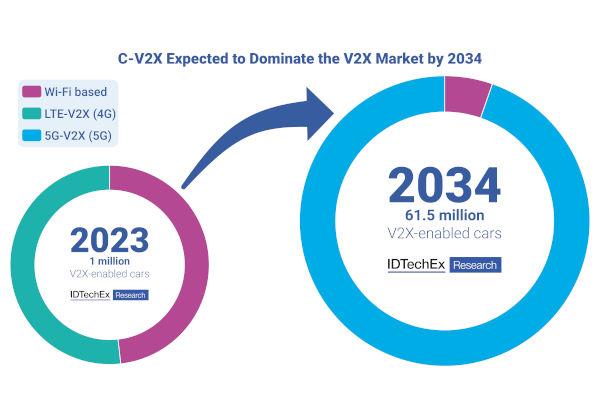
The two most popular V2X technologies, DSRC and C-V2X, require different hardware. DSRC relies on Wi-Fi protocols, while C-V2X uses 4G or 5G protocols. Currently, there are approximately one million V2X connected vehicles on the roads worldwide. Roughly half of the V2X connected vehicle market uses C-V2X technology, and the majority of these vehicles are located in China.
IDTechEx anticipates a significant market shift toward C-V2X technology, with over 90% of the market using 5G-based C-V2X by 2034. The biggest driver of this shift is regulation: the world's two largest vehicle markets, the United States and China, have government organizations actively promoting C-V2X adoption. India, Korea, and Japan are likely to follow the international trends set by the US and China. IDTechEx's analysis concludes that while DSRC technology can be improved, C-V2X as a technology has much greater momentum than DSRC. According to the IDTechEx report "Software-Defined Vehicles, Connected Cars, and AI in Cars 2024-2034: Markets, Trends, and Forecasts", in China alone, 30 million new V2X vehicles are expected to be on the road each year by 2034, most of them with 5G-based C-V2X technology.
What low-loss materials will the C-V2X vehicles use?
With so many C-V2X vehicles set to enter service in the next decade, the question arises: What materials will the 5G components in these vehicles use? After all, the materials used in 5G components, particularly low-loss materials, are fundamental technological elements. 5G components, such as filters and antennas, face high transmission losses. High transmission loss leads to poor signal propagation, which would severely limit the effectiveness of 5G communications. Reducing this transmission loss is key to extending the reach of 5G technology, including in connected vehicles, making it essential to maximize the dielectric performance of the materials used in 5G components.
For these reasons, low-loss materials will be an important factor for C-V2X in connected vehicles. In fact, connected vehicles may represent a new market opportunity for low-loss materials in the future. Therefore, it is worthwhile to explore which low-loss materials would be suitable for the V2X-enabled vehicle market.
The key factor determining which low-loss materials will be used for 5G V2X components is the frequency band in which V2X operates. 5G telecommunications consist of two frequency bands: sub-6 GHz (3.5–7 GHz) and mmWave (24–71 GHz). Sub-6 GHz 5G is the most widely deployed 5G frequency band to date and is projected to comprise 78% of 5G deployments by 2022. Therefore, low-loss materials used in sub-6 GHz applications are expected to represent approximately two-thirds of the 5G market by revenue in 2024, according to estimates in the IDTechEx report, “Low-Loss Materials for 5G and 6G 2024–2034: Markets, Trends, Forecasts.”.
C-V2X falls within the sub-6 GHz 5G band, having been allocated the 5.9 GHz frequency band. In 2020, the US Federal Communications Commission specifically assigned the 5.895 to 5.925 GHz frequency range to C-V2X. As such, 5G components used for V2X will need to utilize low-loss materials suitable for the sub-6 GHz band. With slightly higher performance requirements than 4G, sub-6 GHz applications typically utilize 4G low-loss materials. This includes common epoxy dielectric materials such as FR-4 and epoxy-based BT, which are available from numerous suppliers, as noted in the IDTechEx report. Other materials used in 4G components such as antennas include polyimide, used in 4G antennas for smartphones. Other options that could serve this market include low-loss materials that offer balanced performance in the sub-6 GHz and mmWave bands, such as modified polyimide, liquid crystal polymers, and hydrocarbons. Factors influencing the selection of low-loss materials include balancing dielectric properties and moisture absorption with material cost. Therefore, it is possible that in the future, several low-loss materials and suppliers will ultimately supply the V2X vehicle market.